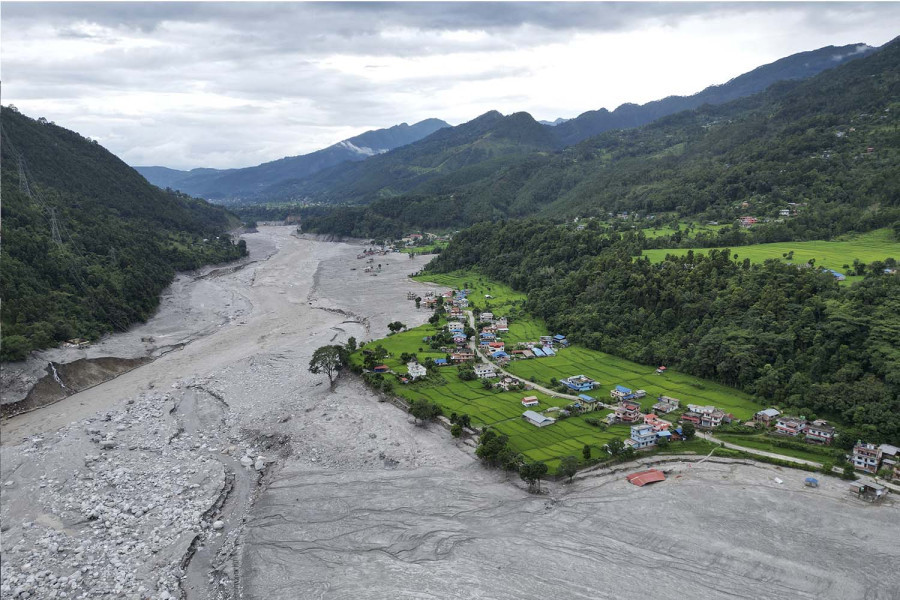
There is considerable interest in how the government will raise international funds to reconstruct and rebuild infrastructure and private and public property damaged by last month’s Bhotekoshi floods.
The actual extent of the damage and the cost of reconstruction will be known only after the government completes its post-disaster needs assessment (PDNA). The government, however, has already begun preparations to mobilise funds.
According to a rapid damage needs assessment released in the first week of this month, Nepal will require Rs721.31 billion, or approximately $5 billion, for reconstruction. The National Planning Commission has been entrusted with preparing the PDNA, and its report is expected within a month.
Some development partners, including the World Bank and the European Union, have been providing technical and other support for the PDNA.
Following the 2015 earthquake and the completion of the PDNA, the then government organised a donor conference in Kathmandu, bringing together bilateral and multilateral donors to mobilise funds for reconstruction.
This time, however, the mood within the government and the Finance Ministry appear to be leaning towards bilateral negotiations with major donors, according to ministry officials.
“This time, we want to generate funds through bilateral negotiations with major donor countries like India, China, the US, Japan, South Korea, European nations, and others,” a senior Finance Ministry official said. “With multilateral donors like the World Bank, Asian Development Bank, Asian Infrastructure Investment Bank, International Monetary Fund and others, we prefer bilateral negotiations rather than organising a donor conference.”
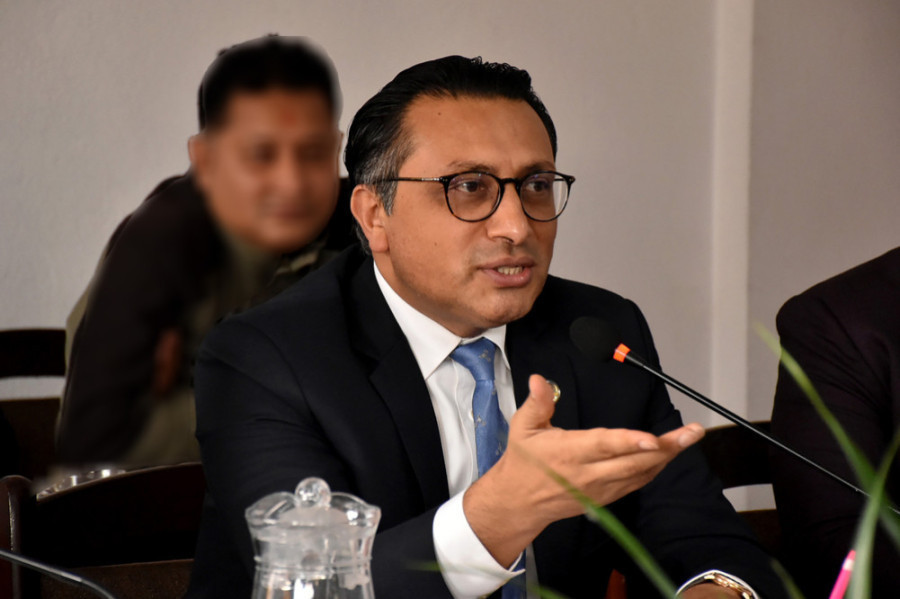
There has been no formal decision yet, but funds could be generated through bilateral negotiations and correspondence, said Amrit Lamsal, head of the International Economic Relations Division at the Finance Ministry.
In this connection, Finance Minister Swarnim Wagle visited India and returned on Saturday after meeting his Indian counterpart Nirmala Sitharaman, External Affairs Minister S Jaishankar, and other officials.
During his three-day stay in New Delhi, Wagle thanked India for its support and sought help for reconstruction. Both Jaishankar and Sitharaman assured him that India would decide on its support for Nepal's reconstruction after the PDNA report is released.
In an interview with The Hindu newspaper, Wagle put Nepal's reconstruction needs following the August floods at $4.7 billion to $5 billion over three to five years. He said Nepal suffered about $1.8 billion in direct damage and $900 million in losses, but that rebuilding with greater resilience would require $4.7 billion to $5 billion over the next three to five years.
As the Finance Ministry seeks to mobilise funds through bilateral talks and negotiations, the window for foreign funding in the form of grants and aid is narrowing, leaving Nepal increasingly dependent on concessional and other forms of soft loans.
“We are expecting grants and aid from very few countries, and we expect soft loans and concessional loans from many multilateral donors. This is what international financial architecture is building up. Many donors have cut down the aid and grant portion of their lending process, so we would like to depend on concessional loans,” the Finance Ministry official said.
The August 26 flooding has left at least 1,403 people dead in Nepal, according to the latest government figures, with 6,150 still missing. Post File Photo
Wagle is expected to undertake more bilateral visits in the coming weeks to mobilise funds for reconstruction and seek greater support for climate-vulnerable countries.
He is scheduled to travel to Doha to participate in the 2026 annual meeting of the board of governors of the Beijing-based Asian Infrastructure Investment Bank (AIIB) on September 28 and 29. Nepal is the founding member of the AIIB , New York and has been seeking financing for several infrastructure projects.
During the AIIB meeting and his interactions with counterparts on the sidelines, Wagle plans to highlight Nepal's vulnerability to climate-induced disasters and the growing costs the country faces.
Wagle is also scheduled to travel to New York and Washington DC to meet officials from the World Bank and the UN. The annual meetings of the International Monetary Fund and the World Bank Group are scheduled to take place in Bangkok from October 12-18, and Wagle plans to participate.
“I will be going to Doha, [for the meeting of the] Asian Infrastructure Investment Bank. From then on, I think I will go to the US—New York and Washington DC—to talk with the World Bank and the United Nations,” Wagle told the Indian news agency ANI.
“In the middle of October, there’s the annual meeting of the Bretton Woods institutions in Bangkok. I will be there,” Wagle said.
A few days ago, speaking to The Post, Foreign Minister Shisir Khanal said the government would prefer grants and aid over loans for reconstruction, although a formal decision has yet to be made.
“Not taking loans is not a declared policy, but we prefer grants and aid,” Khanal told the Post.
Officials and experts, however, say grants alone are unlikely to cover the cost of reconstruction. Nepal's debt burden also increased significantly after the 2015 earthquake and the subsequent reconstruction drive.
The government also plans to seek support from the global Loss and Damage Fund, arguing that climate change contributed to the severity of the floods. Officials acknowledge, however, that international climate funding alone will not be enough.
“But this is at replacement value. When we build back better, this is going to be in excess of $4.5 billion, $5 billion over a number of years. This will require a lot of international solidarity, international assistance, and we will count on Indian assistance, as Prime Minister Modi conveyed to our Prime Minister Balen Shah when they spoke on the telephone,” Wagle told ANI.
The August 26 flooding has left at least 1,403 people dead in Nepal, according to the latest government figures, with 6,150 still missing. A preliminary government assessment estimated total damage and economic losses at Rs408 billion.
Anil Giri is a Chief Sub Editor covering diplomacy, international relations and national politics for The Kathmandu Post. Giri has been working as a journalist for more than two decades, contributing to numerous national and international media outlets.




 26.52°C Kathmandu