



 16.76°C Kathmandu
Sat, Oct 10, 2026
National
More complaints, fewer wins for CIAA in corruption cases
The anti-graft agency received more than 40,500 complaints last fiscal year, while its conviction rate at the Special Court fell to 51.92 percent.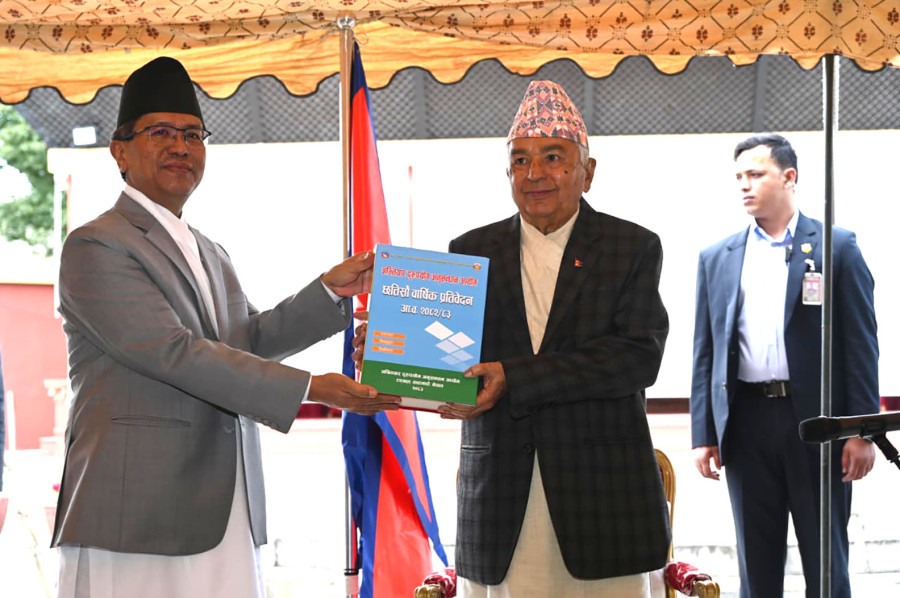
bookmark
Durga Dulal
Published at : September 18, 2026
Updated at : September 18, 2026 06:52
Kathmandu
The Commission for Investigation of Abuse of Authority received more than 40,500 complaints of irregularities in the last fiscal year, even as fewer of its corruption cases resulted in convictions at the Special Court, according to its annual report submitted to President Ramchandra Paudel on Thursday.
The anti-graft body secured convictions in 51.92 percent of the cases decided by the Special Court in fiscal year 2025-26, down from 52.67 percent in 2024-25 and 65.24 percent in 2023-24.
Of the 156 cases it filed during the year, the Special Court upheld the CIAA’s charges in 81, spokesperson Suresh Neupane said.
The CIAA has appealed against 104 Special Court verdicts at the Supreme Court and filed three review petitions. The commission prosecutes cases involving corruption, illicit enrichment, forged academic certificates and bribery, among other offences.
Rs5.24 billion in damages claimed
The CIAA sought Rs5.24 billion in damages in cases filed last fiscal year against 990 defendants. The defendants included 145 women, 801 men and 44 organisations. The largest number of cases, 56, involved losses to or misuse of public property. They were followed by bribery, misuse of office for personal gain, forged academic certificates and illicit enrichment.
Former CIAA chief commissioner Suryanath Upadhyay said the declining success rate suggested that the commission needed to strengthen its investigations. “The figures show that the CIAA still needs to put more effort into investigations,” Upadhyay said. “It should make sure that all the evidence has been properly collected and established before filing cases.”
He said the commission could not realistically expect to win every case but should improve on its current record.
Dipesh Ghimire, a professor who researches governance, said several factors could explain the decline in the CIAA’s success rate.
He linked the outcome to the commission’s expertise, investigative methods and the capacity of its investigators. “The success rate does not match the level of performance expected from an institution created for this purpose,” Ghimire said. “It is directly linked to the CIAA’s capacity, the expertise available there and how investigations are conducted.”
He said the commission appeared to rely heavily on cases involving forged documents and arrests made while suspects were allegedly caught taking bribes.
Ghimire also said the commission had at times filed cases without conducting thorough investigations. He pointed to the passport procurement case as an example, alleging that the CIAA filed the case under pressure from the Office of the Prime Minister without carrying out an adequate investigation. He said the Special Court’s verdicts had also flagged cases that reached the courts without adequate investigation and evidence.
“The problem is broader. It comes down to who is appointed to the commission, how often staff are transferred and how investigations are handled. An agency tasked with serious anti-corruption investigations needs the right expertise, continuity and investigative standards.”
He also cited frequent transfers of CIAA staff and the commission’s reliance on investigations conducted by the Office of the Attorney General and the police as factors affecting its success rate.
Over 40,500 complaints
The CIAA received 40,542 complaints in fiscal 2025-26, according to the report. Of those, 33,519 were registered during the fiscal year, and 7,323 were carried over from the earlier year. The commission received complaints through its website, email, telephone, post, social media and in-person submissions. Its website remained the most common channel.
The CIAA said it resolved 80.37 percent, or 32,823, of the complaints it received. Another 8,019 were carried forward into this fiscal year. The commission received 37,026 complaints in the fiscal year 2024-25.
Local units accounted for 49.03 percent of all complaints, with 20,025 complaints filed against them. Kathmandu Metropolitan City had the highest number of complaints among the ten local units receiving the most, with 441 complaints, or 2.20 percent of the total. It was followed by Pokhara Metropolitan City, Bideha Municipality, Chhipaharmai Rural Municipality and Janakpurdham Sub-metropolitan City.
In the fiscal year 2024-25, local units attracted 19,933 complaints. Pokhara topped the list with 413, followed by Kathmandu Metropolitan City with 381, Chhipaharmai Rural Municipality with 298 and Suwarna Rural Municipality with 230.
Madhesh province again recorded the highest number of complaints against a provincial government. The CIAA received 5,305 complaints concerning provincial governments, of which 1,475, or 27.8 percent, were against Madhesh province. Gandaki province recorded the fewest, with 407 complaints, or 7.67 percent.
In Madhesh, the largest number of complaints concerned physical infrastructure and transport.
Madhesh also topped the list in the fiscal year 2024-25, with about 1,200 complaints. It was followed by Koshi, Bagmati, Gandaki, Lumbini, Karnali and Sudurpaschim.
Land ministry draws most federal complaints
Among federal agencies, the Ministry of Land Management, Co-operatives, Federal Affairs and General Administration received the most complaints alleging irregularities among federal ministries last fiscal year.
A total of 3,036 complaints related to the ministry were registered with the anti-graft agency. The complaints accounted for more than 19 percent of the 15,512 complaints registered against federal government agencies during the year, said spokesperson Neupane.
The Ministry of Education and Sports followed with 1,983 complaints. The Home Ministry was the subject of 1,757 complaints, while 1,095 complaints were related to the Ministry of Infrastructure Development.
The commission received 877 complaints concerning the Ministry of Finance and 816 against the Ministry of Health and Food Safety. The Ministry of Energy, Water Resources and Irrigation was the subject of 657 complaints, while 563 complaints concerned the Ministry of Culture, Tourism and Civil Aviation.
Similarly, 548 complaints were registered against the Ministry of Agriculture, Forests and Environment, and 399 against the Ministry of Information and Communications.
Upadhyay said the rise in complaints was natural as government budgets and resources had gradually expanded to local units and wards, while citizens had become more aware of their right to report suspected wrongdoing.
But he said the CIAA should focus less on the number of complaints it receives and more on improving the quality of its investigations.
Ghimire also attributed the rise in complaints to the transfer of greater powers and resources to local governments under the federal system.
“After the country adopted federalism, resources were distributed through local governments and down to the ward level,” Ghimire said. “Once resources reach those levels, complaints of irregularities are bound to emerge, which helps explain the increase.”
He warned, however, against treating every complaint as proof of corruption.
“There is a growing and dangerous tendency in society to assume that anyone reported to the CIAA must be corrupt and that the commission must file a case against them,” Ghimire said. “Not every complaint can lead to prosecution, but those who are actually guilty should not escape the law. That requires serious investigations and skilled experts at the commission.”
Durga Dulal
Durga Dulal is a journalist associated with Kantipur Daily, covering law, justice, and constitutional affairs.


Most Read from National

Balendra Shah UN speech: Full transcript of Nepal prime minister’s address to the 81st UN General Assembly
Heavy rains cut off key roads to Kathmandu

The speech Nepal — and the world — had been waiting for
For 26 years, India has searched passengers at Kathmandu airport. Nepal can’t say why
14 Nepalis missing on Himlung after avalanche as bad weather hampers rescue
Editor's Picks

Constitutional Bench caught in seniority, ‘pick and choose’ dispute

A Dom boy’s long road to becoming a doctor

From blankets to handmade dolls, two foreign women bring comfort to flood survivors

News Analysis: When institutional defence exposes institutional fault lines

It’s a bird … it’s a plane … it’s the Indian ambassador’s farewell tweets
E-PAPER | October 10, 2026

×