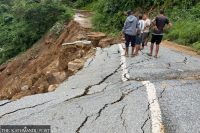
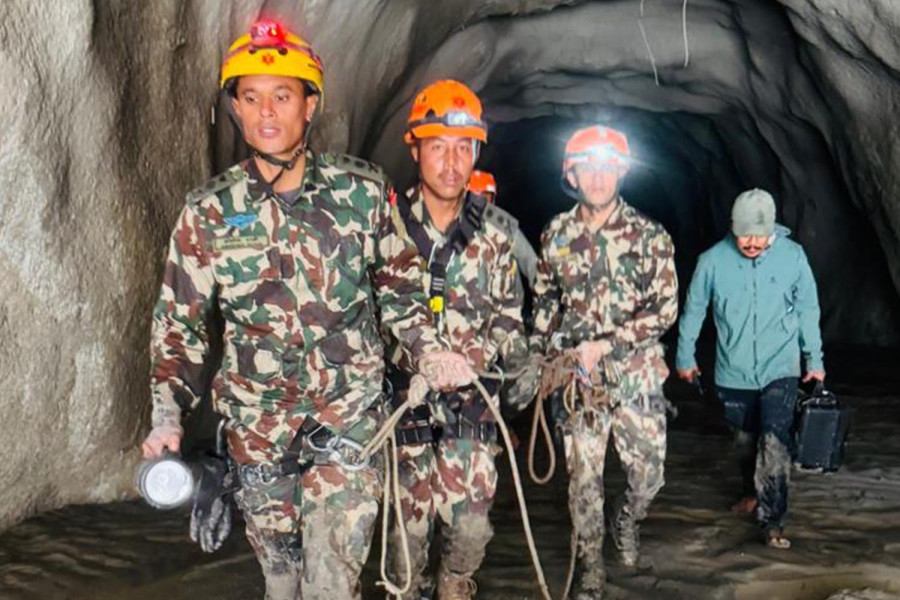
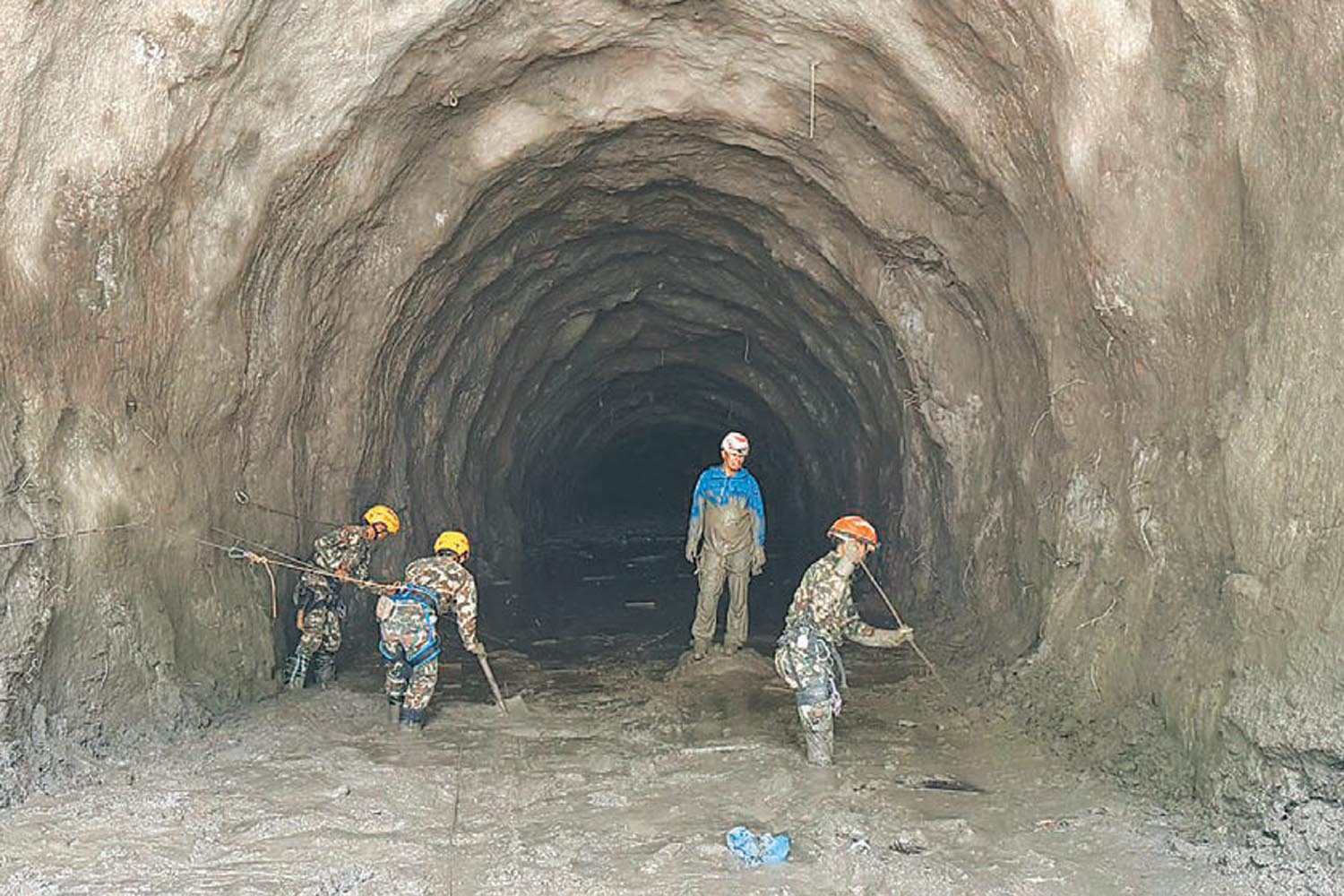
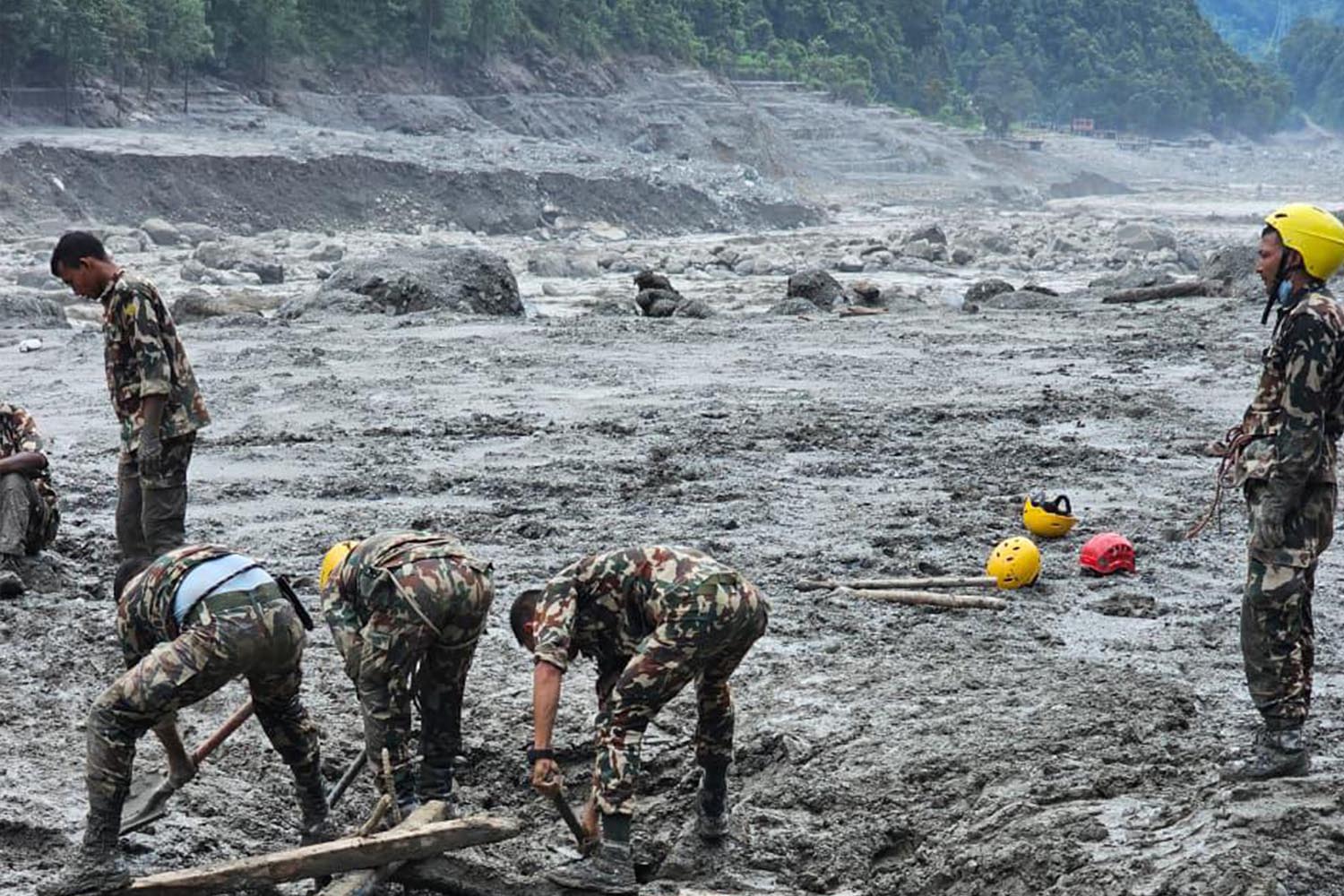
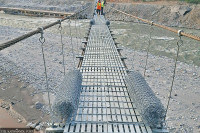
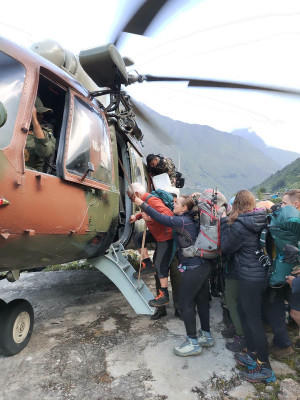
Hundreds of hydropower workers and staff remain missing across projects in Rasuwa and Nuwakot after the August 26 Bhotekoshi flood. Floodwater, mud, debris and blocked tunnels are slowing access to underground powerhouses where workers may still be trapped Photo: Courtesy of Nepali Army
Mithu Khadka has spent days calling her husband’s phone, hoping that this time he might answer. Instead, there has been only silence. The last time she spoke to Kamal Khadka, known as Nanu, was in a video call at around 8:30 am on Wednesday. Two hours later, the Bhotekoshi flood tore through hydropower sites in Rasuwa and Nuwakot, leaving hundreds of workers missing.
Khadka, who had worked for two years at the under-construction 216MW Upper Trishuli-1 Hydropower Project, was among them. “Looking at the mobile screen all the time has hurt my eyes,” said Mithu, from Gaurishankar Municipality-2 in Dolakha. “His name is neither on the list of the missing nor among those who have been found. It feels as though my whole world has disappeared.”
Her husband is among hundreds of workers, engineers and technicians who remain unaccounted for after the flood tore through hydropower sites along the Bhotekoshi and Trishuli river systems.
Some may have been swept away. Others may be trapped inside tunnels and underground powerhouses buried by water, mud and debris.
For their families, the uncertainty has become almost unbearable.
According to the Independent Power Producers’ Association of Nepal (IPPAN), 898 people working at 11 hydropower projects, including projects under construction, remain out of contact. But authorities have yet to establish how many were outside when the flood struck and how many may still be trapped underground.
That uncertainty has turned the rescue operation into a race against time.
“Until we see a body, there is hope,” Mithu said. “We have pleaded with the company to search for them. But they say they cannot simply go inside on their own.”
Across Nepal, families are demanding that rescuers push deeper into damaged tunnel systems. For some, the underground powerhouses offer the last possibility that their relatives survived the initial disaster.
Searching for a father
Twenty-year-old Anush Gurung of ward 18 of Bhimdatta Municipality in Kanchanpur is holding on to that possibility. His 60-year-old father, Laxman Gurung, worked on the Mailung side of the Upper Trishuli-1 project through Sino Hydro, the Chinese contractor.
Friends and colleagues have given the family conflicting accounts of his final movements.
“Some of my father’s friends say they saw him going inside. Others say they saw him coming out,” Anush said. “Whom are we supposed to believe? If the tunnel is searched, we would know for certain.” The last conversation between father and son took place at 8:11 on Wednesday morning. They were discussing where Anush should study for his bachelor’s degree. He believes his father ended the call at 8:17 and entered the tunnel soon afterwards.
Mobile phones do not work inside.
Since then, family members have scattered across the country in search of information. His sister has repeatedly visited an army camp in Nuwakot. His brother-in-law and other relatives travelled to Chitwan to inspect recovered bodies. Anush and his younger sister have been making inquiries at Tribhuvan University Teaching Hospital in Kathmandu and at the project company.
They have found nothing.
“Now our only hope is inside the tunnel,” he said. “If the rescue had reached there in time, perhaps they could have been found alive.”
The Upper Trishuli-1 project says 254 people have been rescued safely from surrounding areas, while more than 576 others remain unaccounted for.
The project is Nepal’s largest hydropower scheme under construction with direct foreign investment. Its dam and associated structures are being built in Haku, Rasuwa, while its underground powerhouse is located in Uttargaya.
The 216MW project had reached 86 percent physical progress before the disaster. Its total cost, including interest, is estimated at Rs64 billion.
Giriraj Adhikari, managing director of Nepal Water and Energy Development Company, said people had been rescued from the dam area, the desander basin and tunnels.
But the headrace tunnel, which carries water towards the powerhouse, has been inundated.
“Chinese teams and everyone concerned are on the ground,” Adhikari said.
For relatives, however, the question is not simply whether rescue teams have reached the project site. It is whether they can get to the places where people may still be trapped.
Dhruva Bista, whose brother Saubhagya Bista of Bardibas remains missing from the project, said the management company flew relatives over the site by helicopter on Monday to show them the scale of the destruction.
“The rescue is taking too long,” he said. “The conditions there are extremely difficult.”
A race to reach the tunnels
At another project, the 37MW Upper Trishuli-3B in Nuwakot, relatives have gathered at an army rescue and relief centre in Bidur, pressing authorities to accelerate the search.
At least 122 people, including 12 engineers employed by Chilime Engineering and Services Company and others involved in tunnel construction, remain out of contact.
Indian tunnel rescue team works alongside the Nepali Army at the Chilime Hydropower Project in Rasuwa on Monday. Photo: Courtesy of Indian envoy Naveen Srivastava’s x
Bivek Pandey, whose 58-year-old father Kamal Bahadur Pandey from Bhaktapur is among them, said families still believe some survivors may be trapped beneath sand and debris. “After four days of continuous pressure, the army finally brought an excavator on Monday,” he said. “If excavation begins, the sand covering the quarters can be removed. We still have hope.”
The Nepali Army said it intensified rescue efforts at the Upper Trishuli-3B tunnel on Monday.
A Chinese rescue team arrived with its own private helicopter and conducted aerial reconnaissance of Upper Trishuli-3B and Upper Trishuli-1 before briefing the army on conditions at the two sites. The team subsequently focused its efforts on Upper Trishuli-1.
At Upper Trishuli-3B, army personnel and the Nepal Electricity Authority began excavation near the tunnel area.
The project, which had achieved 65 percent physical completion, is a cascade project downstream of the 60MW Upper Trishuli-3A. Its estimated cost is Rs7.44 billion.
For Pushkar Amatya, acting chief executive officer of the Rasuwagadhi Hydropower Project, the disaster is both professional and deeply personal. His own brother, engineer Prabin Amatya, is missing from Upper Trishuli-3B. “My younger brother Prabin was an engineer there,” he said. “I learned that he had finished his routine inspection and was coming out. There has been no information about him since.”
At the same time, employees at the Rasuwagadhi Hydropower Project, where Pushkar works, are also feared trapped inside an underground powerhouse. “My own project has people missing, and my own brother is missing at another project,” he said.
Seven metres from the powerhouse
The rescue effort at the 111MW Rasuwagadhi Hydropower Project illustrates the difficulty of reaching the underground facilities.
On Monday, army personnel managed to enter the project tunnel but could not reach the underground powerhouse.
Narnath Neupane, company secretary of Rasuwagadhi Hydropower Company, project developer, said the team went as far as the section of the tunnel remained open. “They even crawled through places where there was only one or two feet of space,” he said. “After that, they found the tunnel completely blocked.”
The rescuers were forced to return because reaching the blocked section would require drilling equipment and other heavy machinery.
According to the company, the blockage begins with only about seven metres remaining before the underground powerhouse.
Rescuers have reached the same elevation as the powerhouse through the main tunnel, but the employees may be one floor above, in the control room.
Neupane said the government has to bring in additional equipment and treat the operation with the same urgency being applied elsewhere. “They have to keep digging, removing debris and clearing the way,” he said. “They have not yet reached the powerhouse. The government must give this priority.”
More than 93 people associated with the project, including those from the outside camp, remain unaccounted for.
The longer the tunnel remains inaccessible, the harder it becomes for project officials to reassure families. “Until now, we had been insisting that our people might still be safe,” Neupane said. “But now people are asking us what evidence we have.”
The Rasuwagadhi project, built at an estimated cost of Rs23.73 billion, has its powerhouse at Timure in Rasuwa. It had already suffered damage to its dam and other headworks during flooding in 2025 and was brought into full operation only in June this year.
‘Every second matters’
Perhaps nowhere is the sense of urgency more acute than at the 60MW Upper Trishuli-3A project. Between 30 and 40 people, including experienced technicians and engineers from the Nepal Electricity Authority and specialists brought in from different projects, are believed to be trapped inside its underground powerhouse.
Rescue work began on Saturday night, but teams have so far only managed to reach parts of the tunnel system.
The project has a headrace tunnel approximately 4.1 kilometres long and an underground powerhouse. The rescue operation is focused on reaching that chamber through the tunnel system.
Shriram Neupane, an energy expert and Rastriya Swatantra Party (RSP) lawmaker, said rescuers had found water and mud near the crown, or highest part, of the tunnel. “There is water and mud at the crown,” he said. “There are large rocks, and work is continuing day and night to break them.”
Photo: Courtesy of Nepali Army
He said the rescue team still had about 120 metres to travel through water and mud before reaching the powerhouse.
The project has been covered by debris estimated to be 16 to 17 metres high and spread across a width of 30 to 40 metres.
Families are demanding that the rescue effort be accelerated.
Sita Pandey of Butwal believes her husband, Jiblal Adhikari, may be among those trapped inside the Upper Trishuli-3A powerhouse. “He works inside the powerhouse,” she said. “Because there is an oxygen system there, I have perhaps a 50 percent hope that he is alive. But with every hour that passes, that hope becomes smaller.”
Adhikari, who normally works at the Kulekhani project, had travelled to Upper Trishuli-3A to inspect machinery during annual maintenance work.
Relatives have been regularly visiting the Nepal Electricity Authority’s offices, demanding faster action.
“The rescue process has been too slow,” said Jiban Khadka of Pyuthan. “The more time passes, the more our hope dies. Now it has to move at maximum speed, because every second matters to us.”
Former energy minister Kulman Ghising said the government should give equal priority to rescuing workers trapped in underground powerhouses at other hydropower projects. “The same intensity being applied at Upper Trishuli-3A should be applied to other projects as well,” he said. “Rather than relying on assumptions, authorities should bring in experts who have worked at these sites and use their knowledge to accelerate the rescue.”
Ghising said underground powerhouses could offer conditions that allow people to survive longer than those exposed directly to floodwaters. “Every underground powerhouse has oxygen facilities. There are kitchens and separate areas in the upper parts of the building,” he said. “There are risks around generators and turbines, but there are control rooms at higher levels inside the powerhouse that could be safer.”
After visiting the Rasuwagadhi project, Ghising said around 250 metres of its access tunnel remained open and authorities should push further to create a route to the underground powerhouse.
At Chilime, however, the tunnel is filled with water and the tailrace is also blocked, meaning water would need to be pumped out before rescue teams could proceed.
Under normal circumstances, underground hydropower facilities maintain communication links with the Nepal Electricity Authority’s load dispatch centre through telephone and email systems. But those connections have been cut since the flood.
For the families waiting outside, the silence has become the cruellest part of the disaster.
They do not know whether their relatives were swept away, buried beneath debris, stranded in the mountains or trapped behind blocked tunnels deep underground.
The lists of the missing offer numbers, but few answers.
For Mithu Khadka, every unanswered phone call is a reminder of that uncertainty. Somewhere beyond the damaged roads, collapsed structures and mud-filled tunnels may lie the answer to whether her husband is alive. Until rescuers reach those places, families like hers say they cannot stop hoping. “Until we see a body,” Mithu said, “there is hope.”
Hom Karki is a reporter with two decades experience covering migrant workers issues and the Nepali diaspora. He was previously based in the Gulf for Kantipur Daily.




 24.59°C Kathmandu