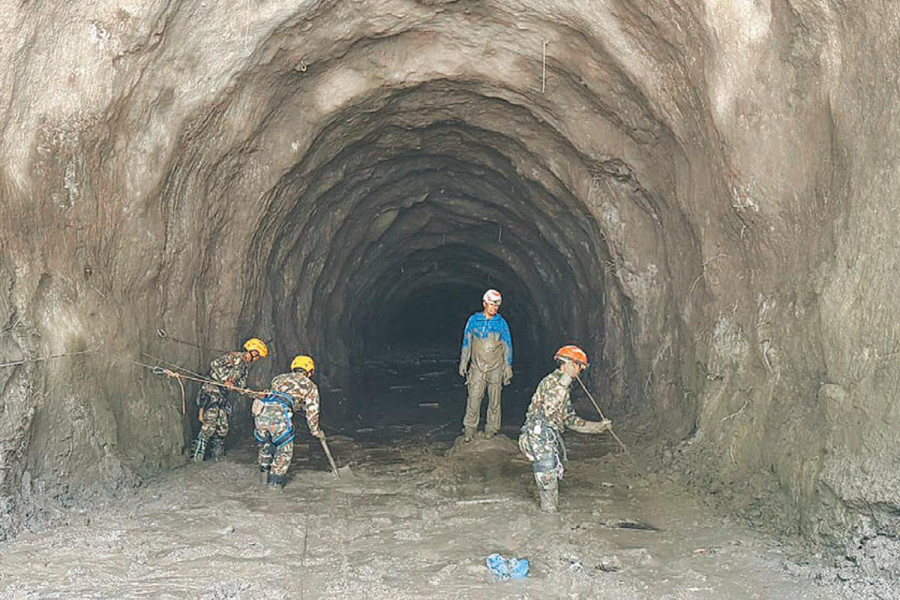
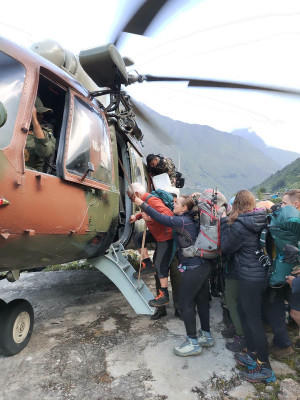
Assistance ranges from tunnel rescue and forensic expertise to relief materials and specialised equipment. Nepal seeks more help for recovery and reconstruction. Indian tunnel rescue team works alongside the Nepali Army at the Chilime Hydropower Project in Rasuwa on Monday. Photo: Courtesy of Indian envoy Naveen Srivastava’s x
In the aftermath of the August 26 Bhotekoshi disaster, Nepal is turning increasingly to foreign governments for specialised expertise and equipment as the scale of the search, rescue and recovery operation becomes clearer.
What began largely as a domestic rescue effort has evolved into an international response, with countries sending tunnel-rescue teams, forensic specialists, drones and other equipment, while Nepal seeks additional help to identify the dead and reach people who may still be trapped in difficult terrain.
So far, 903 bodies have been recovered from the disaster-hit areas, while around 4,200 people remain unaccounted for. More than 10,000 people have been rescued, including over 323 foreign nationals. About 590 foreign nationals from 32 countries are still missing, according to the Nepal Tourism Board.
After initially limiting overseas involvement, officials said Nepal has since become more proactive in seeking specialised support that is not readily available domestically.
“The Nepal government has become more proactive since Sunday in seeking logistical and technical assistance from foreign governments,” an official at a diplomatic mission in Nepal told the Post.
The immediate need is increasingly about reaching places that conventional rescue operations cannot easily access and identifying victims whose remains have yet to be matched with families.
India and China, Nepal’s two immediate neighbours, have deployed specialised tunnel-rescue teams to work alongside Nepali security personnel at hydropower projects in the disaster-hit areas. An 11-member Indian team is working at Mailung, the site of the Chilime Hydropower Project, while a nine-member Chinese team has been deployed at the Upper Trishuli 3A project site in Syabrubesi, according to the Foreign Ministry.
India’s assistance has also extended from rescue to the identification of the dead. An 18-member team of Indian forensic experts specialising in DNA analysis has arrived in Kathmandu and is working with the Nepal Police Central Forensic Science Laboratory and Tribhuvan University Teaching Hospital.
“The team has arrived in Kathmandu and is working with the Nepal Police Central Forensic Science Laboratory and Tribhuvan University Teaching Hospital to analyse DNA samples,” Indian ambassador Naveen Srivastava said on X.
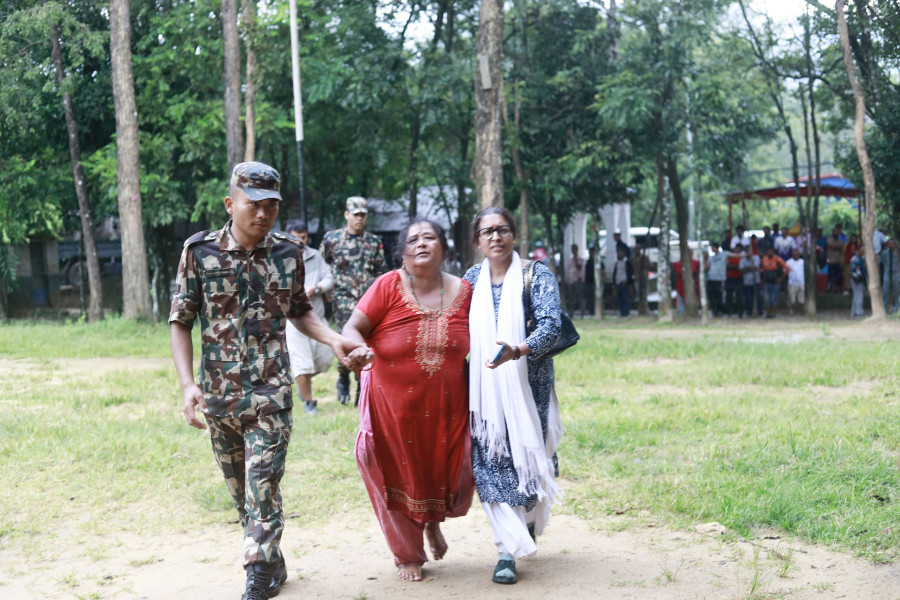
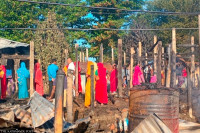
A Nepali Army personnel leads affected women to safety at the No. 1 Military Training Centre in Bidur, Nuwakot, after being rescued by helicopter from flood-affected areas along the Bhotekoshi river in Rasuwa and Nuwakot. RSS
As the authorities struggle with the large number of unidentified bodies, Singapore is preparing to contribute another specialised capability. The Singapore Police Force is deploying officers trained in Disaster Victim Identification (DVI) at Nepal’s request, according to the Singapore Embassy in New Delhi, which is accredited to Nepal.
Singapore will also provide humanitarian supplies from civilian sources and the Singapore Armed Forces. Its assistance is expected to complement the forensic work already being undertaken by Nepal and India, as authorities try to establish the identities of those killed.
The need for such support has become more urgent as the authorities confront not only the number of dead but also the logistical difficulties of recovering and preserving remains. Nepal has already received airtight body bags, with additional supplies being sent by India and China, while it has sought more freezers for storing bodies.
The government is also looking beyond immediate rescue operations to technology that could help search the rugged and inaccessible terrain. It has requested LiDAR equipment from the United States, as well as DNA testing kits and other essential non-food items and services, according to Ministry of Foreign Affairs spokesperson Lok Bahadur Poudel Chhetri. LiDAR uses laser pulses to measure distances and can generate detailed three-dimensional maps, potentially helping authorities assess difficult terrain and search areas affected by the disaster.
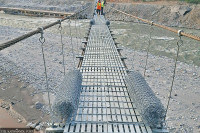
Nepal has also requested Bailey bridges and high-capacity drones. Some Bailey bridges have already been received, while high-capacity drones are expected from China and Singapore. Japan and the Republic of Korea are also expected to provide specialised equipment soon, the officials say.
South Korea has already deployed a rescue team to the affected areas with drones and other equipment. Australia, meanwhile, has sent 12 response personnel to Kathmandu, including crisis-response and consular officers and members of the Australian Federal Police. The team is supporting the crisis response alongside Australian officials already in Nepal.
The Australian government has raised its humanitarian support for the disaster to $8 million. As many as 42 Australians remain missing in the floods.
Beyond the specialised equipment and personnel, the international response is beginning to address more basic needs arising from the destruction. Relief materials already received from India, China, the United Arab Emirates and other countries include bridge units, generators, solar lamps, emergency rescue equipment, tents, blankets, sleeping bags, food and medicines.
Chhetri said they are expecting more assistance from countries including the UAE, Myanmar, the United States, Qatar, the United Kingdom, Australia, South Korea, Japan, New Zealand, Malaysia, Singapore, Bangladesh and Pakistan, as well as international organisations including the United Nations, World Health Organisation, World Food Programme and UNICEF. Nepal is also receiving financial assistance from foreign governments and development partners.
The focus remains on finding those still missing, recovering and identifying the dead, and helping communities along the Bhotekoshi and Trishuli river corridors begin to recover.
The disaster has also required close coordination with China over Nepalis affected or stranded on the Chinese side of the border. The Foreign Ministry and Nepal’s missions in China are in constant contact to collect and share information about Nepali nationals, Chettri said.
“The Chinese side has facilitated the return of Nepali nationals from Tibet through Hilsa and other border points,” he said on Monday.
Nepal and China have also been exchanging information in real time on hydrological and meteorological conditions, including flood risks, avalanches, glacial lakes and other water-induced disasters, Chettri said.
Foreign assistance is likely to become even more important as Nepal moves beyond the immediate rescue phase. The government is conducting a preliminary assessment of its needs, while a detailed post-disaster needs assessment will determine the scale of support required for rehabilitation and reconstruction. The National Planning Commission will lead the preparation of the Post-Disaster Needs Assessment, according to Chettri.
Anil Giri is a Chief Sub Editor covering diplomacy, international relations and national politics for The Kathmandu Post. Giri has been working as a journalist for more than two decades, contributing to numerous national and international media outlets.




 16.45°C Kathmandu