Tatopani, major trade route linking China, shut for six days leaving freight containers stranded
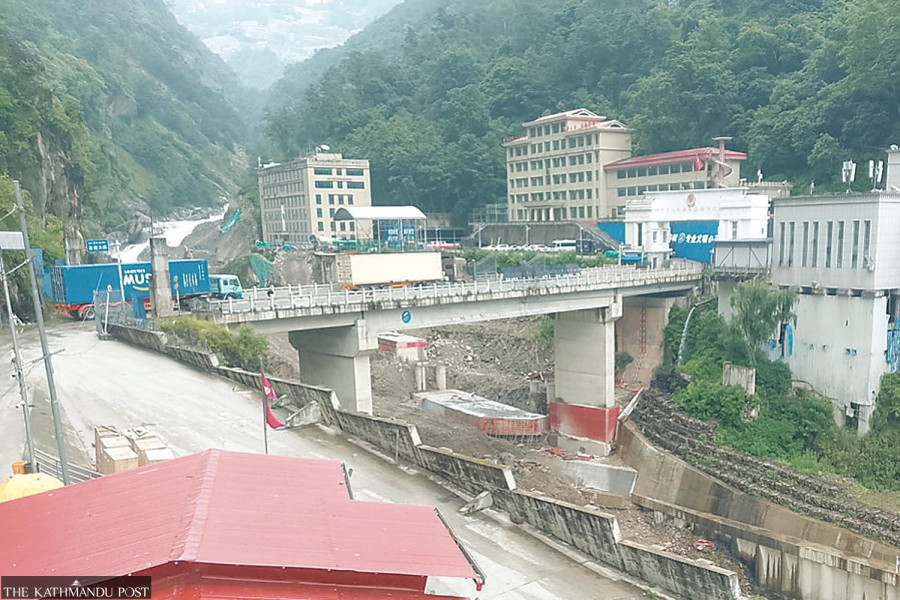
The Kodari road section was disrupted on July 13 following a heavy landslide at Liping and major road subsidence near the Eco and Daklang areas. The Friendship Bridge at the Tatopani border point, pictured recently. Post Photo
Incessant rainfall has brought operations at the Tatopani border crossing—a crucial trade route between Nepal and China—to a complete halt for the past six days. The landslides and severe road subsidence have left around 150 cargo containers carrying goods worth millions of rupees stranded on the Chinese side, while dozens of freight trucks are stuck on the Nepali side.
Traders, exasperated by the recurring road obstructions in the Tatopani trading area—which has struggled to bounce back since the devastating 2015 earthquakes—have voiced bitter grievances against the government, declaring that what was once a ‘hero border crossing’ has now been reduced to a ‘zero border crossing’.
By Tuesday, the crucial border link had remained completely inoperative. The Kodari road section was disrupted on July 13 following a heavy landslide at Liping and major road subsidence near the Eco and Daklang areas, and authorities have been unable to restore traffic.
Rajesh Bhandari, an executive member of the Nepal Trans-Himalayan Border Commerce Association, said although light access was temporarily cleared around Liping and Daklang, traffic ground to a total halt because the earth continues to sink daily at Eco.
"Over 150 containers carrying perishable items such as apples, oranges, and ginger, as well as readymade garments and industrial machinery, are stranded across the landslide zone," said Bhandari. "Furthermore, more than 45 trucks loaded with goods worth millions of rupees are stuck further inland at Nyalam and adjacent regions in China. When will the government finally open its eyes to our plight?"
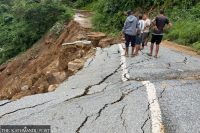
Having enjoyed uninterrupted operations until July 11 due to a late arrival of monsoon, the Tatopani point faced its first major seasonal shutdown this year. Following two days of incessant downpour, a massive mudslide engulfed Liping while the road bed at Eco gave way completely, slumping into the churning Bhote Koshi river. The long-standing landslide at Daklang, which authorities had managed to stabilise recently, has also reactivated.
Narayan Dutta Bhandari, chief of the Division Road Office in Charikot, stated that road crews cleared debris at Liping and briefly managed to open a passage through Daklang. He, however, said that continuous rainfall at the Eco area has severely hindered repair efforts, though emergency work remains underway.
After the initial landslides and road collapse last Monday, technical teams patched the damaged sections, enabling one-way traffic by Thursday evening. Trans-border freight movement resumed briefly, but relentless overnight rains caused a swollen mountain rivulet to wash away the newly repaired track at Eco on Thursday night, forcing the border closure once again.
‘Hero to Zero’ customs point
Before the devastating 2015 earthquake, the border settlement presented a starkly different reality. The town was adorned with decorative lights, neat modern buildings, and bustling markets teeming with merchants and travellers. Long queues of cargo containers and public vehicles jammed the lanes, waiting to unload merchandise while security personnel struggled to direct the relentless traffic. Across the border lay Khasa, and on the Nepali side, Liping market exuded the vibrant atmosphere of a daily festival.
In those peak years, Nepali traders regularly travelled into the Khasa market area to fetch up to 200 container loads of goods every day. Situated in Bhotekoshi Rural Municipality-2 in Sindhupalchok district, the Liping market serves as the gateway to the Miteri Bridge (Friendship Bridge) connecting Nepal and China.
Before the earthquake and its powerful aftershocks devastated the region, Tatopani was celebrated nationwide as the premier commercial hub and the primary overland route for pilgrims heading to Kailash Mansarovar in Tibet. To local entrepreneurs today, those golden years feel like a distant dream.
Now, the border point stands desolate and eerie.
"The hero border point of the past has turned into a zero border point today. Nothing is like what it used to be," said Amrit Khadka, a former VDC chairman of the Tatopani region. Khadka, who remains involved in numerous educational and commercial initiatives, has been a direct witness to the decline of Tatopani.
Prior to the 2015 disaster, the Liping area boasted around 150 houses and shelters, 60 hotels, five commercial bank branches, and dozens of cooperatives and corporate offices. However, when the earthquake demolished physical structures and forced the border to close, the entire local population was displaced.
To make matters worse, a catastrophic flash flood in the Bhote Koshi river dealt a second devastating blow to the border town as it was barely beginning to recover in 2016. The disaster occurred when a landslide at Chepsang, between Khasa and Kuti in Tibet, dammed the river, creating a temporary body of water that eventually burst. The resulting flash flood swept away 80 homes in Liping.
At present, only seven to ten dilapidated, half-ruined houses remain amidst the rubble. Near the Miteri Bridge, a small arrival-and-departure facility with a modest walkthrough gate has been erected and painted, while the local immigration office functions out of a roughly repainted structure. In Liping market, a handful of business owners have renovated derelict buildings or set up temporary shacks to run small hotels and retail shops selling Chinese goods.
Local residents are permitted to buy household items only after walking up to a cluster of roughly two dozen small shops near the border-demarcating Miteri Bridge. Previously, local Nepalis were granted entry into the Chinese border area purely for domestic purchases. However, following the recent Gen Z protests in Nepal, Chinese authorities restricted local movement, permitting residents to cross over only once a day and return with limited goods.
"We had hoped the opening of the customs point would improve conditions, but crossing the border is no longer smooth," said Sangdoma Sherpa, a resident of Bhotekoshi-3. "Chinese security personnel across the border do not display a welcoming attitude. Ever since the protests and the subsequent change of government in Nepal, they have gradually tightened entry passes and movement rules."
Despite generating billions of rupees in customs revenue whenever the border is functioning, the government has failed to provide safe parking facilities or organised infrastructure for freight vehicles. Business owners who returned to reopen shops and hotels—hoping for a revival of cross-border commerce—express deep frustration at the constant parade of visiting ministers, politicians, and official inspection teams.
"People keep proclaiming that the border is open, but looking at the reality here fills us with despair," said Sete Shrestha, a local trader. "Across the border in China, immense modern infrastructure has been constructed. Meanwhile, we spend our days staring at these ruins alongside visitors who come just to sightsee. China has finished building its infrastructure up to the border. Nepal, on the other hand, has made no preparations whatsoever,” he lamented.
The local economy has been hit further by strict customs enforcement. Information Officer Tul Bahadur Pandey at the Tatopani Dry Port and Customs Office reported that import volumes dropped from around 4,500 containers in the fiscal year 2024-25 to just 3,600 in 2025-26. Daily container arrivals, which previously averaged 25 to 30 trucks, have plummeted to ten, seven, or even four per day. Pandey attributed this drop to recurrent road blockages caused by floods and landslides, inadequate physical infrastructure, and stringent technical regulations.
The Tatopani Customs Office recently banned the entry of food and agricultural goods lacking formal quarantine clearance at the Miteri Bridge passenger branch.
Pandey explained that, under government mandates, commercial firms registered for VAT must fulfill all legal import requirements and obtain valid quarantine permits before bringing in items. Unprocessed goods are no longer allowed through customs, ending the old practice where individuals could import goods worth up to Rs5,000 by paying a simple flat fee.
This sudden enforcement has severely impacted hundreds of families across Bhotekoshi Rural Municipality and the nearby Barhabise. Kumar Shrestha, chair of Bhotekoshi Rural Municipality-2, emphasised that the new rules have plunged local livelihoods into crisis. "Numerous border families relied entirely on this small-scale trade for their daily survival. Now they have been left essentially jobless,” said Shrestha.
Barhabise-Tatopani road remains in dire state for decade
The 26-kilometre Barhabise-Tatopani stretch of the strategic Kodari Highway has not seen a full upgrade since the 2015 earthquake. Every monsoon, this vital transport artery is severely disrupted by landslides.
Shrestha expressed frustration that despite being assigned to Chinese grant funding and Chinese contractors, the road’s condition remains abysmal.
"It is once again Chinese grants, Chinese companies, and Chinese contractors, yet the condition of the highway remains unchanged," he said.
Following the 2015 disaster, the Chinese government announced substantial financial assistance across multiple phases for the reconstruction of the Kodari Highway and landslide control. During former President Ram Baran Yadav's official visit to China in 2015, Chinese President Xi Jinping pledged approximately Rs16.20 billion in aid.
Under this assistance programme, the contract for road repairs and asphalt paving was awarded to the China Railway Fourth Construction Bureau Group Company Ltd. Nearly a decade later, however, major sections of the road remain the same.
Last year, massive landslides forced the Tatopani border to close for nearly three months. Following intense pressure from local residents, a budget of Rs484.9 million was allocated for landslide mitigation. According to Division Road chief Bhandari, a contract was initially awarded to a Nepali construction firm, which completed roughly 15 percent of the work before the Ministry of Foreign Affairs instructed the office to terminate the agreement. The ministry decided that the work should be executed through a Chinese firm; however, the designated Chinese construction company has yet to mobilise to the site.
According to Bhandari, while two preliminary phases of agreements have been signed between Nepal and China, the formal implementation agreement remains pending. Authorities hope the Chinese firm will commence long-term landslide stabilisation at the Eco site once the monsoon subsides.
Local residents emphasise that finding a lasting solution is exceptionally difficult, as around 175 households reside on the hill directly above the Eco landslide while the furious Bhote Koshi continuously erodes the base below.
Sharada Prasad Parajuli, an executive member of the Trans-Himalayan Border Commerce Association, highlighted that recurring road closures force many traders to reroute trucks carrying perishable cargo to the Rasuwagadhi-Kerung border crossing instead.
"Severe bank erosion by the Bhote Koshi river is now threatening the customs yard itself," said Parajuli. "When landslides block the road, responsible government agencies fail to clear them promptly, forcing traders to pool their own money to clear the debris and repair the track."




 16.18°C Kathmandu