Commercial vegetable farming is transforming a Chitwan Chepang settlement
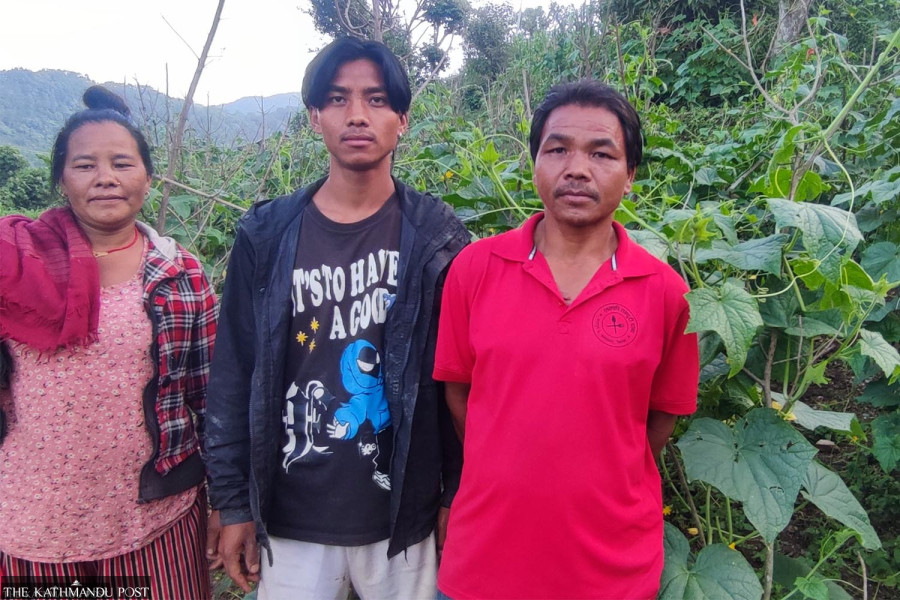
Once a subsistence and food-insecure village, Hapani in Ichchhakamana Rural Municipality is seeing steady rise in household incomes. Tek Bahadur Chepang (right) standing amid rows of thriving cucumber vines in Chepang-majority settlement in ward 2 of Ichchhakamana Rural Municipality, Chitwan. Ramesh Kumar Paudel/TKP
A decade ago, Tek Bahadur Chepang returned home disappointed after spending three years working in Malaysia. The earnings were not enough to improve his family’s life, and he faced the same uncertainty that had long defined the lives of many Chepang families in the hills of northern Chitwan.
Now, standing amid rows of thriving cucumber vines in Hapani, a Chepang-majority settlement in ward 2 of Ichchhakamana Rural Municipality, he represents a different story—self-reliance, rising incomes and changing aspirations.
On Friday morning alone, Tek Bahadur sold five quintals of cucumbers from his farm. There were plenty others nearly ready for harvest. “I started picking cucumbers on May 29. The first harvest was 80 kilos, the second nearly two quintals and the third five quintals,” he said. “The next harvest in the first week of June should exceed a tonne.”
Tek Bahadur harvests and sells cucumbers every two or three days and expects production to continue until the end of July. Afterwards, he plans to plant tomatoes.
“Cucumber is my main crop. I have also been raising goats for the past four or five years. Together, these activities generate around Rs1.5 million annually,” he said.
Tek Bahadur’s success reflects a wider transformation unfolding across Kaule Hapani, where commercial vegetable farming has changed the identity of the marginalised Chepang community, long associated with poverty, food insecurity and subsistence agriculture.
Eighty-one-year-old Dil Bahadur Praja Chepang remembers a very different time.
“In the past, maize planted in February would only be ready around August. We grew maize and a little millet on the slopes. Once the grain ran out, families suffered shortages. People had to search the forest for wild tubers and other wild roots to survive,” he said. According to him, such hardships are now largely gone.
The change has come gradually over the past decade as more families embraced commercial farming. Farmers now grow cucumbers, tomatoes, beans, cauliflower and coriander, supplying markets in Fisling, Tandi and Narayanghat.
Ward chair Pancha Bahadur Praja Chepang, himself a resident of Hapani, is among those who made the switch early. “Most farmers cultivate cucumbers, while I focus more on tomatoes. I sell tomatoes worth around Rs500,000 each year,” he said.
He says villagers no longer need to leave home merely to earn cash for daily necessities.
“There are around 35 households in Hapani. Every family is involved in some form of farming,” said Panch Bahadur. “Many earn at least Rs100,000 to Rs200,000 annually. The situation where people had to migrate simply to feed their families is no longer common here.”
Tek Bahadur, who also chairs the Hapani Farmers’ Group, said visible success encouraged others to follow. “When people saw that hard work in agriculture could generate income, more households began growing vegetables,” he said.
Infrastructure improvements have also played a crucial role. When vegetable cultivation first began, there was no road access to the settlement. Farmers carried loads weighing up to 50 kilograms on their backs and trekked for nearly four hours to reach Fisling market.
“We used to carry vegetables ourselves. Later, mini-trucks started collecting produce after the road opened. For the past four years, [Mahindra] Bolero jeeps have been reaching our farms directly,” said Tek Bahadur.
The local government has also tried to support the sector. According to Pancha Bahadur, the rural municipality procured an agricultural transport vehicle at a subsidised cost to help farmers ferry their produce to market.
Yet challenges remain. Although much of the Shaktikhor-Fisling road has been blacktopped, sections around Olyang remain incomplete. There is still no bridge over the Rigdi stream, while the road linking Olyang and Hapani remains narrow and unpaved.
“Travel becomes difficult during the monsoon. If road connectivity improves further, vegetable farming can expand significantly,” said Panch Bahadur.
The ward chair traces the beginning of the farming movement to a training programme he attended more than a decade ago while working as a community mobiliser. “After receiving vegetable farming training, I was expected to share what I learned with villagers,” he said. “I started growing vegetables myself and carried them in a doko [basket] on my back to Fisling to sell. Gradually, other households followed.”
The transformation is visible not only in fields but also in everyday life. Income from farming enabled Tek Bahadur to educate his two sons in Bharatpur. His elder son has completed Grade 12, while the younger recently sat the same examination. The family has also bought farmland near Shaktikhor and residential land in Jyamire, east of Ratnanagar.
“I cultivate vegetables on about one bigha [0.68 hectares] of land, some of which is taken on lease,” he said. “The income is reinvested in farming. We may not become rich, but we have managed to build a life while staying in the village.”
In Hapani, hills once associated with hunger now display rows of green vegetable fields. For a community historically portrayed as surviving on marginal land and wild fruits and roots, commercial farming has become a pathway to dignity, stability and opportunity.
The marginalised Chepang community faces broader deprivation. Many lack land ownership certificates, and literacy remains low. According to the 2021 national census, Nepal is home to 84,364 Chepangs.




 14.81°C Kathmandu
1.jpg)