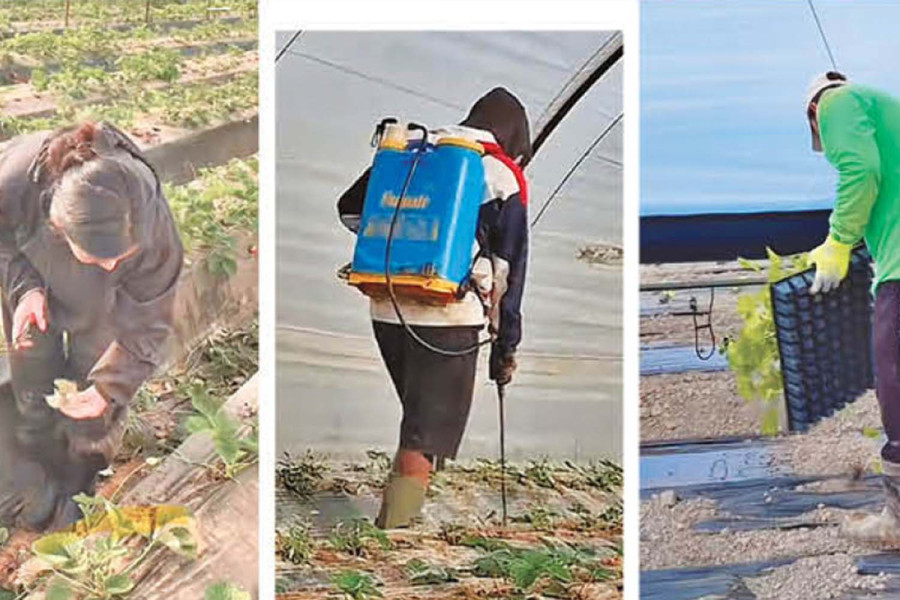
With the strawberry season underway in Greece, Ganesh Thapa from Butwal is busy planting seedlings in Lappa village, a three-hour drive from Athens. He works alongside 32 Nepali agricultural workers, including seven women.
“Strawberry season runs from September to June. Right now, we are planting, harvesting, and sending fruit to market,” Thapa told the Post over the phone.
Manolada and nearby villages produce around 90 percent of Greece’s strawberries, employing at least 4,000, mostly undocumented Nepali workers.
Former Greek Prime Minister George Papandreou dubbed strawberries ‘red gold’, reflecting their value in an industry that earns millions of euros annually. Nearly all Greek strawberries are exported, with just four percent consumed locally. In 2024, Greece earned 712 million euros from 80,000 tons of strawberries, a growth driven largely by low-paid immigrant labour.
Networks of human traffickers are active in bringing such migrant workers to Greek villages. Greece, located on the EU’s periphery, has become a primary gateway for migrants entering Europe. Many migrants from Turkey and North African countries enter through Greece, while Nepalis often enter via Romania and Croatia. According to the Department of Foreign Employment, nearly 40,000 Nepalis went to Europe in the past fiscal year, including 21,000 to Romania, 11,000 to Croatia, 3,200 to Serbia, 1,900 to Portugal, 1,100 to Slovenia, and 1,000 to Austria. Most went through personal contacts or agents.
The Greek government had allocated quotas for 89,000 migrant workers from non-EU countries in 2025, including 41,670 for general workers, 45,620 for seasonal workers, and 2,000 for highly skilled workers.
It is difficult to bring Nepali workers under these quotas legally. Nepal has no policy of sending workers seasonally only for nine months. As a result, human trafficking fills the labour gap in Greek villages.
Traffickers lure Nepalis with valid labour visas for Romania, Croatia, and Serbia by promising earnings of up to 1,300 euros in Greece and arrange travel by air or land. Traffickers themselves cover the upfront costs, which are then deducted from the workers’ wages.
Thapa arrived in Greece from Romania on April 1. He said he had paid Rs550,000 in Nepal for a driving job in Romania, but never received a salary or work. “One company promised to arrange my residence permit and brought me here. They asked for additional fees, then later said they couldn’t issue the permit and returned the money. By then, my visa had expired, and I couldn’t return to Nepal. Greece became my only option,” he said.
Thapa reached Greece through Sneha Thapa, who connects Nepalis working legally in Romania with farm jobs in Greece via TikTok and Facebook. She charged 3,500 euros per person—including taxi fare—deducted from their wages. Workers had to follow the farm placements she assigned. Thapa and four others agreed to these terms.
“We travelled from Romania to Greece in 14 hours by taxi through Bulgaria. The border crossings were smooth, and there were no inspections. They handled everything,” Thapa said.
The group was sent to farms contracted by a Bangladeshi employer. “Of the 35 of us, only four have Greek refugee cards, and five have passports. The rest don’t even have documents. Some received local cards from the farm owners to avoid the police. My card is still being processed. Once I have it, working, travelling, and living will be much safer,” he added.
The cost of bringing workers to Greece is deducted from their wages. “Last month, the full amount for our trip was finally deducted. It took seven months to pay off, including three months—June, July, and August—when there was no work,” Thapa said. “Work also stops when it rains.”
Human traffickers often rely on the workers themselves to spread their network. Agent Susmita Thapa is widely known among Nepalis in Greece. She recruits Nepali workers from Romania, Bulgaria, Macedonia, Bosnia and Herzegovina, Albania, Turkey, and Cyprus, sending them to Greece, Italy, Spain, and France. On TikTok, she claims, “If you cannot find work or are undocumented in Europe, you can work with zero upfront cost.” In the past year alone, she has allegedly sent more than 120 groups to Greece.
Bonded labour camps
Fifteen years ago, Greek agriculture was dominated by Albanian, Romanian, Bulgarian, and Egyptian workers. Today, only a few Bulgarians and Romanians arrive at the start of each season. Following Bangladeshis and Pakistanis, Nepalis have become increasingly visible. They are preferred for strawberry work for their physical endurance and quiet, diligent work ethic. Most are undocumented and fear deportation or arrest, making them unlikely to protest against contractors—qualities that have made them a primary source of labour.
Anu Shrestha from Kohalpur came to Greece through Sneha Thapa after nine months of work in Romania. She does not have a passport and arrived with a Romanian temporary residence permit, which allows travel across Europe but does not permit employment.
“Sneha told me I would work in a hotel, but I ended up in agriculture,” Anu Shrestha said in a video showing a wheelbarrow of strawberries. “At this farm in Tripoli [Greece], the work is extremely hard. There are about 40 Nepalis like me—none have passports. We came with big dreams, but the residence card process doesn’t work in Greece. Everyone here is undocumented.” She described the daily grind. “We ride in lorry trucks, start at 7am, eat the snacks we bring at 10am., and work until 5pm.”
Nepali agricultural workers rarely have direct contact with their employers and often do not know their full names. Their main point of contact is a contractor or supervisor, who mediates between the workers and farm owners. Many contractors exploit this system to maximise their own profits at the workers’ expense.
Workers are paid five euros an hour, though some contractors give only 4.50 euros, claiming it is enough to cover their costs and interest. “We work in the chilling cold, face snow, have no holidays, and don’t get paid on time. Being undocumented adds to the hardship,” Anu Shrestha said. “There are no toilets at work. We carry water bottles and rush to find places to relieve ourselves.” Working eight hours a day, 30 days a month, they earn 1,080 to 1,200 euros, with 150 euros deducted for food and 50 euros for accommodation.
Living conditions are harsh. Temporary camps are scattered across large strawberry fields, which Nepali workers compare to cow or goat sheds. Up to 30 people may share a single room, making social distancing impossible.
“Our shelter is divided into two sections, one for men and one for women. There are no beds—we sleep on strawberry crates with bedding on top, and there’s nowhere to store our belongings,” said Urmila Yonzon. Most of the camp smells foul, and the toilets are without running water. “We often fall sick in winter.”
Urmila, who went to Serbia on a foreign employment permit from Nepal’s Department of Foreign Employment and reached Greece through Susmita Thapa, described the situation as “like bonded labour in Europe.” She said, “The whole village feels like a deportation centre. Without a passport, we cannot leave. We cannot quit until the contractor’s money is cleared. From morning to evening, we work in a labour camp. Leaving the place means getting arrested.”
Greek anti-human trafficking operations
Greek police have conducted raids on agricultural farms over allegations of labour exploitation, undocumented work, and human trafficking. On October 7, authorities arrested 10 Pakistanis and a 29-year-old Nepali woman, whose identity has not been disclosed, on charges including human trafficking, labour exploitation, criminal group involvement, immigration violations, and drug offences, according to a police statement on October 8.
Twenty-five Nepalis were rescued from a single farm, where they had been held in bondage, forced to work long hours, threatened, and sometimes beaten. They lived in unhealthy and inhumane conditions. On the same day, more than a hundred undocumented workers were detained across various farms.
Since November 2024, the group has used social media to lure Nepalis legally working in Romania to Greece, promising high wages. Workers were transported by air or land through North Macedonia. In some cases, traffickers covered travel costs, confiscated passports, and imposed debt repayment on the workers.
In July, 26 Nepalis were rescued from a warehouse in Tripoli where they had no toilets and slept on vegetable crates. The anti-human trafficking unit reported that they had been confined to temporary shelters and forced to work without pay for months.
Most Nepali workers are employed in Peloponnese, including Argolis, Ilia, Arcadia, Laconia, and Messinia. In July 2024, Greek police arrested two Nepalis on human trafficking charges for exploiting workers. It is unclear whether they remain in custody or have been released.
Bharat Kumar Regmi, head of Nepal’s permanent mission to the UN in Vienna, overseeing Nepalis in Greece, said there is no confirmed list of imprisoned Nepalis. “The IOM monitors undocumented Nepalis and other migrant workers to facilitate their return home. Each month, we request travel documents for 8–10 people,” he said.
The Nepali Embassy lacks accurate data, but the Non-Resident Nepali Association estimates around 5,000 Nepalis in Greece, 4,000 of them undocumented in agriculture. “A growing number of Nepalis in Europe are leaving the countries where they hold visas to work in Greece, creating new challenges,” Regmi said. “Undocumented Nepali workers face harsh conditions and lack access to legal status.”
Arjun Gurung from Lamjung, who travelled via Croatia, said he paid Rs800,000 for work there. “Unable to find a job, I came to Greece and ended up with even more debt. Coming to Europe has only increased the risks.”
The Greek Asylum Service and Appeals Authority handle asylum applications, with the Appeals Authority providing free legal aid. Yet the process is slow. In 2024, only 33,000 of over 89,000 undocumented migrants gained legal status.
Formal employment in Europe typically requires a visa or refugee status. Greece is somewhat more lenient, yet 80 percent of Nepalis arriving there are undocumented, and gaining legal status can take years.
Recent Greek policies have made immigration rules stricter. A September law criminalises illegal residence, imposing 2–5 years in prison and a 10,000-euro fine. An October 20 directive clarified that anyone without asylum rights will have their applications rejected, can be held in administrative detention for up to 24 months, and will be considered committing a “serious crime,” with their status immediately suspended or cancelled. The only way to avoid these penalties is to leave Greece.
‘Eighty percent of Nepalis in Greece are undocumented’
Bharat Kumar Regmi, head of Nepal’s permanent mission to the UN, said undocumented Nepalis are increasingly reaching Greece. The Non-Resident Nepali Association (NRNA) is working to address the issue, but formal reports from workers are rare, leaving official data limited.
“Authorities usually become aware of problems only when there are passport issues. Some eighty percent of Nepalis are undocumented. Last year, 700 passports were processed. The International Organization for Migration (IOM) helps Nepalis who wish to return home, arranging travel documents and tickets for 8–10 people each month,” he said.
Across Europe, formal employment generally requires a visa or refugee status. Greece is somewhat more permissive, drawing undocumented Nepalis. Once workers become undocumented, obtaining legal status can take years, and the embassy cannot intervene, said Regmi.
Hom Karki is a reporter with two decades experience covering migrant workers issues and the Nepali diaspora. He was previously based in the Gulf for Kantipur Daily.




 23.34°C Kathmandu