



 23.24°C Kathmandu
1.jpg)

Tue, Sep 29, 2026
National
Construction of ‘iconic’ Narayani bridge begins after an 18-month delay
The 420-metre bridge will have two 53-metre towers with a 10-metre clearance to allow vessels to pass underneath.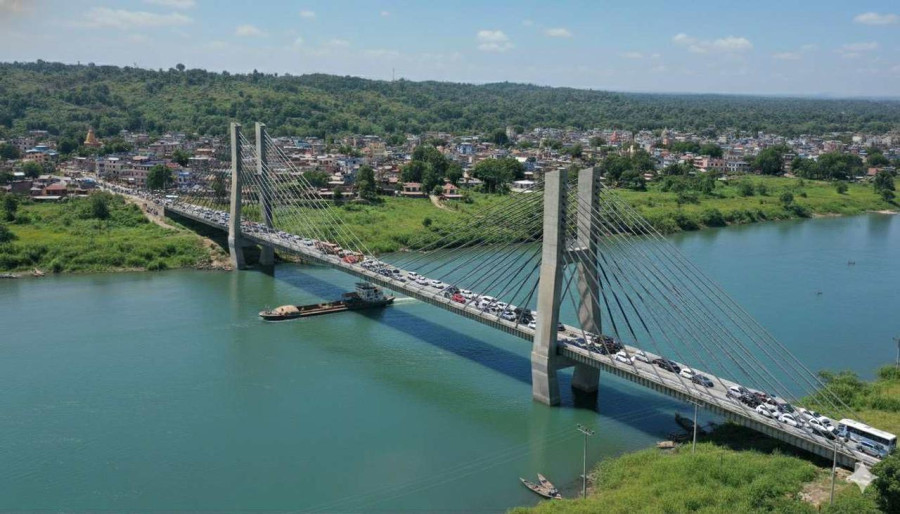
bookmark
Ramesh Kumar Paudel
Published at : December 1, 2025
Updated at : December 2, 2025 07:18
Chitwan
Construction of the long-awaited signature bridge over the Narayani river has finally begun a year and a half after the ceremonial groundbreaking of the ‘iconic bridge’.
Then prime minister Pushpa Kamal Dahal and minister for physical infrastructure and transport Raghubir Mahaseth performed the symbolic foundation-laying ceremony on May 14 last year at Narayanghat, but work did not commence as expected.
The government had signed a contract with Tundi Construction on May 23, 2023 to complete the bridge within four years, with the first year allocated for design and the remaining three for construction. However, the revised design of the bridge was only approved in November, 2024, paving the way for physical construction.
“We have started field work. Because the design approval process was delayed, the overall construction period will extend by about one and a half years,” said Manjil Mishra, project manager of the construction company. As per the project contract, the detailed design of the bridge was to be approved by May 2024.
Mishra claimed that the company completed the initial concept within 90 days and the full design within nine months as stipulated. “The government was supposed to approve the design within three months, but it was rejected, so we had to prepare a second design,” he said.
“The flooding in September last year also made it necessary to modify the original plan,” said Mishra, adding that the bridge’s two towers will rise to a height of 53 metres. “The Civil Aviation Authority Nepal and the nearby airport must also approve the tower height. Moreover, because the bridge is being designed to allow the passage of water vessels, the Nepal Shipping Office has to clear it as well. There had been no such practice in Nepal before. Using models from India and Bangladesh, we have designed it to allow vessels of up to 2,000 tonnes,” Mishra said.
The clearance between the bridge deck and the river surface will remain 10 metres even during the monsoon, meaning water transport will be possible for around 330 days a year. The new bridge will sit nine metres above the existing Narayani bridge and will be about 2.5 metres taller than the old one.
The total length of the bridge is 420 metres, with a width of 12 metres, including a 7.5-metre carriageway and a three-metre-wide footpath. The estimated cost stands at Rs1.68 billion. Two large towers, spaced 220 metres apart, will stabilise the bridge with a system of cables.
“This is the first bridge in Nepal to use two towers and multiple cables. The Karnali bridge at Chisapani has only one tower,” Mishra said. “Some people call it a signature bridge, but technically, it is an iconic bridge.”
The construction of the existing Narayani bridge started in early 1980s and took nearly four years to complete. With the East-West Highway now expanded in many sections, the old bridge has become both narrow and outdated, causing persistent congestion. “We stationed 17 staff on site two years ago, waiting for design approval,” Mishra said. “Now that it has finally come through, there will be no further delay from our side. We will complete the fieldwork within three years.”
Narayan Lamichhane, chief of the Division Road Office in Bharatpur, said that the construction of the iconic bridge finally began. “Construction has begun and we will monitor it closely and push for its timely completion, as this bridge is crucial for both regional connectivity and future water transport,” said Lamichhane.
Ramesh Kumar Paudel
Ramesh Kumar Paudel is the Chitwan correspondent for Kantipur Publications.


Most Read from National

Government recommends ambassadors to India, US, China and 10 other countries
Balendra Shah UN speech: Full transcript of Nepal prime minister’s address to the 81st UN General Assembly
Heavy rains cut off key roads to Kathmandu
Families of missing foreign nationals want answers Nepal can’t give
The speech Nepal — and the world — had been waiting for
Editor's Picks

What triggered the Rasuwa flood? Scientists piece together a complex chain of events

The floods keep coming. Nepal keeps starting over

In a settlement destroyed by the Bhotekoshi flood, a disabled couple offer strangers the little they have

Nepal working on detailed assessment as Bhotekoshi flood reconstruction could cost up to $5 billion

Rabindra Dhant gave Nepal a reason to smile. Now his camp wants real action behind the praise
E-PAPER | September 29, 2026

×