Kailash-Manasarovar pilgrimage fuels Humla economy as tourist inflow surges
Hotels in Simkot, Hilsa and Nepalgunj report near-full occupancy as Indian pilgrims travel to Mount Kailash and Lake Manasarovar via Humla, generating jobs and local revenue. Pilgrims who have arrived in Simkot, the headquarters of Humla district, for a visit to Mount Kailash and Lake Manasarovar. Post Photo
At Hotel Bijaya in Simkot, the headquarters of Humla district, owner Bijay Lama and his staff have barely had a moment to spare.
The hotel has been hosting between 40 and 60 Indian pilgrims a day travelling to Mount Kailash and Lake Manasarovar in China’s Tibet Autonomous Region, keeping the business running at full capacity.
“It has only been a month since pilgrims started arriving, and the Kailash-Mansarovar pilgrimage season will continue for another three months,” Lama said. “Providing accommodation, meals and other services leaves us with almost no free time.”
The situation is similar at Hotel Potala, where owner Min Bahadur Tamang said rooms are almost exclusively occupied by Indian pilgrims.
“We have bookings through September,” Tamang said. “We are doing everything we can to keep our guests satisfied. We are accommodating up to 40 pilgrims a day with lodging and meals.”
Since the third week of May alone, his hotel has served nearly 800 visitors.
Unlike the pre-Covid-19 period, pilgrims no longer have to stay in tents, as tour operators are now distributing guests among hotels according to capacity. Before the pandemic, a shortage of rooms often forced operators to set up temporary camps.
All eight major hotels in Simkot are now fully occupied. According to Mim Lama, president of the Hotel Entrepreneurs’ Association, larger hotels are packed with Indian pilgrims, while smaller lodges are occupied by airline staff, trekking guides, tourism workers and other visitors.
He said investors have spent between Rs10 million and Rs50 million each on hotels such as Kailash, Manasarovar, Karnali, Humla and Alice in Simkot to cater to the growing pilgrimage market.
Across the border transit point of Hilsa, near the Chinese border, around a dozen hotels offering tourist facilities have also opened. Most charge a package rate of Rs3,500 per person for overnight accommodation with meals.
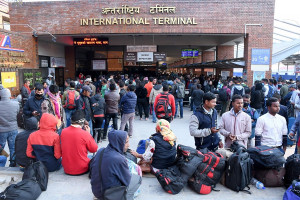
The influx of pilgrims has also filled hotels in Nepalgunj, the main gateway to Humla.
Hotels catering to Indian visitors in Nepalgunj and nearby Kohalpur are reporting near-full occupancy. Two four- and five-star hotels operate in each town, while around half a dozen three-star hotels are also experiencing heavy demand.
Keshab Neupane, regional executive director of Siddhartha Business Group of Hospitality, said his hotels are hosting between 80 and 100 Indian pilgrims every day.
“Bookings have already been confirmed until mid-August,” he said.
Hotels including Siddhartha, Soaltee Westend Premier, Hotel Starlight, Diamond Palace Lords Plaza, Hotel Batika, Hotel Sneha, Hotel City Palace, Cygnett Inn Krishna, and Kalpataru Plaza are operating at or near full capacity, according to Neupane.
Indian pilgrims began using the Hilsa border crossing in Humla after the devastating 2015 earthquake disrupted traditional pilgrimage routes.
The Tatopani border crossing in Sindhupalchok, which closed after the earthquake, has yet to reopen.
Alternatively, pilgrims can undertake the Mansarovar pilgrimage by road via Rasuwagadhi and Kerung, while some travel by air via Lhasa.
Tour operators say the Humla route is the fastest option. A pilgrimage through other routes in Nepal generally takes at least 10 days, whereas the Humla itinerary can be completed in seven.
According to the Association of Kailash Tour Operators Nepal (AKTON), most Indian pilgrims travel via Lucknow to Nepalgunj before heading to Humla.
“Lucknow is the nearest Indian airport to Nepal, and Nepalgunj is just 190 kilometres away, a journey of around three hours,” said AKTON president Bimal Naharki.
“Pilgrims then fly from Nepalgunj to Simkot and continue by helicopter to Hilsa on the Nepal-China border. From there, the 105-kilometre journey to Manasarovar can be completed in about four hours.”
Typically, pilgrims spend their first night in Nepalgunj, the second in Simkot, and the third at Darchen Base Camp on the shores of Lake Manasarovar after entering Tibet. On the fourth day, they travel to Mount Kailash, about 60 kilometres away, for pilgrimage and sightseeing.
“Those who are physically fit complete the 52-kilometre circumambulation of Mount Kailash,” said tourism entrepreneur Bijay Singh. “Those unable to walk remain at Darchen and return after viewing the mountain.”
Pilgrims then return to Simkot the following day, spend another night in Nepalgunj, and travel home, completing the journey in as little as seven days.
AKTON estimates that around 20,000 Indian pilgrims have booked the Kailash-Manasarovar pilgrimage this year.
Naharki said 35 tour operators are organising pilgrimage packages this season, with bookings still ongoing.
He said the Hilsa route has become the preferred option because it is shorter, less time-consuming, and comparatively economical, despite the challenging terrain and weather conditions.
The surge in visitors has significantly increased air traffic.
Summit Air has stationed three aircraft in Nepalgunj for the season, while Sita Air has deployed two and Tara Air one. During peak periods, airlines have operated up to 29 flights a day between Nepalgunj and Simkot, although around 10 daily flights are currently operating.
Mahendra Singh, chief of the Civil Aviation Authority of Nepal, Simkot branch, said six helicopters operated by Simrik, Fishtail, Mountain, Prabhu, and Kailash Air have also been stationed in Humla to ferry pilgrims between Simkot and Hilsa.
“Flights operate from 7 am until 5 pm,” he said. “The volume of aircraft has become so high that we experience air traffic congestion almost every day.”
According to the District Police Office, 5,014 pilgrims have travelled through Humla to Mount Kailash and Lake Manasarovar so far this season, including 2,487 women and 2,527 men.
Police said another 400 pilgrims are currently waiting in Simkot for their turn to continue the journey.
Indian pilgrims began arriving in large numbers from the third week of May, with between 80 and 300 people crossing through the Hilsa border every day, according to tourism entrepreneur Ranjit Lama.
The influx has created seasonal employment across the local economy.
Lama said the pilgrimage season has kept porters, trekking guides, airline staff, and helicopter crews busy.
Airlines have hired around 25 workers to load and unload baggage, while up to 50 porters find work each day at Simkot Airport.
Pilgrims usually spend one night in Simkot on the outbound journey and another on the return, while staying one night in Hilsa before entering China. The remaining three to four days of the pilgrimage are spent in Tibet.
Tourism entrepreneurs estimate that each pilgrim spends at least Rs10,500 during two nights in Simkot and one night in Hilsa.
Based on current visitor numbers, hotels alone have generated an estimated Rs52.6 million in business so far this season.
Hotels are also increasingly serving local food, including Marsi rice, buckwheat, and millet dishes, while sourcing fresh vegetables from nearby farms.
Lama said the increased demand has benefited local farmers.
“A single hotel now consumes up to 50 kilograms of fresh vegetables every day,” he said.
Locally grown vegetables are selling for between Rs100 and Rs200 per kilogram.
Many pilgrims also buy local produce to take home, including walnuts, beans, buckwheat, proso millet, foxtail millet, and Marsi rice.
“Once the apple harvest begins, we expect growers will also find a good market,” Lama said.
Walnuts currently sell for around Rs10 each, while other local agricultural products fetch between Rs150 and Rs200 per kilogram, with many visitors purchasing them as souvenirs before returning to India.Top of Form
Tourism entrepreneur Tshering Lama said the pilgrimage has also created seasonal jobs for local people.
Even porters carrying luggage from Simkot Airport to hotels are earning up to Rs3,000 a day.
“Porters charge between Rs100 and Rs300 per bag,” he said. “Handling the luggage of just 10 pilgrims can earn one porter at least Rs3,000 in a day.”
Both Simkot and Namkha rural municipalities are also generating revenue from the influx of foreign visitors.
Bijaya Bhandari, chair of Simkot Rural Municipality, said authorities charge each pilgrim Rs1,100 as a sanitation fee.
“So far, we have collected Rs5.5 million in revenue,” he said.
According to tourism entrepreneur Tenzin Norbu, most pilgrims travelling to Kailash-Manasarovar come from southern India, Gujarat, Maharashtra and northern India. The majority are over the age of 50.
“Most visitors are retired professionals or businesspeople,” Norbu said. “Many Indians believe they should visit Mount Kailash at least once in their lifetime. Retired people usually have both the financial means and the time to make the 10- to 15-day journey, so they make up the largest group of pilgrims.”
Many pilgrims said they had waited years to fulfil their spiritual ambition due to the Covid-19 pandemic.
Nitis Kumar Verma, 67, from Kanpur Dehat in the Indian state of Uttar Pradesh, returned to Nepalgunj via Humla last Monday after completing the pilgrimage.
“It had been my wish for a long time, but I couldn’t come because of the pandemic,” he said. “After visiting Kailash, I felt as though I had received the blessings of Lord Shiva himself. I believe the pilgrimage brings spiritual liberation.”
Another member of the same group, 66-year-old Manoj Patel from Agra, said the journey had been the greatest experience of his life.
“I hope Lord Bholenath fulfils our prayers,” he said. “The pilgrimage gave me a profound sense of spiritual joy.”
Norbu said Hindu scriptures describe Mount Kailash as the abode of Lord Shiva.
“The Kailash-Manasarovar pilgrimage is regarded as a symbol of spiritual purification, freedom from the burden of past deeds and ultimately salvation,” he said. “That is why many Indians believe they must undertake the pilgrimage at least once in their lifetime.”
He added that financial subsidies offered by several Indian state governments have also encouraged more people to make the journey.
According to Norbu, the state government of Telangana provides a subsidy of 25,000 Indian rupees for pilgrims, Karnataka offers 50,000 rupees, and Uttar Pradesh provides as much as 100,000 rupees.
AKTON said pilgrimage packages for Indian travellers cost between 250,000 and 300,000 Indian rupees.
For Nepali pilgrims, packages starting from Kathmandu cost around Rs150,000, according to tourism entrepreneur Sange Lama.
After crossing the border at Hilsa, pilgrims travel about 30 kilometres to Taklakot, also known as Purang, before continuing another 80 kilometres to Lake Manasarovar.
From there, they proceed roughly 50 kilometres to Darchen, the base camp for Mount Kailash, where pilgrims begin the sacred circuit around the 6,714-metre peak.
Mount Kailash, located near the borders of Nepal, India and China, is known for its distinctive pyramid-like shape.
The 53-kilometre circumambulation of the mountain takes between one and three days, depending on the pilgrim’s physical condition.
“Horses are available for those who want to complete the circuit in a single day,” Mim Lama said.
The route begins at Darchen and passes through Yamadwar, Dirapuk, Juthulpuk and Dolma La Pass before concluding back in Darchen.
Mount Kailash stands near Lake Manasarovar and Lake Rakshastal and is regarded as the source region of four of Asia’s major rivers: the Indus, Sutlej, Brahmaputra and Karnali.
Mim Lama said the mountain is widely believed never to have been climbed.
Religious campaigner Khimananda Sharma said Mount Kailash holds profound spiritual significance for followers of all faiths within the broader Omkara tradition.
Buddhists worship it as Thangka Rinpoche, Jains regard it as the mountain of deity, and Bon followers regard it as a pre-Buddhist sacred site. “While Hindus, Buddhists and Bon followers complete the circumambulation in a clockwise direction, Jains walk counter-clockwise,” he said.
The mountain receives heavy snowfall for about three months each winter, while strong winds are common during mid-March and mid-May.
The period from June to September is generally regarded as the best season for the pilgrimage.
Humla Chief District Officer Tek Kumar Regmi said the journey is not only a religious pilgrimage but also a test of endurance, discipline and resilience.
“As pilgrims travel through remote Himalayan settlements, changing weather and diverse landscapes, the journey becomes an exercise in self-discipline, restraint and devotion,” he said.
“At high altitude, amid cold temperatures, fatigue and physical hardship, many pilgrims rely on prayer, meditation and yoga to maintain both physical and mental balance.”
He described the Kailash-Manasarovar pilgrimage as both a spiritual and adventure journey because it passes through some of the Himalayas’ most challenging terrain.
“Pilgrims must remain vigilant at all times because adverse weather, altitude sickness and other health risks are common,” Regmi said.
He added that inadequate accommodation, limited food options suited to the harsh climate, poor telecommunications, unreliable internet access, shortages of drinking water and insufficient toilet facilities continue to pose challenges for visitors.
According to data, last year, around 6,500 Indian pilgrims travelled through Humla to visit Mount Kailash and Lake Manasarovar.




 24.59°C Kathmandu