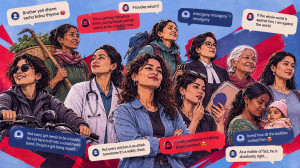
The 16 Days of Activism against Gender-Based Violence (GBV) began Wednesday, on the International Day for the Elimination of Violence against Women, and will end on December 10, International Human Rights Day. The government, NGOs, INGOs and women’s rights activists run awareness programmes and pledge to end violence against women and girls. According to the United Nations, globally, one in three women experience different forms of violence in their lifetime. While physical and sexual violence, harassment and domestic violence persist, technology-driven violence, including cyberbullying, online sexual harassment, trolling, hate speech and AI-generated deepfakes, has added another layer of problems for women around the world.
In Nepal, more than 16.5 million people (of them, 65.6 percent women) are active online. Social media has facilitated users to connect with friends, families and the world, but it has also become a medium to harm women and gender and sexual minorities. According to the Cyber Bureau, between 2023 and 2024, online crimes that targeted women and girls increased. In this period, 19,730 cybercrime cases were reported, of which 8,745 were filed by women. But these numbers could be just the tip of the iceberg; women, often due to social stigma, victim-blaming and fear, cannot make it to the police station.
Tackling technology-facilitated violence against women requires addressing the same patriarchal norms that normalise domestic and public abuse. But these norms are so deeply rooted that men who abuse women at home and in public spaces are emboldened to do so even in online spaces. The culture of impunity and lack of victim-centric approaches in GBV cases further encourage perpetrators to commit heinous crimes against women. For women enduring trauma from sexual violence and online harassment, cases that haven’t been settled yet, including those of survivors of sexual violence during the Maoist insurgency, Nirmala Panta and many more women and girls, discourage them from speaking up.
Then there is also the need to fix existing laws. Even as Nepal has laws that criminalise various forms of violence against women and the Ministry of Law, Justice and Parliamentary Affairs recently drafted a bill to amend the National Penal Code, 2017, legal experts and advocates call for additional revisions to address discrimination, clarify legal definitions and remove the statute of limitations for filing complaints of rape and other sexual offences. The Electronic Transactions Act, which was formulated almost 18 years ago, fails to address modern technological realities and emerging challenges. At present, all forms of online abuse targeting women and children are prosecuted under Section 47 of the ETA—a provision that is overly narrow and insufficient.
Indeed, the government drafted the bill to amend the National Penal Code, 2017, to tackle GBV. But it should also consider legal experts’ call to address the gaps. Awareness programmes and campaigns during the 16 Days of Activism bring some change, but they have never been enough. Often, programmes in Kathmandu never reach remote areas, making them centralised and symbolic. A 16-day window cannot dismantle the year-round violence that women experience at home, in public places and on online platforms. The current parliament has more women than ever before; this time, they must work differently and year-round to make our institutions responsive to GBV, empower women to speak out against harassment and violence and end impunity once and for all.




 7.12°C Kathmandu