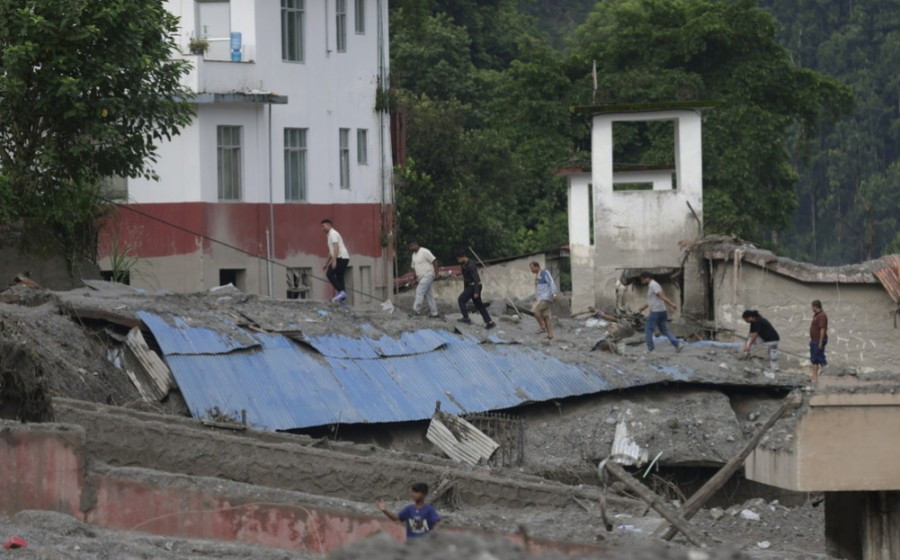
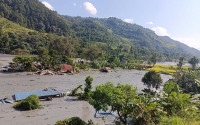
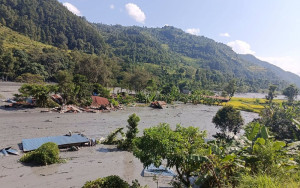
The damage from the August 26 flooding in the Bhotekoshi–Trishuli river corridor is immense. As the assessments unfold, an increasingly bleak picture is emerging. From vital infrastructure like roads, schools and health posts to private houses, thousands of properties were swept away by the disaster within minutes, not to mention the precious lives of hundreds.
An assessment by the National Disaster Risk Reduction and Management Authority paints a staggering picture, estimating that around 1.6 million people have been affected. Satellite mapping has identified 4,689 buildings within the affected zone along the Bhotekoshi–Trishuli corridor. The flood also destroyed or damaged critical infrastructure: 41 motorable bridges were swept away, and another four were damaged, while 40 kilometres of roads connecting with the northern border were completely washed away. Nineteen schools, with 6,901 students enrolled, have either been destroyed or damaged, while four health posts were destroyed and two others partially damaged.
The disaster has also dealt a severe blow to Nepal’s energy infrastructure. Twelve hydropower projects—some operational, others under construction—were damaged. Communications services were disrupted. Estimating the total loss will take time, but it is likely to run into several billion dollars.
Along with the search and rescue efforts, the government also faces the daunting task of restoring basic connectivity and then carrying out rehabilitation and reconstruction. Addressing the House of Representatives on Wednesday, Prime Minister Balendra Shah said work had begun on three Bailey bridges, while feasibility studies were underway for 20 more, as the government works to bring vital infrastructure and services back into operation.
In the House meeting, he said every individual would be catered for and that everyone would be taken care of during recovery and rehabilitation. This is a positive gesture from the prime minister. However, it demands huge resources. A country that depends heavily on domestic and foreign borrowing to fund most of its development activities does not have the capacity to bring everything back to normal on its own. Appealing to national and international donors is the only way out.
The support being generated for the Prime Minister’s Relief Fund is very encouraging. More than Rs7 billion, in addition to $6 million in dollar accounts, has been collected in just over a week. However, it is far from enough. If the early estimate by Govind Raj Pokharel, former vice-chairperson of the National Planning Commission and former chief executive officer of the National Reconstruction Authority, is anything to go by, rehabilitation and recovery from the disaster will cost several times more than the $6 billion spent on post-earthquake reconstruction.
Unlike after the earthquake, many flood victims do not have land on which to rebuild their homes. This will require the relocation of entire settlements and the realignment of highways and bridges, all of which will be costly.
The disaster was caused by an ice-rock avalanche, with global warming being a contributing factor. Nepal cannot be held responsible for the forces driving such climate-induced disasters. As Prime Minister Shah rightly said, Nepal will have to make a strong case before the international community about the disaster.
Supporting Nepal’s reconstruction and rehabilitation should not be seen simply as an act of generosity. It is a responsibility of the international community, particularly of countries that have contributed disproportionately to global warming. Nepal has contributed little to the climate crisis but is bearing its devastating consequences. It should therefore make a strong case for international support, while ensuring that the assistance it receives is used effectively and transparently to rebuild the lives and communities shattered by the disaster.




 24.82°C Kathmandu