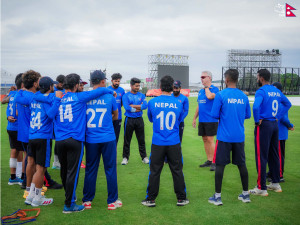
Transforming from underdogs to contenders, Nepal cricket now seeks tangible backing
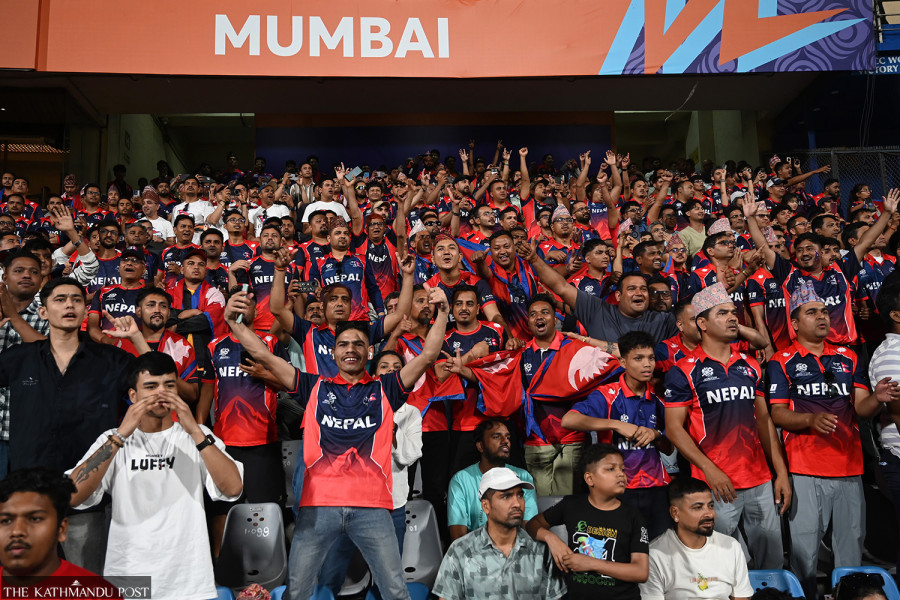
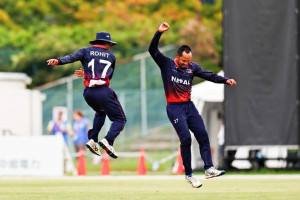
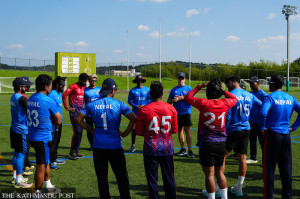
However, as the Rhinos look forward to becoming a major cricketing nation, fans’ support alone is not sufficient. Nepali fans celebrate during the match against Scotland at Wankhede stadium on Tuesday. Angad Dhakal/TKP
The rise of the Nepali men’s national cricket team at successive ICC events has transformed them from wide-eyed underdogs into formidable competitors.
Their fixture against the English cricket team at the T20 World Cup earlier this month was a contest that could have tilted either way. But it was not framed as a fairy-tale scare or an emotional overachievement. There were no ‘cardiac kids’ labels, no patronising applause for spirited resistance.
Instead, Nepal were assessed on tactical execution, composure, and game awareness, the language reserved for serious cricketing sides.
Now, as the world applauds without surprise, Nepal cricket stands at a different crossroads: acknowledged globally, yet still seeking the structural and practical backing required to sustain its ascent.
Relentless support from fans
Except during the games including the 12 Full Members of the ICC, it is not a casual scene to witness a large crowd in matches of the Associates.
However, when Nepal plays, the scenario is different. And it is not only the case when Nepal plays at home. Even when the Rhinos are touring outside the country, the turnout of Nepali fans on foreign soil makes the opponents, especially the hosts, envious.
Whether it is a friendly series, or the matches of the CWC League 2, or the T20 World Cup, the loyalty of Nepali fans have been tested many times over the last decade.
The turnout of the Nepali fans during the 2024 T20 World Cup co-hosted by the USA and the West Indies was a declaration that cricket in Nepal was the most popular sport of late, even defeating the long-dominated craze for football, a sport which has been affected by corruption and poor governance.
The similar craze, or even a bigger one, of Nepali cricket was witnessed in the 2026 ICC Men’s T20 World Cup underway in India, with Sri Lanka as co-hosts.
Nepal were the only team in the tournament to have been given a single venue—Mumbai’s Wankhede Stadium—for their group stage fixtures. And Mumbai was crowded with Nepalis for over 10 days, making the Mumbaikars, Indians and the world aware of the passion of Nepali cricket once again.
When Nepal played their first group stage fixture of the 2026 T20 World Cup against England on February 8, the total match attendance at Wankhede, as per the ICC, was 19,369. Almost a similar number of fans were at Wankhede for the matches against Italy on February 12, the West Indies on February 15 and Scotland on February 17.
And the Nepali fans turned out in large numbers up to the last match against Scotland despite three consecutive losses. “After our game against England, they started booking tickets and supported us to the last game,” Nepal’s skipper Rohit Kumar Paudel said during the post-match presentation after defeating Scotland on Tuesday. Paudel dedicated the win to the fans who kept on supporting them relentlessly irrespective of the results.
However, as the Rhinos look forward to becoming a major cricketing nation, fans’ support alone is not sufficient.
‘Exposure, exposure, exposure’
Cricket is not a sport that is as widely popular globally as are football and volleyball. However, the scenario is changing.
The emergence of Italy, a footballing nation that still does not have a decent ground for cricket, in the 2026 T20 World Cup is an example. The way Japan’s under-age teams are performing is another example.
And as more new teams have started to play cricket in a more professional manner, they are also demanding similar treatment as the Full Members.
“I think for us, we just need more exposure to this, playing the bigger teams. More fixtures against them is only going to make us better,” Scotland skipper Richie Berrinton said after the loss against Nepal. “The pleasing thing for me is we’ve shown once again that we can compete at that level.”
“...for the teams ranked from 15 to 25 to continue to grow, 26, I think we need to continue to play more cricket,” said John Manenti of Italy after the loss against England.
And the call for more exposure is high for Nepal as well. “When we come in the next World Cup, I think at least in a year we have to play two series against some good test playing countries so that we can see where we stand against them because playing against best players in the world will show your capabilities, your abilities,” Paudel said after the win over Scotland. “So I think we have to have that regular series against them.”
And better exposure for the Associates is something cricket greats also deem necessary.
Darren Sammy, in the pre-match conference before facing Nepal, had stressed that “it was the responsibility of Test nations to play with the Associates outside the ICC events, so that they can aid in overall growth of cricket.”
And when Nepal ended their 2026 T20 World Cup campaign on a high after defeating Scotland by seven wickets, Ravichandran Ashwin, India’s second all-time leading wicket-taker in Tests with 537 wickets, posted on X, “Nepal have shown enough to get some bilaterals with full member teams. Their players deserve a lot more in terms of exposure and guidance.”
Further, to make Ashwin’s post more interesting, one of India’s all-time best all-rounders Ravindra Jadeja commented, “Yeh ashinfo 3 test match series???”
Many more legends of the game are calling for Nepal’s fixtures with Full Members. And the fans are now waiting for it to happen.
Nayak Paudel covers sports for The Kathmandu Post. He previously worked at the Post (2018–19) and spent over five years at The Rising Nepal. His reporting spans crime, health, education, and social issues.




 28.31°C Kathmandu