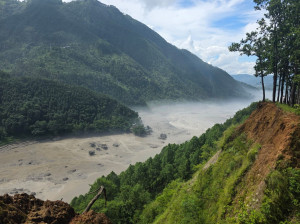
The Bhotekoshi flood exposed a new reality of mountain risk: the greatest threats facing the Himalayas are increasingly not isolated hazards, but interacting hazards whose impacts can multiply rapidly across regions and national boundaries.
Nepal’s message to the world at the upcoming United Nations General Assembly should therefore be a call to build a safer and more resilient Himalayan region through international cooperation, scientific collaboration, shared responsibility and hydro-diplomacy.
In today’s rapidly changing mountain environment, glacier instability, landslides, debris flows, extreme precipitation, flooding, infrastructure disruption, and emergency response challenges can combine within minutes. A local event can quickly become a national or even regional crisis.
In mountain disasters, minutes, not hours, determine who survives. Traditional approaches that assess hazards individually are no longer sufficient. The Himalayas must be viewed as an interconnected system where environmental, social, economic and infrastructure risks overlap and interact. Understanding these connections is essential for protecting lives, sustaining development, and strengthening resilience.
The disaster also demonstrated that historical experience alone is no longer an adequate guide for future risk. As climate uncertainty increases, hazard patterns are becoming more complex and less predictable. Governments, infrastructure owners, and communities must adapt accordingly.
Yet amid immense loss, Nepal demonstrated remarkable strength. The Nepali Army, Armed Police Force, Nepal Police, local governments, technical professionals, volunteers and international partners responded under exceptionally difficult conditions. Their efforts saved lives and reflected the resilience, courage, and determination of the Nepali people. Resilience must now be coupled with transformation.
Rivers, watersheds, ecosystems, and mountain processes are interconnected. Risk management must become equally interconnected. The Himalayan region urgently needs a new framework for cooperation grounded in hydro-diplomacy.
Hydro-diplomacy is not simply about water management. It is a framework for public safety, sustainable development, climate adaptation, and regional cooperation and stability. Effective management of shared river systems depends on trust, transparency, communication, and collaboration among nations.
Future transboundary agreements should include real-time monitoring, data sharing, joint risk assessments, coordinated emergency preparedness, and effective communication protocols. Resilience depends on cooperation before disaster strikes, not after.
The recent dialogue between Nepal and China on hazard monitoring and information sharing is encouraging. It should become the foundation for broader regional cooperation throughout the Himalayan region.
Nepal’s message to the world at the UNGA should be clear, constructive and forward-looking. Climate justice should mean more than financial assistance. It should mean meaningful cooperation through scientific partnerships, technology transfer, capacity building, resilient infrastructure investment, and improved access to climate and hazard information.
The most effective response to climate risk is not isolation, but collaboration. Global experience consistently demonstrates that resilience is built through cooperation. Open data sharing, collaborative research, joint emergency planning, and transparent communication strengthen both public safety and regional stability. Conversely, fragmented decision-making, restricted information exchange, and inappropriate messaging amplify disaster impacts, weaken resilience, and diminish cooperation.
The Himalayas are not solely Nepal’s concern. They are among the world’s most important mountain systems, supporting water security, energy, ecosystems, agriculture, and livelihoods for hundreds of millions of people. A safer Himalaya is therefore a global interest.
The path forward is challenging but achievable.
First, Nepal should institutionalise watershed-scale assessments that evaluate cascading hazards and interconnected risks. Major infrastructure projects must consider not only individual hazards but also how hazards may interact under changing climatic conditions.
Second, Nepal should establish a National Mountain Risk Management Framework integrating climate adaptation, geohazard assessment, infrastructure governance, emergency management, and community resilience.
Third, dam safety and critical infrastructure governance should be strengthened through risk-informed regulation, independent review, lifecycle risk management, and robust emergency preparedness planning aligned with international best practices.
Fourth, emergency preparedness must become a national priority. Like Japan, communities living downstream of major infrastructure and hazard-prone areas should clearly understand warning systems, evacuation zones, emergency procedures, and escape routes.
Fifth, Nepal should foster a national culture of risk awareness and preparedness. Communities must become active partners in resilience building. Long-term resilience begins with education. Disaster risk reduction, climate adaptation, emergency management, and hazard communication should become integral components of schools, universities, professional training, and community development programs.
Finally, Nepal should harness the expertise of its global professional community. Nepali engineers, scientists, and emergency management professionals working around the world represent an invaluable national resource that should be fully channelled and integrated into Nepal’s resilience policy.




 15.26°C Kathmandu