Bridges gone, roads damaged, villages cut off from relief
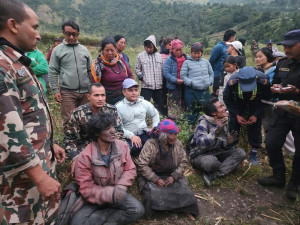
Helicopters and temporary crossings are helping deliver food and other essentials to cut-off communities in Rasuwa and Nuwakot, but officials say restoring roads and bridges must be an immediate priority.Residents affected by the Bhotekoshi floods carry relief supplies distributed near Trishuli Bazar in Nuwakot to a local holding centre. RSS
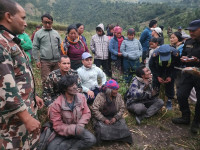
In Tarsama, ward 1 of Gosainkunda Rural Municipality in Rasuwa, relief workers on Tuesday measured out rice and lentils into small containers before distributing them to flood-displaced families.
The unusual method was necessary because the road connecting the ward to Dhunche, the district headquarters, remains cut off after the August 26 Bhotekoshi flood. Relief supplies have reached Dhunche, but getting them to remote settlements remains difficult.
“We still can’t transport relief supplies by road, so we measured out rice and lentils into containers for distribution in Tarsama on Tuesday,” said Urken Chhiring Lama, chairman of ward 1. “Supplies brought by helicopter are not coming in small sacks, so we have to measure them out before distributing them. There is relief in Dhunche, but people in the villages are compelled to manage with whatever they can find.”
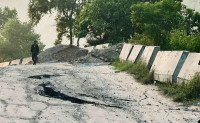
In neighbouring Amachhodingmo Rural Municipality, all five wards have been cut off from the road network after the flood washed away sections of the Syaphrubesi-Goljung-Gatlang-Chilime road.
Since the disaster, settlements around Haku, Nesing, Gatlang, Goljung and Chilime have had no regular road access. Relief supplies from Dhunche have to be flown in, while local officials say restoring road connections should be the priority if life is to return to normal.
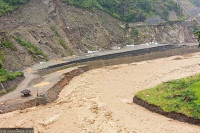
The flood also destroyed a Bailey bridge and a suspension bridge connecting Hakubeshi to Dhunche, leaving the settlement isolated.
“We are still in a situation similar to a blockade,” said Sang Lama Tamang, ward 1 chair of Amachhodingmo. “Because we have to rely on helicopters to transport supplies, we have been distributing roughly one sack of rice per household.”
Helicopters and drones have provided some relief, with support from the government and the World Food Programme. But local officials say such deliveries cannot replace road transport.
“Until vehicles can carry supplies by road, shortages will continue,” Lama said. “We have asked the federal and provincial governments to allocate the funds needed to rebuild the roads and bridges.”
The local government has started building a ropeway across the Trishuli River at Hakubeshi after both bridges were swept away. Once completed, it will allow residents to cross the river and reach Dhunche more easily, although it is only a temporary solution.
“We will be able to connect Hakubeshi with Dhunche after the ropeway is completed,” Lama said. “People will at least be able to cross between the two sides.”
The municipality is also looking for land where displaced families can be housed temporarily. One option is the public land in ward 3 of Parbatikunda Rural Municipality, but officials say the area is too cold and are looking at other sites with technical teams.
For some displaced residents, even temporary accommodation remains uncertain.
Kippa Nagarkoti, a member of ward 2 council of Gosainkunda Rural Municipality, is staying at Mustang Monastery in Kathmandu. She is a permanent resident of Timure, a settlement badly affected by the flood.
“Timure remains deserted since the floods. We don’t know when people can return or where they will live,” she said.
Gosainkunda chairperson Kaisang Norbu Tamang said roads had reopened in some areas around Rasuwa, but delivering relief to more remote settlements remained difficult.
“The first priority has to be restoring the road network. Other work can follow,” he said.
Officials are considering land around Dhunche and Thulo Syabru for temporary settlements. But they say any relocation site must be both safe and economically viable for families who may have to live there for an extended period.
Further south, some communities in Uttargaya Rural Municipality have regained easier access after vehicles from Dhading began reaching settlements such as Gogane, Tiru, Dadagaun and Thulogaun.
“Food and other supplies can now reach these areas,” said Uttargaya vice-chairperson Chameli Gurung. “But our concern now is how to move people staying in shelters to safer locations. They cannot remain in shelters for a long time.”
Some 618 private houses in Uttargaya have been damaged, according to local officials. The municipality has begun looking for land for temporary housing in ward 5.
In Kalika Rural Municipality, road repairs have also eased the situation in the flood-hit Gapchet area.
“Things are gradually becoming easier now that vehicles can reach the area,” said Dawa Tamang, chairman of ward 1. Relief supplies have reached 72 families, but he said displaced residents still needed accommodation.
Bridges are now the lifeline
The need for permanent access is particularly acute in Nuwakot, where the Bhotekoshi flood affected Bidur, Belkotgadhi, Kispang and Tarkeshwar municipalities.
Several wards of Bidur were among the worst affected. About 1,900 houses in Nuwakot were either partially or completely damaged, while 1,499 displaced people are staying in shelters in Bidur and Belkotgadhi.
Local officials say there is currently no major shortage of food or medicine at the shelters. But they say restoring transport links has become more urgent.
Prabha Bogati, deputy mayor of Bidur municipality, said relief distribution has become easier, but the destruction of bridges across the Trishuli River is making everyday life difficult.
“Daily life has not returned to normal in wards 3, 6, 7, 8, 9, 12 and 23,” she said. “Bailey bridges now need to be prioritised. The ropeway is helping people cross the river, but they have to wait for a long time. Without a bridge, it is difficult to carry out even basic daily activities.”
The municipality has begun planning for rehabilitation. Technical teams from Kathmandu have also surveyed vacant public land that could be used to house them temporarily. Officials are also looking at land belonging to the Nepal Electricity Authority and other government agencies for temporary housing.
The Bhotekoshi flood damaged about 40 kilometres of roads and swept away 41 motorable bridges, according to officials.
Supplies are available, but access remains a problem
Relief collection centres in Rasuwa and Nuwakot have received food, medicine and other supplies from the government, aid organisations and donors. Local representatives say the issue is increasingly one of distribution rather than a lack of supplies.
According to the National Disaster Risk Reduction and Management Authority (NDRRMA), Nuwakot had received 589,000 kilograms of rice, of which 193,000 kilograms had been distributed. Rasuwa had received 99,900 kilograms, with 78,910 kilograms distributed, according to the authority’s latest figures.
Relief efforts have also included pulses, cooking oil, salt, oral rehydration solution, tents, blankets, mattresses, clothing and footwear. Medical supplies distributed in Nuwakot included antibiotics, medicines for hypertension and diabetes, and face masks.
The authority has also sent generators to help restore electricity in areas where the flood damaged power infrastructure. Seven generators have been sent to Nuwakot and two to Rasuwa, while health teams have arranged free ambulance services for 26 people requiring urgent treatment.
For communities still cut off from the road network, however, relief supplies in district headquarters and collection centres offer only a partial solution.
As local officials across the two districts are finding, helicopters and temporary crossings can keep people supplied for a while.




 18.17°C Kathmandu