



 16.01°C Kathmandu
Thu, Oct 8, 2026
Politics
Former President Bhandari returns to UML under ex-PM Oli
Her return as the party’s No. 2 has intensified the UML’s leadership struggle and revived debate over a former head of state re-entering active politics.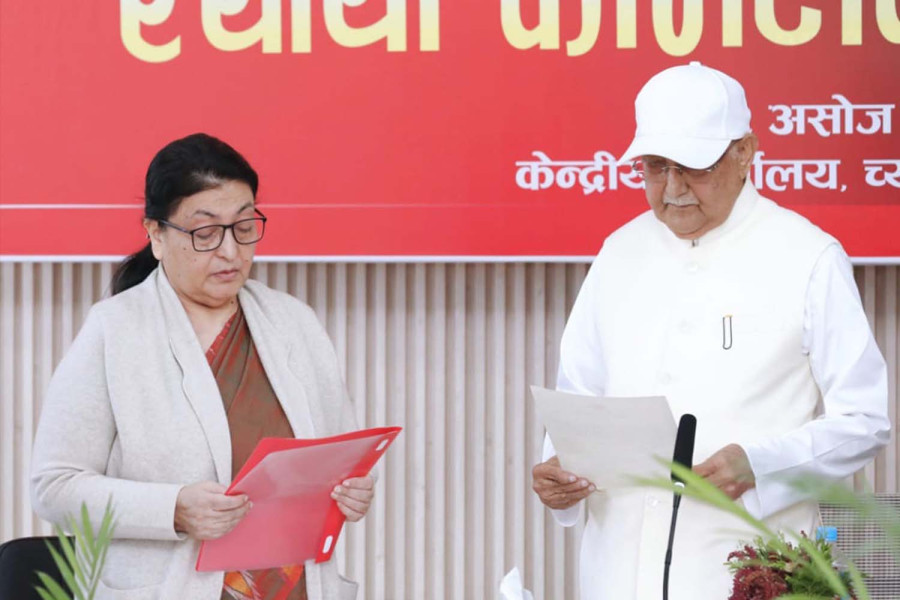
bookmark
Ganga BC
Published at : October 8, 2026
Updated at : October 8, 2026 21:04
Kathmandu
Former President Bidya Devi Bhandari has officially returned to active politics in the CPN-UML on Thursday, 11 years after she left party responsibilities to become head of state.
The UML central committee last month nominated Bhandari as a senior leader, putting her in second place after party chair and former prime minister KP Sharma Oli. The party created the position by invoking a statutory provision for removing obstacles, even though its existing statute does not recognise a senior leader post.
Bhandari served as president for two consecutive terms, from October 2015 to March 2018 and from March 2018 to March 2023. Before becoming the country’s President, she was a UML vice-chair. She later remained active through the Madan Bhandari Foundation, established in memory of her late husband.
Political analysts have expressed grave concern that her return in active politics threatens to draw decisions made during her tenure as head of state into partisan controversy. They argue that the country’s former presidents should not return to active party politics.
At Thursday’s Standing Committee meeting, UML chief Oli administered the oath to Bhandari. She was seated to Oli’s right, while party vice-chair Ram Bahadur Thapa sat on his left. General Secretary Shankar Pokharel, who previously sat beside Oli in Secretariat meetings, was seated behind vice-chairs Bishnu Paudel and Gokarna Bista on Thursday. An office bearers’ meeting held at Oli’s residence in Gundu in May had decided to grant party membership to Bhandari.
Ahead of the latest central committee meeting, Pokharel’s distance from Oli had grown after he prepared a report advocating restructuring the party and its leadership.
A party leader said Oli could be using Bhandari’s return to send a message to leaders such as Paudel, Pokharel, Gokarna Bista, and Raghu Panta, all of whom had called for leadership restructuring. “Chairman Oli has brought Bidya Bhandari forward to send a message to Bishnu Paudel and Shankar Pokharel. He may possibly project Bhandari for UML’s future leadership,” the leader said.
Bhandari’s return had already begun reshaping the party’s internal power struggle. She returned at a time when Oli was under pressure to reconsider his leadership after the UML’s poor showing in the March 5 parliamentary election. The party won seven first-past-the-post seats and 18 proportional-representation seats, leaving it with just 25 seats in the House of Representatives. The UML was the second-largest party in the previous lower house, with 78 seats.
Bhandari says she has returned without personal ambition. Speaking in Butwal on September 29, she said she had been uncertain about accepting a role but eventually agreed after repeated requests from party leaders.
“There was uncertainty about whether I should take responsibility now, but when people from all sides began inviting me in recognition of my seniority and past contribution, I accepted,” said Bhandari. “I have returned to take responsibility again to build the party and the country. After reaching the highest constitutional post, I have no desire for any position or personal interest.”
Since returning to active politics, she has begun calling for a candid review of the party leadership, its working style, and the communist movement.
Bhandari’s return, however, has renewed an ethical debate over the presidency. Hari Sharma, a political scientist and former adviser to President Ram Baran Yadav, said the constitution does not expressly prohibit a former President from joining active politics. But he said the issue went beyond legality.
“The constitution does not stop a former president from active party politics. This is a moral question. The presidency is an impartial institution. It is defined as the highest institution created by the constitution and a symbol of the republic,” said Sharma. “A person reaches that position as someone who does not belong to any political party. It is better for someone who has held that office to remain outside active party politics.”
Sharma said decisions made by a President while in office could be judged differently once the former office-holder became an active partisan. “The presidency should be kept above political merits and demerits. Therefore, the presidency we have imagined should remain outside parties,” he said, noting that former presidents in neighbouring India had not returned to active politics, unlike former executive presidents in some other countries.
Along with former president Bhandari, former Vice-president Nanda Bahadur Pun is also active in politics. He has reunited with his former party leaders in the Nepali Communist Party, which was formed through the merger of several leftist parties, including his former Maoist party.
Constitutional expert Bipin Adhikari said the country’s governance system is not fully defined in the constitution and argued that former presidents should uphold the dignity of the office they once held.
“Much of the governance system is not laid out in the constitution. The protocol of national honour places the president at the highest level. Therefore, it is not customary for a president to act below the dignity of the office,” he said. “While in office, the president receives information related to the administration, army, government, security, and matters of confidentiality. A person who has held such a highly dignified and respected position joining party politics again is not compatible with the principle.”
UML leader Binda Pandey, however, said Bhandari’s placement in the second rank would not fundamentally change party life. She questioned whether the party was focusing on public concerns rather than positions.
“The main question is how many issues affecting the people have we raised and will raise. Women’s leadership cannot be developed merely by bringing women into party committees. But people are looking for results, while we are preoccupied with positions,” said Pandey.
The latest decision reverses the UML’s position from last year. In July 2025, the central committee had decided that the former President Bhandari should not return to party politics and should instead remain a head of state, serving as an adviser and guardian. The party argued that the constitution did not envisage a former president returning to party affiliation.
Bhandari challenged that position, saying that no one could take away her party membership. She argued the constitution protected her right to political participation and that no law or party rule expressly barred her return.
The UML restored her membership in May this year after talks with Oli. The central committee then elevated her to senior leader, ending a dispute that began when her membership was put on hold and she was excluded from the 2025 statute convention of the party.
Her formal elevation also comes after a change in the UML’s leadership rules. The party removed the 70-year age bar and two-term limit for top leadership positions in 2025, clearing the way for Oli to seek another term. Internal pressure for restructuring intensified after the party’s electoral setback.
Under the amended provision announced this week, the senior leader will rank second after the chair and attend meetings of the central committee, politburo, standing committee and secretariat. The senior leader is also expected to assist the chair, contribute to timely party decisions, defend the party’s principles, policies, programmes, and reputation, and carry out assignments given by the party’s major bodies.
The arrangement is expected to be put before the next statute convention. Bhandari’s return therefore gives her a formal platform inside the UML while leaving unresolved the question of whether a head of state should return to partisan politics—and whether her elevation is the beginning of another leadership contest.
Most Read from Politics
At UN, Prime Minister Balendra Shah to make Nepal’s case for climate justice
In New York, Foreign Minister Khanal introduces Nepal’s new political order
Home Minister Sudan Gurung to visit India next week
From the Himalayas to the islands, Nepal calls for a united climate response
Uproar in Nepal parliament over former chief justice’s unexplained detention
Editor's Picks
What triggered the Rasuwa flood? Scientists piece together a complex chain of events
The floods keep coming. Nepal keeps starting over
In a settlement destroyed by the Bhotekoshi flood, a disabled couple offer strangers the little they have
Nepal working on detailed assessment as Bhotekoshi flood reconstruction could cost up to $5 billion
Rabindra Dhant gave Nepal a reason to smile. Now his camp wants real action behind the praise
E-PAPER | October 08, 2026

×