Thapa says Congress must bridge political divides and rebuild public trust
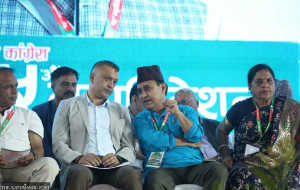
Congress president calls for a more open party and Parliament, criticises the revolving door of power and urges cooperation to address Nepal’s economic and political challenges. Nepal Photo Library
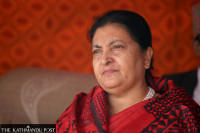
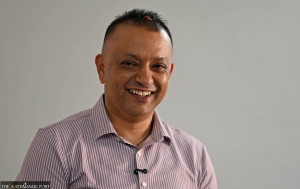
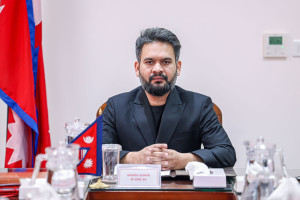
Nepali Congress president Gagan Thapa has called on his party to become a bridge between Nepal’s democratic past and its future, saying it must connect generations, respond to citizens’ concerns and restore public faith in politics.
Addressing the inaugural ceremony of the Congress’s 15th general convention in Kathmandu on Sunday, Thapa said the party should serve as a bridge for democracy, prosperity, justice and trust.
“Congress wants democracy and diversity. We must be able to deliver to citizens and protect their dignity,” he said. “We must become a bridge between people’s needs and the circumstances they face, between history and possibility. If the bridge collapses, trust collapses.”
Thapa said the central question for the Congress was not when it was founded, but whether it could answer the questions facing citizens today.
“A party is not new or old based on when it was established,” he said. “The party that can answer citizens’ questions is the new one. The party that can work with citizens is the new one.”
He said the Congress must change its working methods, language, thinking and political culture while remaining rooted in the values associated with founding leaders BP Koirala and Ganesh Man Singh.
“Our spirit is the spirit of BP Koirala and Ganesh Man,” Thapa said. “Their political values are what we are carrying forward. But our style, language, actions, way of thinking, customs and culture must change.”
Thapa said the party needed to bring together the experience of older generations and the energy of younger people. It should be prepared to lose elections rather than compromise its principles, he said.
“We must be able to say that we are prepared to lose not one but five elections for the sake of our principles,” he said.
‘We failed citizens’
Thapa said the repeated return of the same politicians to positions of power had fuelled public frustration with politics.
He described Nepal’s political system as resembling a “game of musical chairs”, with former prime ministers seeking to become prime minister again and ministers repeatedly returning to government.
This, he said, had contributed to a perception that all parties and politicians were the same and equally ineffective, helping to fuel the anger that erupted in the September 8-9 protests last year.
Thapa said both the state’s suppression of protesters on September 8 and the criminal violence that followed on September 9 were wrong.
He said political parties could not dismiss the public’s dissatisfaction simply by pointing to the current government. The grievances had accumulated over years, he said.
“Citizens had legitimate aspirations. We failed them,” Thapa said.
He said the Congress should not define itself merely through its organisation, party offices or electoral machinery. Its relevance would depend on whether it could answer public questions.
Thapa also addressed former Congress president Sher Bahadur Deuba, who did not attend the convention despite the party leaving a seat for him at the opening ceremony.
He said respect for a former leader should not be measured by how many times party leaders visited his residence or offered formal gestures of respect, but by whether the party had become stronger and broader under his leadership.
“We kept a chair empty for Sher Bahadur Deuba. We thought he would come to inaugurate the convention,” Thapa said. “But respect for Sher Bahadur Deuba is not shown by how many times we go to his door and salute him. It should be judged by whether the party he worked for became stronger and broader.”
Thapa said Congress members who had left the party should not be regarded simply as former colleagues. He said the party would seek to reconnect with them while asking voters to judge the new leadership by its conduct and performance.
Responding to remarks by Rastriya Swatantra Party chairman Rabi Lamichhane that some Congress supporters had voted for the RSP, Thapa said Congress had also contributed to the political training of many figures now in the ruling party.
He claimed that 40 to 50 people in Parliament had received political training through the Congress, adding that many RSP leaders had previously stood on Congress platforms.
“We did not send only voters; if you look inside Parliament, we trained and sent 40 to 50 people,” Thapa said. “From the RSP’s vice-president downwards, there are many friends we trained who once stood on the Congress stage applauding.”
Thapa said the Congress had no permanent enemies and should cooperate with other parties on issues of national importance, even while competing with them electorally.
“We can compete in elections,” he said. “But saying that we are simply the opposition or that they are the government will not solve our problems. We need cooperation.”
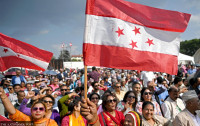
Thapa also explained the decision to hold the convention at Khulamanch, or Tundikhel, a venue associated with major political movements including the 1990 and 2006-07 democratic movements and the peace process.
He said Nepal needed more “open grounds” for political and social dialogue, including within Parliament and the Congress itself.
“Parliament also needs an open ground,” he said, arguing that the prime minister should appear before lawmakers and respect the institution that elected him.
He said similar spaces were needed for dialogue between the state and citizens, among different communities and within political parties, where members could question their leaders without fear of expulsion or intimidation.
Thapa also warned against placing the blame for the government’s first six months entirely on domestic factors. Nepal, he said, must consider the impact of global political and economic changes, including rising protectionism, climate change, automation and artificial intelligence.
“What will AI and automation do to our country? Where have we discussed this? Has it been discussed in Parliament?” he asked.
Thapa said the Congress must therefore look beyond the immediate political contest and prepare for changes that could reshape Nepal’s economy and society over the coming years.




 14.82°C Kathmandu