Japan cites privacy in withholding details on Nepal’s envoy nominee
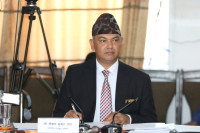
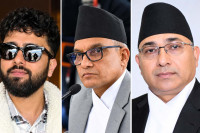
The parliamentary hearing committee is seeking clarification on Jigyan Kumar Thapa’s Japanese permanent residency and possible links to government-funded institutions, but Tokyo says it cannot disclose personal information. Jigyan Kumar Thapa, Nepal’s ambassador-designate to Japan, during his parliamentary confirmation hearing. Nepal Photo Library
The parliamentary hearing committee is preparing to convene a meeting to decide on the nomination of Jigyan Kumar Thapa as Nepal’s ambassador to Japan. Under the law, the committee must complete the hearing process within 45 days of receiving a nomination. It has until November 5 to decide on Thapa. If it fails to send its decision within that period, there will be no legal obstacle to his appointment.
Committee secretary Tul Bahadur Kandel said a meeting had been proposed for Monday to discuss and decide on Thapa’s nomination.
Questions were raised during the hearing about whether Thapa holds permanent residency in Japan. The committee subsequently wrote twice to the Ministry of Foreign Affairs, seeking details from the Japanese government. The ministry then instructed Nepal’s embassy in Tokyo to establish whether Thapa had renounced his Japanese permanent residency and whether he had received payments or benefits from Japanese government funds.
Japanese authorities, however, said they could not provide the information because it concerned an individual’s privacy, according to foreign ministry officials. “We learnt, while following up with ministry officials, that Japan had responded that it could not disclose personal information,” committee chair Bodh Narayan Shrestha told Kantipur. “We have asked the ministry to send us a written response on the matter.”
The committee first wrote to the foreign ministry on October 11, seeking details about Thapa’s financial obligations and permanent residency status. After the ministry’s request to Nepal’s embassy in Japan went unanswered, the committee sent a second letter to the ministry on October 26, asking it to follow up with the embassy. The ministry also sent a second letter to the embassy that day, seeking information about Thapa’s involvement with Japanese government agencies.
In the personal details he submitted to the parliamentary hearing committee and the foreign ministry, Thapa listed his work with organisations including the Kanagawa International Foundation (KIF) and the Japan International Cooperation Agency. He also acknowledged working with Japanese government ministries, universities and other organisations.
“Since it has been decided to conduct further investigations into whether he received any appointment from Japanese government agencies in connection with these responsibilities, and whether he received remuneration or other benefits from public funds, the committee requests that documents clarifying these matters be sought from the relevant official agencies of the Japanese government and made available to the committee,” the hearing committee said in its letter to the foreign ministry.
The ministry forwarded the request to Nepal’s embassy in Japan, instructing it to obtain the documents from the relevant Japanese government agencies and send them to Kathmandu as soon as possible.
A foreign ministry official confirmed that the committee had been informed that Japan would not provide details about Thapa’s financial dealings, family and personal circumstances. The official said the controversy had arisen partly because Thapa had been nominated as ambassador to the very country whose permanent residency status and official records were under scrutiny.
The official added that the lack of a response despite two rounds of correspondence with Japan had put Nepal in a diplomatically difficult position.
“We had doubts about whether the Japanese government would share an individual’s personal details with another country,” the official said. “There was also the question of whether the Nepal government itself would readily share the personal information of a foreign national with another country.”
The Cabinet proposed ambassadors for 13 countries on September 18. The Office of the Prime Minister and Council of Ministers registered their names with the parliamentary hearing committee on September 23.
Under Rule 26(2) of the Federal Parliament Joint Meeting and Committee (Operation) Rules, 2024, the committee must conduct hearings on the proposed nominees and send its decision to the relevant authority within 45 days of receiving the names. The rule states that if the committee fails to communicate its decision within that period, there will be no obstacle to the appointment of the nominees to the proposed positions.
If the committee does not decide on Thapa’s nomination by November 5, the appointment process could therefore proceed under the rules.
Committee chair Shrestha said the nomination had also raised questions about a potential conflict of interest. The directive governing ambassadorial appointments states that candidates must not hold permanent or temporary residency permits, or enjoy residency-related facilities, in a foreign country. It also requires that they have no conflicting interests in the country to which they are appointed.
Shrestha said the delay stemmed from the government’s failure to carry out adequate background checks before recommending candidates.
“The government appears not to have properly examined the background of the person it nominated,” he said.
Shrestha said the committee would not clear the way for Thapa’s automatic appointment simply by allowing the deadline to pass.
“The parliamentary hearing committee is sovereign in itself, and there is agreement among all members that it must exercise its authority,” he said. “We will make a decision, either to reject or endorse the nomination, within 45 days.”
The committee had suspended its meeting on October 14 after Thapa’s nomination was put to a vote. The meeting was adjourned after lawmakers from the ruling Rastriya Swatantra Party argued that his nomination should be rejected and that the meeting should be suspended.
That day, the committee rejected two of the 13 nominees, Giri Bahadur Sunar, proposed as ambassador to Saudi Arabia, and Chudamani Kharel, proposed for Malaysia. The other 10 nominees were endorsed.
A senior foreign ministry source claimed that Speaker DP Aryal had recommended Thapa’s name for the ambassadorship. According to the source, concerns had been raised at the time that appointing Thapa to Japan could trigger questions about a conflict of interest and his permanent residency status. The source said the government had nevertheless proceeded with the nomination under pressure from the Speaker.
A member of the hearing committee said Aryal had also held several discussions with committee chair Shrestha and Kabindra Burlakoti, the RSP’s chief whip and a committee member, as the panel prepared to decide on Thapa’s nomination.
The member said Thapa had been asked to withdraw his name after the controversy emerged but had refused to do so.
Speaking to Kantipur, Thapa confirmed that the committee had asked him to consider withdrawing his nomination.
During his hearing, Thapa said he had renounced his Japanese permanent residency in March to become Nepal’s ambassador to Japan. His wife and sons, however, continue to hold Japanese permanent residency.
The foreign ministry has informally conveyed to the committee the response received through Nepal’s embassy in Japan. The committee is preparing to call a meeting and take a decision after receiving the ministry’s formal written response.
Committee secretary Kandel said the meeting had been proposed to discuss and decide on Thapa’s nomination.
“The ministry has informed us that Japan responded that the details requested by the committee concern personal privacy and cannot be shared,” he said. “We have asked the ministry to send us that response in writing.”
In its letter to Nepal’s embassy in Japan, the foreign ministry also sought proof that Thapa had renounced his Japanese permanent residency.
The foreign ministry had informed the parliamentary hearing committee that it had not received evidence confirming that Thapa had given up his permanent residency in Japan.




 14.32°C Kathmandu