Driving licence applicants in Kathmandu face week-long waits for trials
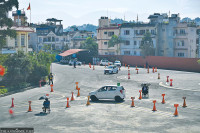
Server outages and excessive fees have added to applicants’ woes. Legal hurdles have delayed plans for new centres.The Ekantakuna driving trial centre pictured on Wednesday afternoon. Angad Dhakal/TKP
On a Wednesday morning, Sumit Pariyar waited for his turn at the driving licence trial centre on the premises of the Transport Management Office at Ekantakuna. He had arrived at 11 am for his motorcycle trial, but his name was called only at 12:30 pm. The festive season had eased the crowds somewhat, but Pariyar said long queues and delays remained a regular part of the process.
“The system requiring applicants to fill out forms online and only visit for written and practical exams is a positive step,” said Pariyar. “It removes the hassle of queuing just to submit paperwork, but once you arrive for the trial, your turn should come much faster. The government must allocate adequate human resources and infrastructure to make this happen.”
A resident of Pulchok in Lalitpur, Pariyar had submitted his online application before Dashain and passed his written examination. He went to Ekantakuna on Wednesday for the practical test.
For many applicants, however, the experience is far less straightforward. Sujay Timilsina, originally from Gorkha and currently staying in Kupandole, rushed to the Ekantakuna transport office that day after persistent server errors prevented him from booking a re-trial. Staff offered no clear solution and told him several offices were experiencing technical issues. He was advised to try again later.
Timilsina had failed his first motorcycle trial on October 6 and attempted to book a re-examination online the next day, but technical problems thwarted his efforts. “It is frustrating when you take time out of your workday and still accomplish nothing,” he said, standing outside the office at 12:15 pm. “Now I have to return.”
Transport officials say the servers are usually resolved by midday. But technical glitches, erratic connectivity, and digital hurdles remain a daily obstacle for applicants across the country.
Four transport management offices in the Kathmandu valley issue driving licences and receive an average of 2,000 applications a day. Around 1,500 candidates take practical tests each day, and between 800 and 1,000 applicants pass.
Despite online registration, applicants seeking new licences or adding another vehicle category routinely wait up to a week for a test slot.
The Ekantakuna office bears the heaviest burden of this daily influx. Mahesh Acharya, senior section officer at the Ekantakuna office said trial schedules are organised through an online quota system.
“Car trials run four days a week, motorcycle and scooter trials five days, and heavy equipment trials one day,” said Acharya. “On average, an applicant gets a trial date within a week of applying. Our office faces immense pressure, accommodating around 220 four-wheeler applicants and roughly 300 two-wheeler applicants daily.”
Successful candidates who clear their trials and pay respective revenues typically receive their printed licences within a week, he added.
To ease congestion across the valley, the Bagmati provincial cabinet decided in November, 2023 to expand licensing services to Banepa, Balaju, and Koteshwar. Banepa has come into operation, but services have yet to start in Balaju and Koteshwar. No definitive timeline exists for Koteshwar, while Balaju has only recently begun preparations after legal disputes were resolved.
Bharat Sharma, information officer at the provincial Ministry of Industry, Tourism, Labour and Transport said preparations to operationalise the Balaju facility is under way.
“We are transitioning the Sano Bharyang transport service office to Balaju to launch comprehensive licensing services, while the Sallaghari service facility will be moved to Koteshwar,” said Sharma. “However, immediate implementation takes time, particularly when dealing with legal interventions.”
Currently, trials are being conducted at Ekantakuna (Lalitpur), Radheradhe (Bhaktapur), Chabahil (Kathmandu), and Thulobharyang (Kathmandu).
Sharma said writ petitions and court-ordered injunctions have repeatedly delayed the expansion of services. “While legal recourse is a constitutional right, the persistent trend of filing petitions, securing court stays, and stalling administrative decisions has severely delayed our capacity to launch new service centres,” he explained.
Bagmati Province oversees 11 transport management offices and one service office. Sharma acknowledged that while expanding physical locations helps decentralise crowds, balancing staffing allocations across multiple offices presents ongoing administrative challenges.
Chetanath Bhattarai, officer at the Transport Management Office in Balaju, echoed these operational hurdles. “The legal disputes have now been resolved, and we are working on internal management to commence licensing services,” said Bhattarai.
Originally established as a service office in 2009, the Balaju office operates under the newly issued Organisation and Management (O&M) survey by the Bagmati provincial government, which grants authority for vehicle registrations. However, the office cannot fully implement its new mandate until it secures staff and budget. “We must make do with the existing manpower,” he added.
According to Keshav Khatiwada, director at the Department of Transport Management, high applicant volumes across existing offices have made it urgent to open the planned secondary facilities. “Offices constantly handle new licence applications alongside renewals,” said Khatiwada. “If we can successfully operationalise the two additional transport offices currently in the pipeline, we should be able to absorb the current volume of service seekers without needing further expansion.”
Transportation experts argue that the underlying issue stems from an insufficient number of authorised trial centres. Former director general of the department Chandraman Shrestha emphasised that expanding the number of trial locations is essential for efficient public service delivery.
“This is an urgent necessity,” said Shrestha. “At the same time, we cannot simply look for the cheapest trial centres; quality and safety standards are paramount. When affordability compromises quality, the entire system suffers. Fees must remain competitive while ensuring rigorous testing standards.”
Shrestha said efforts to reform during his tenure had not eliminated the systemic bottlenecks.
Applicants have also complained that some trial centres charge more fees than the rates set by the provincial government.
The Bagmati province issued the Driving Licence Written and Practical Examination Site (Selection and Operation) Procedure, 2021. Under these regulations, official trial fees are set at Rs238.62 for motorcycles, scooters, and mopeds; Rs409.60 for cars, jeeps, and delivery vans; Rs401.50 for tempos (three-wheeler) and auto-rickshaws; Rs562 for minibuses and minitrucks; Rs562 for buses, trucks, and lorries; and Rs550 for tractors.
However, discrepancies remain widespread. Navraj Devkota, who travelled from Sorhakhutte with his brother Roshan for a four-wheeler trial, showed a receipt for Rs665 paid at Ekantakuna.
“We came for the trial on September 9 and the trial centre operating under the transport office charged well above the official Bagmati province rates,” said Devkota. “It appears different rates are charged at different locations like Chabahil.”
The brothers found that other applicants also faced identical overcharges. “The crowds were massive, and there was no one available to listen to complaints or clarify fee structures,” he added. Kriti Basnet, a resident of Imadol in Lalitpur, reported paying Rs605 for a four-wheeler trial at Ekantakuna on the same day.
Sharma, information officer at the transport ministry, said all fees for the use of vehicles at trial centres must adhere to government rates. “All transport offices must collect standardised fees during practical examinations as prescribed by law,” said Sharma. “We regulate this framework and continue to monitor compliance.”
However, he said, the rules governing additional charges by private training providers for vehicle rental and instruction were more complicated.
Acharya of the Ekantakuna office said agreements with some private training facilities date back to 2016, when transport management fell under federal jurisdiction, before the responsibilities shifted to provinces. “Fees have not been revised upward since 2022,” said Acharya. “These prior arrangements between agencies remain in place, and any further adjustments require higher-level policy decisions.”




 15.9°C Kathmandu