Nepali lawmaker faces privacy backlash over videos of children filmed with smart glasses
Ashika Tamang blurred a child’s face after criticism, but rights advocates say her videos raise wider questions about consent and the responsibilities of elected representatives. AI enhanced image
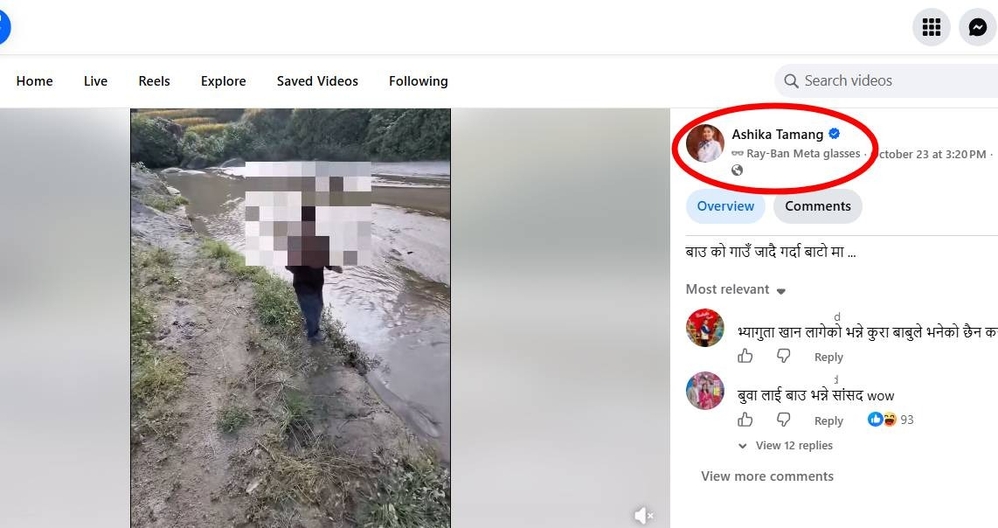
At 3:24 pm on October 23, lawmaker Ashika Tamang posted a two-minute video on her official Facebook account. It showed a boy sitting beside a stream, holding a frog. Tamang took the frog from the child, telling him not to eat it, and released it into the water. She then handed him a lollipop and walked away.
By the time this report was prepared, the video had been viewed 413,000 times, attracted more than 20,000 reactions and drawn over 800 comments. Most of the comments criticised the lawmaker.
“Please don’t turn an innocent child’s activities into content to earn dollars just because you are a member of parliament, Ashika didi,” wrote Himal Thapa, a Facebook user.
Another user accused the lawmaker of violating the child’s privacy: “Children have a right to privacy. Our lawmakers are making money by selling their childhood on social media.”
The videos, filmed using camera-equipped smart glasses and published on her official social media accounts, have raised questions about Tamang’s conduct, the privacy of those recorded in the videos, and the legal limits of recording people without their knowledge or consent. Along with the public, rights advocates and artists have criticised the lawmaker.
Amid the backlash, Tamang posted another video at 5:04 pm on October 23, captioned: “Please do not send such young children to buy alcohol or tobacco products.” It showed a girl walking with what was described as an alcoholic beverage. By the time this report was prepared, the video had been viewed 648,000 times. The girl’s face was clearly visible, prompting further criticism over the disclosure of her identity.
Gen Z activist Majid Ansari commented: “The laws passed by your own Parliament say that children’s privacy must not be violated. Surely you know that, as an honourable member of parliament? You posted the video without even blurring her face. That is disappointing.”
Artist Badri Pangeini also urged Tamang to consider the girl’s privacy.
“The issue you have raised is really important. But that little girl has a right to privacy too, doesn’t she? Please be careful when posting videos,” he wrote.
A screenshot of Ashika Tamang’s viral post featuring a child catching a frog.
After similar comments mounted, Tamang edited the video at 9:37 pm that night, blurring the girl’s face. The revised version was one minute and five seconds long.
Tilottam Poudel, president of the National Campaign for Children as Zones of Peace (CZOP), said photographs and videos of children should not be taken without permission from the children or their guardians.
“If a photograph or video needs to be taken, consent should first be obtained, and the purpose explained. Nobody, including a member of parliament, can record children without permission,” Poudel said. “It may not seem to matter while a child is young, but such material can affect them later in life when it resurfaces on social media or when they apply for something. People need to be sensitive to these issues.”
Nepal’s Children’s Act 2018 explicitly protects children’s privacy. Section 11(2) prohibits the creation, collection, publication, printing, display, sale, distribution or transmission through any medium of personal information, details, photographs or videos that could harm a child’s character or cause shame, humiliation or disgrace.
Poudel added that suspected violations should be reported to the chief district officer or the relevant municipal monitoring committee, chaired by the deputy mayor or rural municipality vice-chairperson, so that the authorities can investigate and take legal action where necessary.
Advocate Pabitra Raut also stressed the need to protect children’s privacy.
“Children are not in a position to give informed consent when their videos are posted. Obtaining consent before making someone’s photograph or video public is a basic principle,” she said. “Privacy needs to be protected because children may not be able to speak up for themselves. They should be able to grow up and live freely as children without being put in difficult situations.”
Santosh Sigdel, executive director of Digital Rights Nepal and a lawyer, said consent was central to recording and publishing videos of children.
“Consent becomes an issue when interacting with children or revealing their identities. Children are not always capable of giving consent themselves,” he said. “Parental consent is needed for photographs or videos of children. Another concern is that children and members of the public may not even realise that a camera or recording technology is being used.”
Questions about privacy have also been raised over Tamang’s videos featuring adults. One video, posted at 7:33 am on October 19, had been viewed 3.9 million times by the time this report was prepared. It had attracted 123,000 reactions and more than 8,600 comments, some critical of her conduct.
“There seems to be little difference between her conduct as an activist and as a lawmaker,” one user commented.
Another wrote: “Please don’t behave like this. It is embarrassing even to say that you are the elected representative from Dhading, didi.”
Section 16 of the Individual Privacy Act 2018 sets protections relating to photographs. It prohibits taking a person’s photograph without consent in a manner that damages their character or social reputation. It also prohibits creating, publishing or making public manipulated images intended to defame someone, including by combining parts of different people’s photographs.
All three videos posted by Tamang were filmed using camera-equipped smart glasses. She has been spotted on various occasions donning Ray-Ban Meta smart glasses.
This is not the first time Tamang’s use of the device has sparked controversy. In August, she was accused of recording a dispute with a ward chairperson over disaster management and relief distribution using smart glasses.
According to a report published by Artha Khabar on September 2, the ward chairperson alleged that Tamang had recorded the exchange using the camera embedded in her glasses and edited the footage to publish only her own statements. That incident also raised questions about how elected representatives record and publish conversations with citizens and local officials.
Advocate Sigdel noted that Nepal has no explicit legal provision banning the use of camera-equipped smart glasses. However, existing privacy laws may apply when people are recorded, and footage is published without their knowledge or consent.
“From a rights perspective, the question is not which technology was used, but what harm it caused and how it affected a person’s rights,” Sigdel said. “Technology keeps changing, so the focus should be on the harm or impact it causes and whether the conduct responsible for that harm has stopped.”
Raut said content posted by public figures spreads more quickly than material shared by ordinary users, making it particularly important for elected representatives to act responsibly.
“Members of parliament should not be going around posting videos like this,” she said. “Content shared by public figures spreads faster than content posted by others, so they have an even greater responsibility.”
Tamang has acknowledged that she made a mistake by failing to protect the child’s privacy.
“I should have covered, or blurred, the child’s face in the video. That was my mistake,” she told Kantipur.
“I have realised my error, and it will not happen again.”




 19.01°C Kathmandu