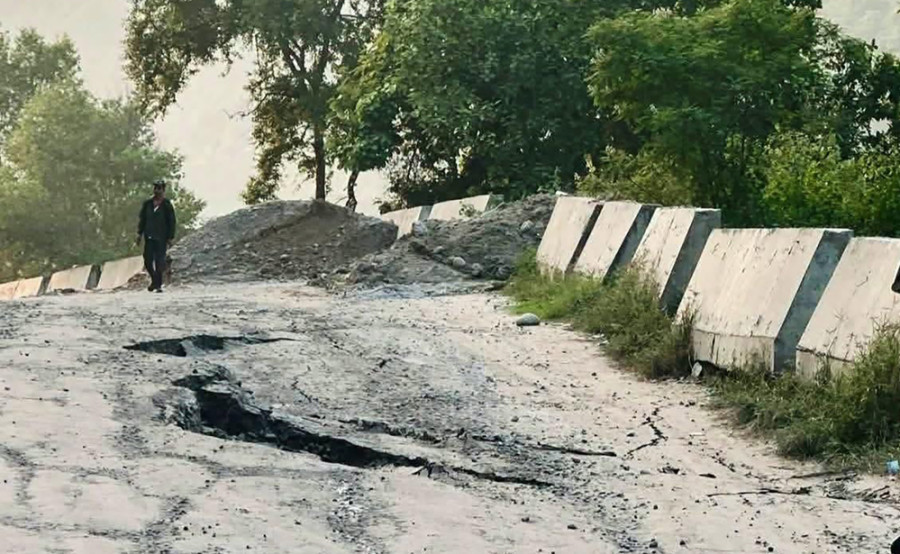
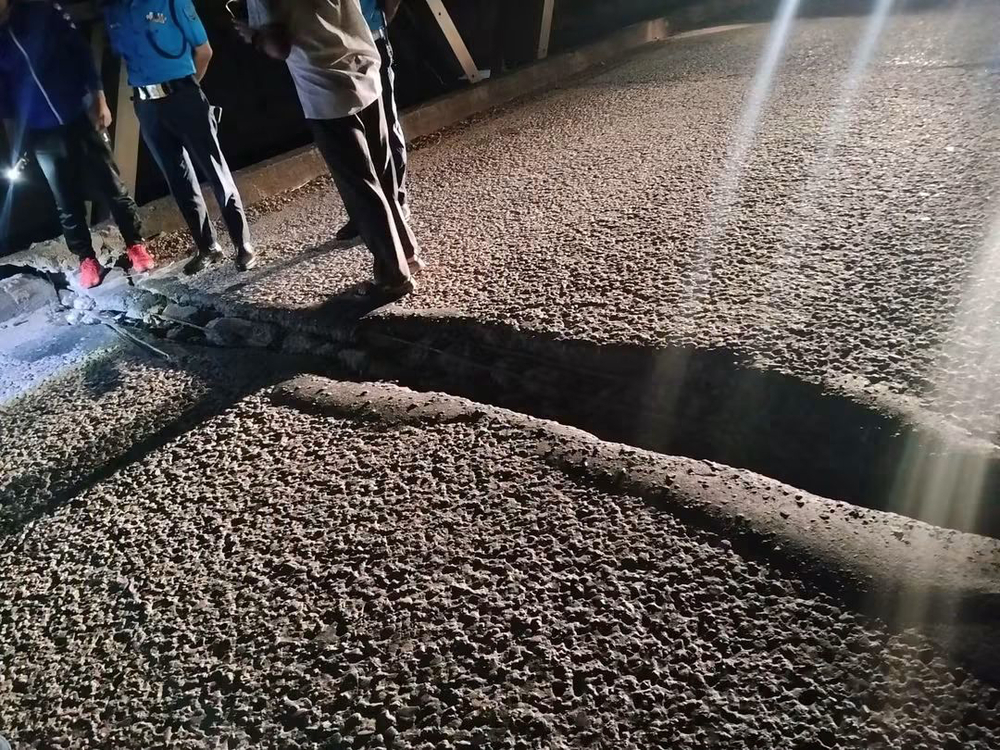
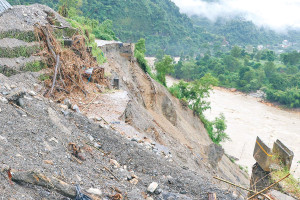
With over a million people expected to leave Kathmandu Valley by road, the collapse of a section of the Prithvi Highway has stranded travellers and forced authorities to expand transport arrangements. Nearly 100 metres of the road at Galaundi along the Prithvi Highway developed cracks on Friday, while a 20-metre section sank, forcing authorities to stop all vehicle movement along the stretch. Post Photo
Severe damage to major highways has thrown festive travel plans into turmoil on the eve of Dashain, forcing aviation authorities to run late-night domestic flights while ground transport networks struggle to cope with the surge of departing passengers.
With over one million travelers expected to leave the Kathmandu Valley by road and another 30,000 to 35,000 by air, transport operators and security agencies are scrambling to manage the annual mass exodus.
The situation turned critical on Friday evening when traffic came to a halt after nearly 100 metres of the road developed cracks and a 20-metre section collapsed at Galaundi along the Prithvi Highway, a lifeline to link Kathmandu with other parts of the country. It is expected to resume one-lane traffic by late Saturday evening. The road damage near Gajuri severely disrupted advance ticket bookings and stranded hundreds of long-distance vehicles.
According to Bijaya Jaishi, director general of the Department of Roads, the collapse stemmed from severe riverbank erosion caused by the Trishuli river following heavy flooding in late August. “Work is underway to cut into the hillside to restore vehicular movement,” said Jaishi. “The Trishuli river’s undercut following the Bhotekoshi floods on August 26 had weakened the base, and the impact manifested now.”
The Prithvi Highway, which typically handles over 15,000 vehicles on a daily basis, sees its traffic volume triple during Dashain, the biggest Hindu’s festival. Similar structural failures occurred earlier on August 30 when river erosion collapsed the Krishnabhir section of the same arterial highway.
Following the Galaundi collapse, advance booking counters were temporarily suspended on Saturday. Degnath Gautam, General Secretary of the Federation of Nepali National Transport Entrepreneurs, confirmed that several long-distance night buses were halted. “We were unable to dispatch the scheduled number of passengers on Friday, forcing many to turn back,” said Gautam. “Small vehicles were rerouted via the Kanti Highway and Tribhuvan Rajpath after 6:00 pm on Saturday, while ticket fares were refunded to affected travelers.”
To manage the overland crisis, the Department of Transport Management is opening nationwide route permits for long and medium-distance public buses. Rajiv Pokharel, director general of the department, announced that additional vehicles would be deployed beyond regular routes as required.
Crucially, authorities are introducing strict monitoring measures this year. “Every Dashain we open route permits, but there was previously no official record of reserved vehicles leaving the Valley. We had no precise tracking of who operated them or how they traveled,” said Pokharel. “To curb high accident rates, prevent overcharging, and track passenger volumes, we have initiated mandatory record-keeping for every departing vehicle.”
Traffic has been halted across the Lokaha bridge on the Narayangadh–Kawasoti section of the Mahendra Highway after part of the ageing structure sagged on Saturday evening. Narayan Sharma/TKP
Joint inspection teams comprising transport officials, traffic police, and transport entrepreneurs have been deployed at major departure points, including New Bus Park in Gongabu, Kalanki, Koteshwar and Balkhu. Fare lists must be prominently displayed at public departure points, and long-distance buses are mandated to employ two drivers.
According to Superintendent of Police Naresh Raj Subedi, information officer for the Kathmandu Valley Traffic Police Office, passenger help desks have been set up at 15 key transit junctions across the Valley. “Strict action will be taken against operators overcharging fares, double-booking seats, exceeding passenger capacity, or driving under the influence,” Subedi said. “Mechanical and emission checks are mandatory at entry points.”
Transport entrepreneurs have urged rapid government intervention. Punya Prasad Sitaula, president of the Federation of Nepali National Transport Entrepreneurs, emphasised the urgency of road repairs. “Thousands of travelers are waiting to head home for the festival,” he said. “The authorities must clear and restore the highways as quickly as possible to prevent total paralysis.”
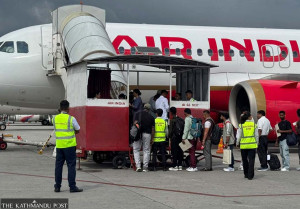
With road routes severely compromised, Tribhuvan International Airport (TIA) is bracing for unprecedented pressure. TIA spokesperson Sanjay Kumar said that internal flight operations are being extended late into the night to accommodate the diversion of travelers from damaged highways.
“Due to the current poor conditions of the roads, internal air traffic is rising sharply. We are preparing to conduct flights until late at night during Dashain,” said Kumar. “Late-night operations are being planned for regional hubs including Biratnagar, Chandragadhi in Jhapa, and Janakpur in Dhanusha.”
Under normal circumstances, the capital’s airport handles 28 flights per hour—20 domestic and eight international. However, current traffic has escalated to 32 flights per hour. “Having enough runway capacity and maintaining safe separation between aircraft remain our primary operational challenges,” Kumar explained. “Not all aircraft can use the runway simultaneously, and weather conditions always pose potential delays. Our strategy is to maximise the utilisation of available runway space and time from early morning until late night.”




 14.75°C Kathmandu