



 18.54°C Kathmandu

Sat, Sep 26, 2026
National
Shah returns from UNGA after putting climate crisis at centre of Nepal’s global pitch
Nepal’s prime minister highlighted the Bhotekoshi floods, climate justice and Himalayan risks at the UN General Assembly, while seeking greater international support for resilience and reconstruction.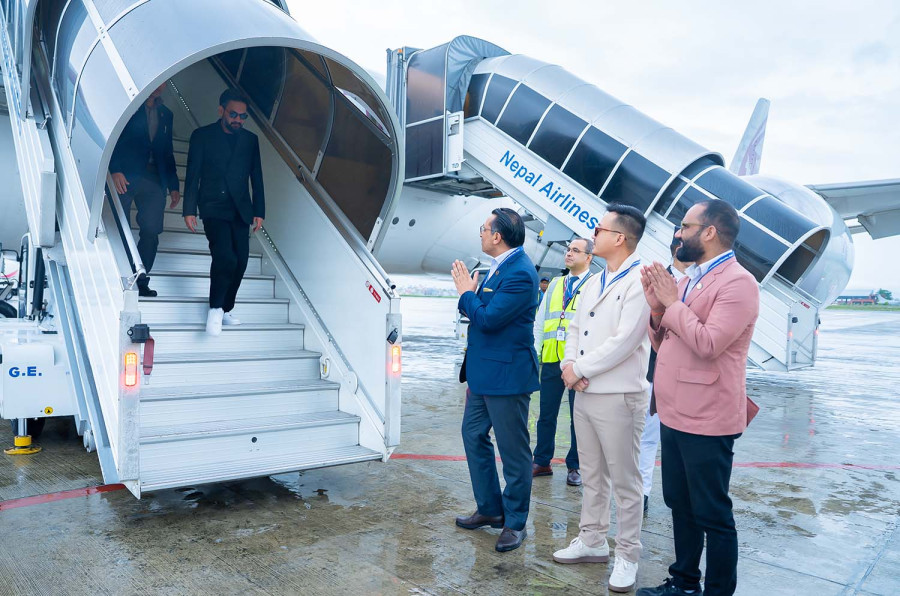
bookmark
Anil Giri
Published at : September 26, 2026
Updated at : September 26, 2026 17:42
Kathmandu
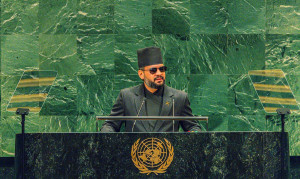
Prime Minister Balendra Shah returned home on Saturday after participating in the high-level week of the 81st session of the United Nations General Assembly in New York, where he put Nepal’s climate vulnerability, climate justice and the need for stronger international support at the centre of his address.
He was welcomed at Tribhuvan International Airport by Acting Prime Minister and Finance Minister Swarnim Wagle and other ministers. No official ceremony was held at the airport’s VVIP lounge upon his arrival from New York.
Shah had left Kathmandu for New York on September 22 to attend the high-level week, which is being held at the UN headquarters from September 22 to 28. The theme of this year’s General Assembly is “Restoring Trust, Managing Transformation: A United Nations that Delivers for All.”
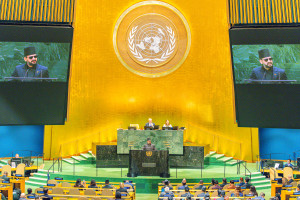
Addressing the General Debate on September 24, Shah presented the recent devastating Bhotekoshi floods as a serious impact of the climate crisis and a warning to the world. He drew the international community’s attention to the heavy loss of life and property caused by the disaster, as well as its impact on physical infrastructure and livelihoods.
He said Nepal is at the forefront of the climate crisis and, despite contributing less than 0.1 percent of global greenhouse gas emissions, is suffering disproportionate and severe impacts from climate change. Climate change, he said, is not merely a humanitarian issue for Nepal but also a development emergency.
Shah also highlighted the impact of climate change on Himalayan ecology, saying that melting glaciers and permafrost are increasing the risks of ice-rock avalanches, floods and landslides.
He proposed establishing a Himalayan Climate Resilience Mechanism to monitor vulnerable glacial lakes, strengthen early warning systems and facilitate cross-border coordination during disasters.
He said climate change should not be turned into a subject of geopolitical conflict and stressed that solutions should be sought on the basis of shared responsibility and solidarity, in accordance with the principle of Common but Differentiated Responsibilities and Respective Capabilities.
Shah said countries that have historically played a greater role in causing the climate crisis and have greater resources and capabilities should shoulder greater responsibility for addressing it. He called on the international community to put climate justice into practice.
He also stressed the need for grant-based international assistance for rehabilitation and reconstruction following climate-induced disasters. Existing climate finance mechanisms, including the Loss and Damage Fund, he said, should make the mobilisation of resources simpler and easier.
Highlighting Nepal’s contribution to environmental protection through forest conservation, hydropower development, the promotion of electric vehicles and climate adaptation efforts at the local level, Shah called for greater investment in climate resilience, stronger infrastructure, effective early warning systems and innovative technologies.
He called for an end to relying solely on ad hoc responses to climate-induced disasters and stressed the need to develop a culture of preparedness.
Climate justice, he said, should not be limited to financial assistance but should also ensure distributive and procedural justice.
Reaffirming Nepal’s unwavering faith in multilateralism, Shah said Nepal has confidence in the United Nations to build a system that listens to the voices of small and poor countries and delivers just outcomes.
During his visit, Shah held a meeting with UN Secretary-General António Guterres.
Guterres expressed deep condolences over the loss of life and property in the Bhotekoshi disaster and said the United Nations stands in solidarity with Nepal on climate issues.
Shah thanked Guterres for his goodwill towards Nepal and congratulated him on his successful tenure. Referring to the heavy losses suffered by Nepal in the Bhotekoshi disaster, Shah said the risk of glacial lake outburst floods remains high.
The two also discussed the rehabilitation of people living along riverbanks and green reconstruction. They also discussed support for extending the timeline for Nepal’s graduation from the list of Least Developed Countries (LDCs).
Shah also held a meeting with Australian Prime Minister Anthony Albanese, during which the two sides discussed various issues of bilateral interest.
Khanal holds meetings on UNGA sidelines
Foreign Minister Shishir Khanal has been participating in ministerial-level meetings of the Least Developed Countries, Landlocked Developing Countries, Non-Aligned Movement, and G77 and China, among others, held during the General Assembly.
Khanal has also been addressing other high-level discussions and side events organised by the United Nations.
He has been holding meetings with counterparts from various friendly countries, including Nepal’s neighbours, as well as high-level UN officials.
The foreign ministry said Nepal’s active and successful participation in the General Assembly has enhanced the country’s image and standing on the international stage.
Anil Giri
Anil Giri is a Chief Sub Editor covering diplomacy, international relations and national politics for The Kathmandu Post. Giri has been working as a journalist for more than two decades, contributing to numerous national and international media outlets.


Most Read from National
Government recommends ambassadors to India, US, China and 10 other countries
Balendra Shah UN speech: Full transcript of Nepal prime minister’s address to the 81st UN General Assembly
Explainer: Why and how EVs catch fire
Families of missing foreign nationals want answers Nepal can’t give
The speech Nepal — and the world — had been waiting for
Editor's Picks

What triggered the Rasuwa flood? Scientists piece together a complex chain of events

The floods keep coming. Nepal keeps starting over

In a settlement destroyed by the Bhotekoshi flood, a disabled couple offer strangers the little they have

Nepal working on detailed assessment as Bhotekoshi flood reconstruction could cost up to $5 billion

Rabindra Dhant gave Nepal a reason to smile. Now his camp wants real action behind the praise
E-PAPER | September 26, 2026

×