A fatal electric vehicle fire in Bharatpur has triggered anxiety across Nepal, prompting urgent questions about whether the tragedy stems from battery fault or external factors. TKP breaks down EV fires in 11 questions. A still of the burning EV from Friday's deadly incident in Bhartatpur, polished with AI tools. Screengrab from social media video
Early Friday morning in Bharatpur, a moving electric car caught fire on the East-West Highway, leaving behind a trail of billows of smoke as it burned. Behind the wheel was 55-year-old Amar Parajuli, a former school director driving home to Bharatpur from Hetauda via Tandi. Parajuli died in the vehicle before police and firefighters could put out the blaze with a fire engine. His body has been kept at Bharatpur Hospital as investigators try to determine how a year-old GAC Aion Y, a model imported by CG Motors Pvt. Ltd., caught fire on the road. Footage of the incident has circulated widely on social media, prompting wider questions across Nepal about why electric vehicles catch fire and how seriously such risks should be taken. Here is an explainer.
When did the first EV fire take place?
Vehicle fires involving electric propulsion did not begin with the modern electric vehicle boom or contemporary Silicon Valley automakers. Battery-powered vehicles operated in American cities during the 1880s and 1890s, though surviving historical records are too sparse to identify a single, verified first electric car fire. The modern era of catalogued lithium-ion passenger car fires effectively began in October 2013, when a Tesla Model S in Washington state ran over a metal road fragment that pierced its underbody battery casing and set the car on fire. Since that incident, public interest in battery safety has intensified alongside the rapid global adoption of electric transport.
How many EVs have caught fire globally?
Establishing a definitive global tally of battery fires remains difficult because international reporting systems are fragmented and incomplete. A global tracking repository verified 511 passenger-EV traction-battery fires between 2010 and June 2024, while broader research confirms several hundred verified cases since 2013. Analysts emphasise that an expanding vehicle fleet inevitably produces more fire incidents over time. Meaningful assessments of safety rely instead on calculating fire rates per vehicle-year or per million miles travelled, metrics where electric cars compare reasonably with internal combustion engines. Data from the US National Transportation Safety Board covering crash-related fires between 2013 and 2017 recorded fire involvement in 2 percent of electric vehicles involved in fatal crashes, compared with 3.2 percent for petrol-driven cars.
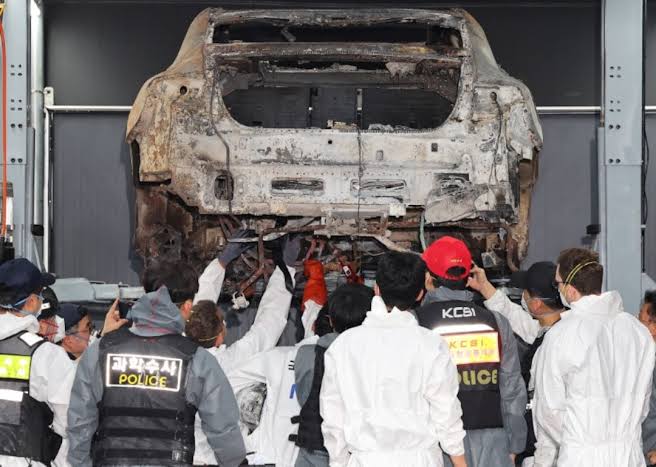
Officials from police, fire, National Forensic Service and Mercedes-Benz conduct a second joint forensic examination of an electric car that caught fire in the underground parking lot of an apartment complex on August 1 in Incheon, South Korea, August 8, 2024. Reuters
How many EV fires have taken place in Nepal?
In Nepal, evaluating vehicle fires requires separating broad reports of burning cars from confirmed battery failures. The Disaster Risk Reduction Portal tracks national fire events but lacks a dedicated category for electric transport, making national statistical generalisations unreliable. Public records document at least two previous high-profile electric car fires in the country. In January 2024, an MG electric vehicle was destroyed by fire overnight in Budhanilkantha, Kathmandu, while plugged into a charger. Subsequent technical investigation by the manufacturer revealed that the high-voltage battery had remained undamaged, attributing the blaze to a short circuit within the charging cable and socket assembly. A similar outcome followed a May 2025 fire involving a BYD Atto 3 in Pathari, Morang, where joint technical inspections confirmed that the Blade battery and high-voltage powertrain were fully intact. Investigators pointed towards external combustible materials near the vehicle as the probable origin. To date, no publicly documented incident in Nepal has been verified as a true traction-battery fire—the Bharatpur case now under investigation could become the first if a battery fault is confirmed.
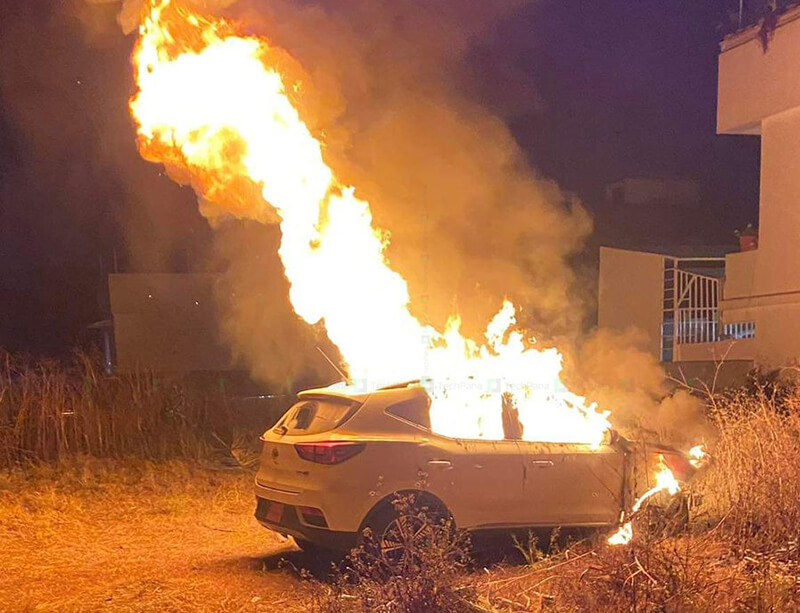
An electric vehicle manufactured by MG caught fire in Kathmandu in 2024. Screengrab from social media video
What caused the Bharatpur fire?
Investigators have not yet established a cause, and those close to the industry caution against reading too much into video of the burning car circulating online.
“The root cause of the incident could be any of several things—a fault in the car itself, a fault in the charging system, or exposure to water,” said Surendra Kumar Uprety, president of the Nepal Automobile Dealers’ Association. “Not everything can be deduced by watching a video.”
For Uprety, the more pressing questions are mechanical and procedural. “Why the car was not stopped, whether the brakes failed, and whether the doors could be unlocked all need to be investigated in detail before we jump to any conclusion,” he said.
That caution was echoed by Madhusudan Paudel, general manager of corporate communications and public relations at Chaudhary Group (CG), the conglomerate whose subsidiary CG Motors imports GAC vehicles into Nepal. “We should let the police run an independent investigation into the case and not draw any conclusion before their report is out,” Paudel said.
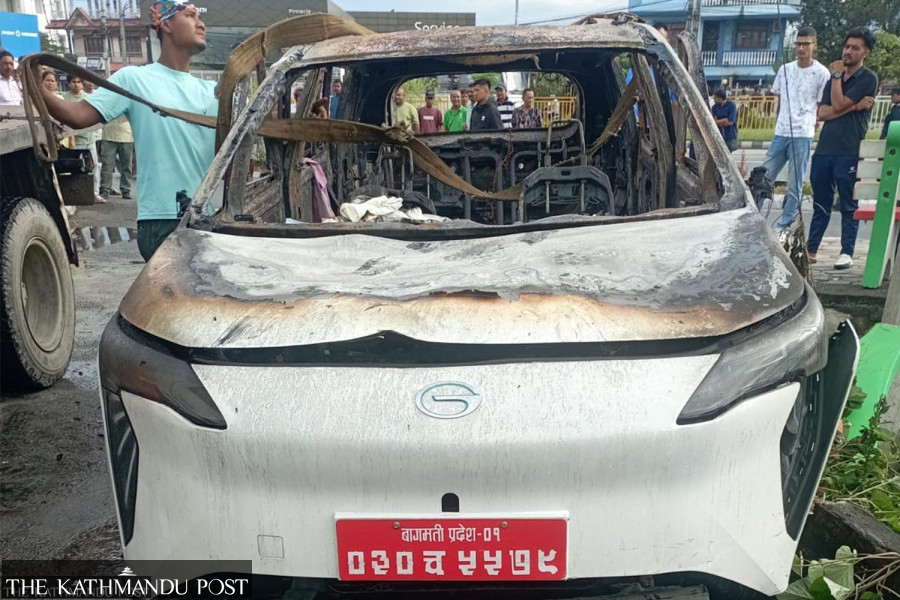
The remains of the Ev that caught fire in Bharatpur on Friday morning. Ramesh Kumar Paudel/TKP
Bishal Silwal, an assistant professor at the Institute of Engineering, Tribhuvan University, offered a more technical hypothesis, while stressing it was based only on what he had seen of the case.
The vehicle is rumoured to have crashed before it caught fire, he said, which points toward a specific chain of failure. “If there had been a crash beforehand, thermal runaway could have been one of the main causes of the fire,” Silwal said.
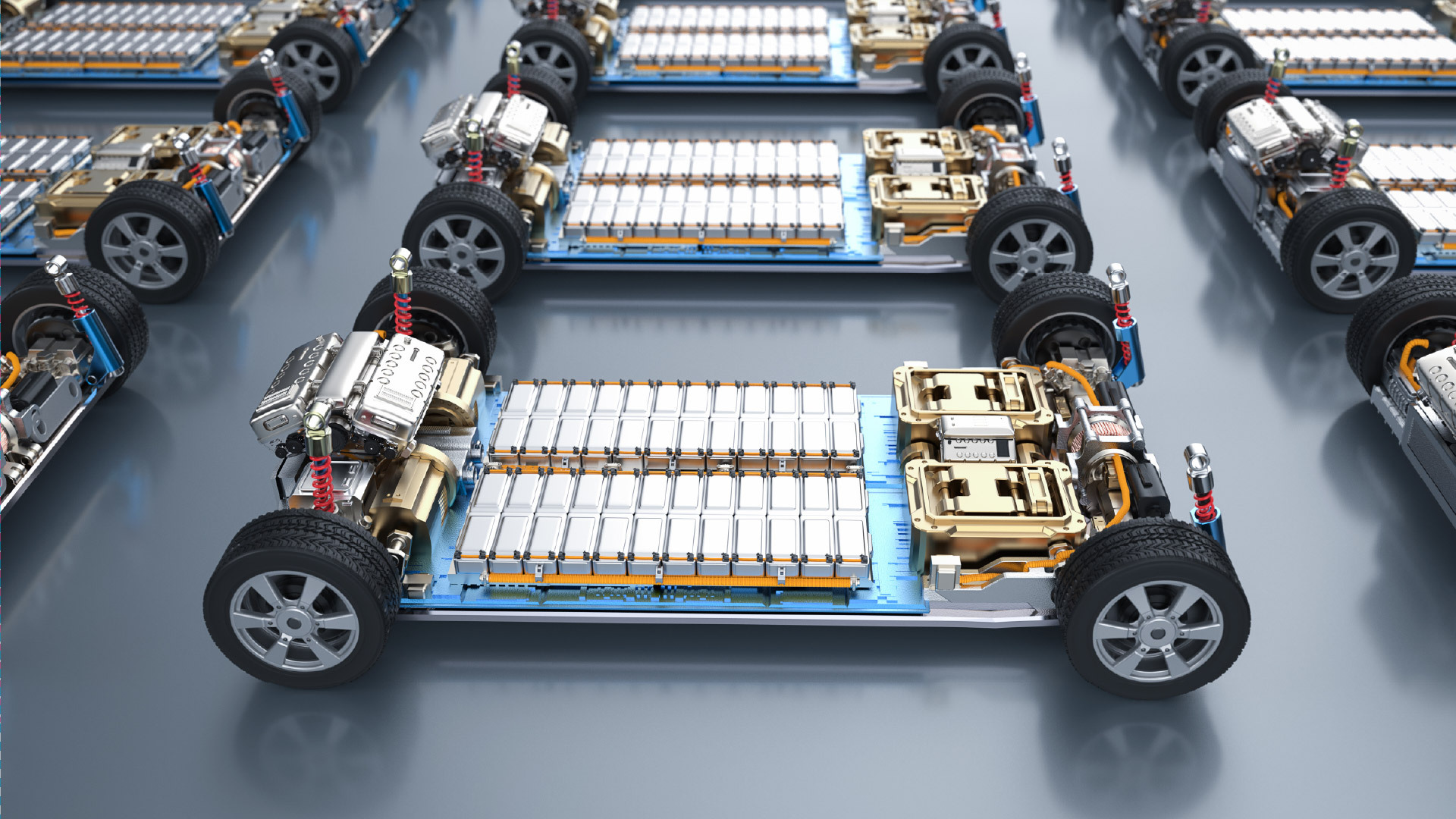
That hypothesis is complicated by CG’s own preliminary reading of the wreck. “Our technical team has preliminarily suspected that this is not a battery fire since the fire seems to originate from the back of the car,” Paudel said. “Generally, battery fires start from the bottom of the car, around the chassis, where the battery is situated. This model’s battery is located under the floor, integrated into the vehicle’s lower chassis—the ‘skateboard platform’ used across much of the EV industry, in which the pack forms a flat slab beneath the cabin floor rather than sitting toward the rear.”
Paudel cautioned against prejudging the manufacturer as quickly as the technology. “We think manufacturers such as GAC must have done their due research on the possibility of safety issues before producing a fleet,” he said. “So we cannot paint a black-and-white picture of the accident.”
Why do EVs catch fire?
Understanding why a high-voltage battery burns requires examining the architecture of lithium-ion cells. Each battery pack houses hundreds or thousands of individual cells containing a flammable liquid electrolyte, with a wafer-thin separator keeping the two terminals inside each cell apart. A severe crash can breach that layer.
“In a serious impact, the separator between these two terminals, which is a very thin layer, can break. This can cause the two terminals to short-circuit, resulting in a rapid rise in the battery’s internal temperature,” Silwal explained.
That temperature spike is where the real danger begins. “One of the problems with lithium-ion batteries is that, once the temperature rises beyond a certain point, it can trigger a chain reaction,” Silwal said. “As the temperature continues to rise, internal chemical reactions occur at high temperatures. This is what we call thermal runaway, and it is a major issue with batteries.” If that heat transfers to adjacent cells, a cascade known as cell-to-cell propagation spreads through the pack, turning a single internal fault into an intense, self-sustaining fire.
The burnt wreckage of a Hyundai Kona Electric vehicle is seen after it caught fire in Daegu, South Korea, October 4, 2020. Reuters
A crash is only one possible trigger. Microscopic manufacturing defects, electrical overcharging, or exposure to conductive saltwater during flooding can each set off the same reaction. Outside the battery pack itself, an electric car also contains conventional wiring, low-voltage 12-volt systems, cabin upholstery, and tyres—any of which can ignite independently through an ordinary electrical or external fault, with no battery involved at all.
Is thermal runaway common?
Despite the alarm the Bharatpur fire has caused, Silwal was clear that outright battery failures remain rare in well-designed vehicles.
“It is not something we can say never happens, because thermal runaway is a known issue with batteries,” he said. “But normally, in well-engineered vehicles, after extensive research and development, it does not happen in every vehicle. There have been isolated cases. BYD, for example, has, on some occasions, identified battery-related problems and recalled an entire fleet.” A recall, he added, is in fact a sign the system is working as intended: “When manufacturers are aware of such a problem, responsible brands will recall the vehicles they have sold.”
Are the EVs plying Nepal’s roads substandard?
For Silwal, the more useful question is whether the vehicles sold in Nepal are built and certified to fail as rarely as possible.
“The important question is whether the vehicle meets international safety regulations and compliance standards,” he said. “Nepal needs to establish a mechanism to test whether vehicles meet those standards. I am not sure whether Nepal has done that adequately.”
Uprety made much the same argument about Nepal’s import regime more broadly, not just for EVs.
“Nepal needs to introduce a strict import standard for EVs—not just EVs, but every imported good,” he said. “The National Standard needs to be high. We are surely not a country that should be the testing ground for new technology, but due to weak import regulations, we seemingly are becoming one.”
Nepal, he added, also needs to invest in the infrastructure required to make EV use safer.
Does driving behaviour matter?
Silwal argues that Nepal’s fires and crashes may have as much to do with driving habits as with battery chemistry, particularly in electric microbuses. Electric motors, he explained, deliver far more torque than the internal combustion engines Nepali drivers are used to.
“Our driving habits have developed around conventional vehicles. We tend to press the accelerator quite hard when we want to accelerate. If we carry the same driving pattern over to an EV, the vehicle can accelerate very quickly,” he said. “Once problems arise and braking is not handled properly, accidents can occur. In my observation, that has been a significant problem with electric microbuses, where many accidents appear to follow this pattern.”
Passenger cars, he said, are a different matter so long as buyers stick to compliant brands.
“If we properly review the compliance of the brands available in the Nepali market, then I don’t think there is necessarily a reason to be afraid,” Silwal said. “Accidents can happen from time to time. They are, after all, accidents. They are not intentional.”
Photo: Courtesy of Geotab
How to stay safe from an EV fire?
Extinguishing a fully developed battery fire demands tactics markedly different from those used on conventional car fires. Because the battery cells are encased inside a sealed metal pack, small handheld extinguishers fail to lower internal temperatures sufficiently to halt thermal runaway. Firefighters must apply massive quantities of water strictly as a cooling agent to absorb heat and prevent propagation. Damaged cells can retain residual electrical energy, raising the hazard of delayed reignition hours or even days after visible flames have vanished. Emergency responders need to be trained to monitor burned vehicles with thermal imaging cameras and isolate them from nearby structures until the battery core has completely cooled.
Uprety argues that responsibility does not end with firefighters and manufacturers. “The main priority should always be the life of the public,” he said. “The EV owners need to be careful themselves. I say that we must run mandatory classes for EV safety. Drivers must never ignore problems in the car such as overheating and battery faults as minor issues.”
Can EV doors auto-lock and trap passengers?
One of the specific questions raised by the Bharatpur fire—whether Parajuli could have gotten a door open—touches on an EV design feature that is not widely understood.
“Normally, EVs have an auto-locking mechanism if the car is still in motion,” Uprety said, describing a standard safety feature meant to stop doors swinging open rather than a defect.
The complication arises if that same car is disabled by a crash or fire. Electronic door handles typically run on a vehicle’s low-voltage 12-volt circuit, separate from the high-voltage battery, and high-voltage isolation systems often cut power automatically during a collision. If a crash or fire also knocks out the 12-volt circuit, the electronic release can go dead at the exact moment a door that auto-locked while moving needs to open. That is why manufacturers build in mechanical door releases—physical catches or levers, independent of the electronics—for emergency egress. There is no single, universal automatic-unlock behaviour triggered by a crash or fire across all EVs. It varies by manufacturer and model.
Whether the GAC Aion Y had a working mechanical release, and whether Parajuli could reach it, is one of the specific points Uprety says investigators still need to establish. “Whether the doors could be unlocked or not needs to be investigated in detail before jumping to a conclusion,” he said.
Do Nepalis need to worry?
Silwal and Uprety arrive at their views from very different vantage points—one an engineering academic, the other the head of the industry’s own dealer association—yet they converge on a similar bottom line: EV fires are real but rare, and writing off the technology on the strength of a single tragedy would be a mistake.
“I would not say there is a great deal to fear. Normally, there may be one or two cases here and there,” Silwal said.
Uprety put it more bluntly. “There is no reason to fear EVs,” he said. “EV is a new technology. One cannot declare that EVs are unsafe drawing from one incident. People need not doubt all EVs based on one incident. This is an accident. Instead of criticising the technology, we need to investigate the accident and make the findings public.”
What both agree Nepal lacks is the regulatory scaffolding: mandatory testing against international standards, stricter import rules, and safety training for owners. Until that scaffolding is built, Uprety warned, Nepal risks remaining a testing ground for a technology it has not yet learned to regulate.




 14.5°C Kathmandu


.jpg)