



 19.57°C Kathmandu
.jpg)
1.jpg)
Thu, Oct 22, 2026
National
Two weeks on, families wait for DNA answers
Relatives of people missing after the Bhotekoshi floods are turning to DNA testing to identify recovered bodies, but labs are overloaded and under-resourced.
bookmark![]()
More than 300 bodies have been buried in the Devghat forest in ward 1 of Bharatpur Metropolitan City after their DNA samples and identification records were preserved. Photo: Nepal Photo Library ![]()
Relatives in Salyan conducted the last rites of the missing victims of the August 26 flood after failing to trace them even after two weeks of the incident. Post Photo ![]()
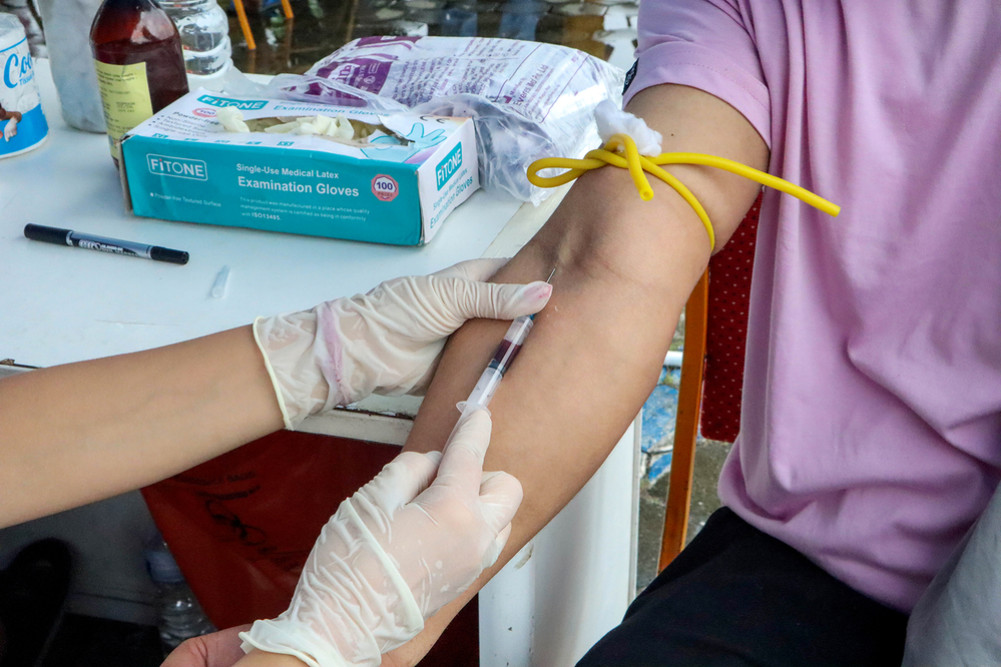
Relatives giving blood for DNA tests to identify the bodies of their missing ones in the August 26 flood. Photo: Nepal Photo Library
Gaurav Pokharel, Deepak Pariyar & Ramesh Kumar Paudel
Published at : September 9, 2026
Updated at : September 9, 2026 19:28
Kathmandu/pokhara/chitwan
Since the Bhotekoshi floods two weeks ago, Purna Prasad Adhikari of Bharatpur has been searching for his missing son, holding on to the hope that he will at least find his remains.
He travelled from Chitwan to Dhading, Tanahun and Pokhara, moving between police stations, hospitals and government offices, looking for any news of 40-year-old Bikash Babu. On Tuesday, after finding nothing, he went to the Chitwan Chamber of Commerce and Industry and gave a blood sample for DNA testing.
Bikash Babu Adhikari, a constable posted at Rasuwa’s Timure near Nepal’s border with China, went missing along with 28 other police personnel when the flood hit.
His father no longer expects to find him alive. What he wants now is something more basic: certainty.
“I’ve lost hope that he is still alive,” Adhikari said. “If we could at least find his body, we could perform the death rites.”
For families like his, DNA testing may be the only way to identify their missing relatives among the recovered bodies. Hundreds of bodies recovered from the flood remain unidentified, as relatives search for answers, give blood samples and wait for a match that could finally end their uncertainty.
For Krishna Bahadur Nepali of Torikhet in Bharatpur, the search for his son has followed a similar path. His son, who worked as a driver in Rasuwa, has been missing since the floods. Nepali travelled to Nawalpur and Dhading after the disaster and returned to Bharatpur after hearing that large numbers of bodies had been recovered there.
He still has no news of his son.
“I have no idea where he is. I’m hoping a DNA test will tell us something,” he said. “Even if he is no longer alive, I just want his body.”
Hundreds of families like theirs are now waiting for DNA results to determine whether unidentified bodies recovered downstream belong to their missing relatives.
By Wednesday afternoon, 1,367 bodies had been recovered, according to data from the National Disaster Risk Reduction and Management Authority. Only 102 had been identified, leaving more than 1,200 families still waiting for answers.
For many of those families, however, the answers could take months.
Nepal has only two laboratories capable of conducting DNA testing: the Nepal Police Central Forensic Science Laboratory and the National Forensic Science Laboratory under the Ministry of Science, Technology and Innovation. Under normal circumstances, the two labs together processed fewer than 1,000 samples a year.
The Bhotekoshi disaster has overwhelmed that capacity. More than 2,000 samples have reached the laboratories in a single surge.
Mukul Pradhan, a senior scientific officer at the National Forensic Science Laboratory in Khumaltar, Lalitpur said his laboratory alone had received samples from 530 people, including recovered bodies and relatives of missing people.
Samples from relatives are being collected at the Nepal Police Hospital in Kathmandu and through district police offices outside the capital.
“We first create DNA profiles from the samples and then proceed with the matching process,” Pradhan told Kantipur. “If a relative comes forward and says a particular body as their family member, we can test that immediately. Otherwise, we have to process samples from both the body and the family member in a second stage.”
The authorities have yet to decide how to handle the large volume of samples.
In the past, the Khumaltar laboratory conducted only about 40 to 45 DNA tests a month, or roughly 350 a year.
Dr Jivan Rijal, a DNA specialist and former head of the laboratory, said both facilities have a severe shortage of qualified personnel.
“We have always been short-staffed, and adding more personnel has never been a priority,” he said. “The chemicals and reagents required for testing are also expensive and can be difficult to procure.”
If the necessary reagents are available on time, the testing process could move more quickly, he said.
The Nepal Police Central Forensic Science Laboratory is facing an even larger backlog. More than 2,000 samples from bodies, body parts, and relatives had reached the facility by Sunday afternoon, according to police spokesman Abi Narayan Kafle.
The figure includes samples from 1,181 bodies or partial remains and 1,186 relatives.
The police laboratory normally conducts about 700 to 800 DNA tests a year.
Foreign experts have been brought in to help cope with the unprecedented workload. Nineteen DNA specialists from India and four from China are assisting the laboratory, while a 44-member South Korean disaster-response team is also providing support, said laboratory chief Senior Superintendent of Police Yog Bahadur Pal.
Police officials said offers of additional assistance have also come from Singapore and Japan.
“This is not a criminal investigation,” Rijal said. “Foreign nationals are also among the missing, so we should use as much international expertise as possible to identify the victims quickly.”
Why identification is taking so long
Forensic teams collect teeth and bones as DNA samples from badly damaged bodies. The same process is used for foreign victims.
To identify a missing child, DNA can be taken from the mother or father. For a missing parent, samples can be collected from their children or spouse. If parents or children are unavailable, siblings can also provide samples.
Fresh blood can produce a result within a day or two, said Binod Neupane, a forensic expert from the Nepal Police Central Forensic Science Laboratory who has been working in Pokhara.
But bodies that have remained submerged in water for a long time can begin to decompose and this makes DNA extraction much harder. In such cases, technicians have to rely on teeth or bones.
“When a body has started decomposing, we have to extract DNA from teeth or bones, and that takes longer,” Neupane said.
In previous cases, extracting DNA from bone has taken between two and four months, he said.
Police Inspector Sandesh Kumar Pokharel of the Central Forensic Science Laboratory said the current backlog could mean waiting at least three months for results, although additional technical assistance could shorten the timeframe.
Families searching for missing relatives do not need to travel to the place where a body was found, Pokharel said, adding that they can contact their nearest district police office or the Nepal Police Hospital in Kathmandu.
The closest relative, preferably a parent or child, must provide two passport-sized photographs when submitting a sample.
Bodies carried downstream
The scale of the disaster has made identification even more difficult. Bodies swept away by the Bhotekoshi and downstream sections of the Trishuli and Narayani rivers have been found as far away as Nuwakot, Dhading, Tanahun, Gorkha, Chitwan and Nawalparasi, with some carried across the border into India.
The largest numbers have been recovered in Chitwan, where 363 bodies have been recovered, followed by Nawalparasi East, where 226 have been recovered along the Narayani river.
Hospital morgues in both districts became so overcrowded that bodies had to be kept in corridors and open areas.
With large numbers of bodies arriving at once, limited mortuary capacity and prolonged exposure to water accelerating decomposition, the government decided to bury unidentified remains after preserving the evidence needed for future identification.
“There was no way to keep the bodies preserved indefinitely. As the smell created a risk of disease outbreaks, we had to manage them,” said Superintendent of Police Navin Karki, chief of the Kaski District Police.
Under the Unclaimed Bodies Management (First Amendment) Directive, 2026, bodies are managed only after post-mortems have been completed and DNA samples collected.
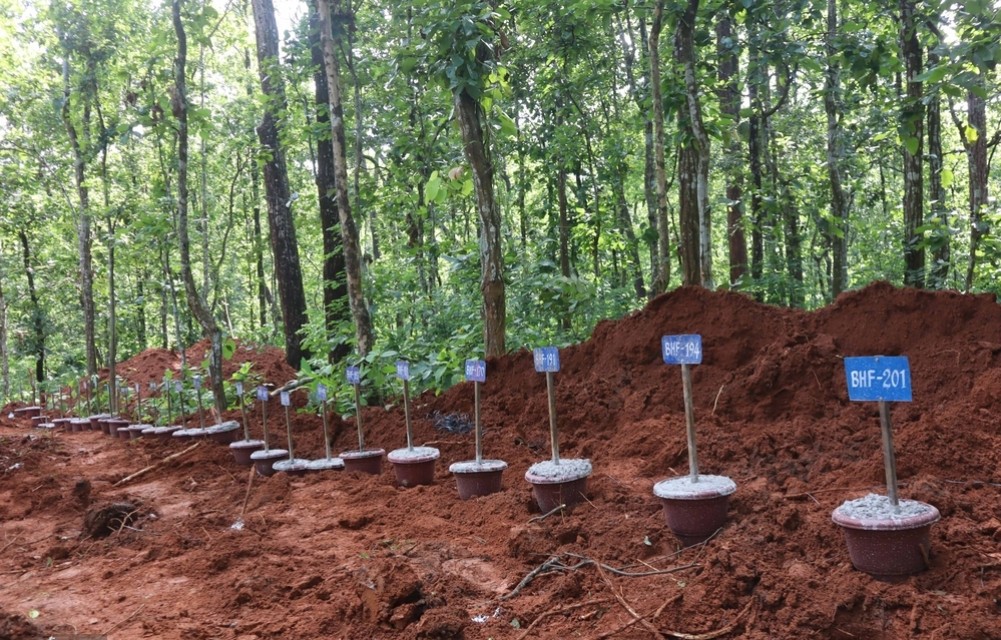
Each body is placed in an airtight plastic bag and buried in a pit 1.5 metres below ground, with pits spaced 40 centimetres apart. A marker carrying the identification number is placed above the grave, while a map is prepared using the GPS coordinates of the burial site. Wire fencing is installed to prevent access by people and animals.
“All bodies have undergone post-mortems and DNA samples have been collected,” Karki said. “We will send the samples to the Nepal Police Central Forensic Science Laboratory within a day or two.”
In Chitwan, only 14 of the 363 bodies recovered so far have been identified and handed over to relatives. The remaining 349 bodies have been buried in the Devghat forest in ward 1 of Bharatpur Metropolitan City after their DNA samples and identification records were preserved.
In Nuwakot, 197 bodies have been recovered. Of these, 85 unidentified bodies were transported to Kathmandu and buried in a Nepal Trust forest area in ward 7 of Gokarneshwar Municipality.
Of the 102 bodies taken to Pokhara, including those recovered in Gorkha, Dhading, Nawalparasi East and Tanahun, 76 have been buried, and 21 have been handed over to relatives.
In Nawalparasi East, 160 have been buried in Jyotikunja and Devchuli community forests. Seventeen have been handed over to relatives.
A further 68 bodies recovered in Nawalparasi West, including remains transferred from India, have been buried in Mulpani Community Forest in Sunawal. Eight have been handed over to families.
Eight bodies taken to Palpa have been buried in Shreenagar Ecotourism Community Forest in Tansen, while 15 bodies recovered in Tanahun have been buried in Chainpur Forest in ward 5 of Byas Municipality.
According to Anil Pandit, Deputy Superintendent of Police in Nawalpur, the remains buried there include 30 women, 45 men, seven boys, eight girls, along with 70 body parts that could not be linked to specific individuals.
Police in Tanahun said each body has been tagged and photographed, with a QR code containing tracking information.
“We completed the legal and scientific procedures before managing the bodies,” said Deputy Superintendent of Police Dwarika Prasad Ghimire. “We have managed them in a way that will not prevent identification in the future.”
A body-management committee headed by the district police chief oversees the process in coordination with local units.
Even after a body has been buried, relatives cannot claim it based solely on photographs. It can be exhumed and handed over only after a DNA match confirms the identity.
“The DNA profiles of family members are kept on record. If there is a match, we will recover the body from its burial site and hand it over to the family,” Karki said.
Families can make a claim for a body for up to 12 years.
Until then, people like Purna Prasad Adhikari and Krishna Bahadur Nepali will continue to wait, hoping that a DNA match will finally tell them what happened to their sons.
Gaurav Pokharel
Pokharel is a journalist at Kantipur Media Group covering national security, defence, and good governance.
Deepak Pariyar
Deepak Pariyar is the Kaski correspondent for Kantipur Publications.
Ramesh Kumar Paudel
Ramesh Kumar Paudel is the Chitwan correspondent for Kantipur Publications.

Most Read from National

Flood sweeps away houses, bridges in Gorkha

What to know about the US trial over Mamta Kafle’s disappearance
Torrent of black mud and rocks engulfs settlements along Budhigandaki

From blankets to handmade dolls, two foreign women bring comfort to flood survivors
Budhi Gandaki flood washes away three bridges in Gorkha
Editor's Picks




E-PAPER | October 22, 2026

×