In disaster aftermath, Nepal battles a flood of misinformation
As rescuers widen reach to people caught in the disaster, social media platforms have been flooded with AI-generated videos, recycled footage and graphic content.
Hours after the Bhotekoshi floods swept away settlements in Rasuwa and Nuwakot districts on Wednesday morning, social media platforms were inundated with dramatic clips purporting to show the destruction.
Some depicted genuine disasters, but from other countries or earlier events. Others were digitally manipulated. Several appeared to have been created entirely by artificial intelligence.
The scale and speed of misinformation has complicated an already chaotic information environment at a time when families are desperately searching for missing relatives and authorities are struggling to establish the full extent of the disaster.
For social media users chasing views and virality, the flood has also become lucrative content.
At 7:26 am on Saturday, a Facebook page called Dudhauli FM posted a 20-second video claiming to show Home Minister Sudan Gurung inside a tunnel at the disaster site.
“Home Minister Gurung's unique style: He reaches inside the tunnel at the incident site to join the rescue,” the caption said, praising what it described as the minister’s proactive involvement.
The page later amended the caption.
The video quickly spread across Facebook, TikTok and X.
But it was not from Nepal.
Fact-checkers established that the footage showed a tunnel rescue operation in Uttarakhand, India. The uniforms worn by the rescuers and the surroundings matched those seen in the original footage, which had been posted by the Fire Service Uttarakhand Police’s Facebook page on August 14.
The false attribution was only one example of misleading content circulating after the disaster.
As rescuers race against time to reach people trapped in tunnels and communities cut off by the devastating flash flood, a torrent of fabricated videos, recycled footage, artificial intelligence-generated imagery and cruel online commentary has bewildered a wider populace.
On August 27, at 7:54 am, an X account named Prakash Kunwar posted a 10-second video showing what appeared to be a catastrophic flood.
“No one imagined this would happen... What can anyone do when nature goes mad! May all those caught in the disaster be rescued safely,” the caption said.
The video had received more than seven million views, over 4,100 reposts and around 15,000 reactions at the time of reporting.
Yet the dramatic scene was not real.
When analysed using Hive Moderation, an AI detection tool, the video was assessed as 97.2 percent likely to have been generated by artificial intelligence. X’s community notes also flagged the clip as artificial, while BBC Verify independently debunked it.
Another viral video posted later that day showed a bridge apparently collapsing amid a raging flood. The user who shared it wrote: “If this video of the Nepal-Tibet flood is true, I have never seen anything like this in my lifetime...”
The clip, analysed through Hive Moderation, was assessed as entirely AI-generated.
International fact-checkers have also joined efforts to trace misleading visuals linked to the disaster.
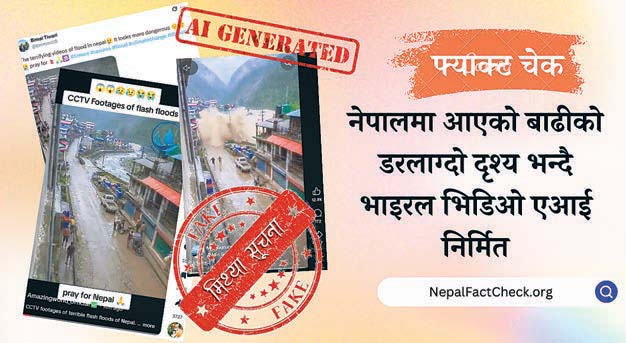
Nepali fact-checking website Nepal Fact Check recently debunked a video that purported to show a glacial lake outburst flood, or GLOF, in Rasuwa. The clip showed a violent torrent of water and carried the English text: “This is a GLOF.”
The footage had no connection to Nepal.
Fact-checkers traced it to a glacial outburst flood at Columbia Glacier in Alaska, United States.
Nepali and foreign factcheckers have been regularly debunking misinformation and disinformation circulating in the aftermath of the August 26 Bhotekoshi flooding. Photo: Courtesy of NepalFactcheck.org
Similarly, a pair of “before and after” photographs claiming to show a picturesque settlement destroyed by the Rasuwa flood went viral on social media. Both images were fabricated, according to an independent verification by the Australian Associated Press fact-checking unit.
The false videos and manipulated images are only one part of the digital disorder surrounding the disaster.
Graphic footage of bodies, injuries and devastated communities has also spread widely, often shared by personal social media accounts without warnings or consideration for victims and their families.
The Nepal Press Council, the country’s media regulatory body, says it has been monitoring online content related to the disaster. Over the past four days, it has instructed 72 social media users to remove inappropriate content, most of it posted through personal accounts.
The council has also opened a dedicated portal, titled “Special Complaints on the Bhotekoshi Incident”, through which members of the public can report misinformation and graphic material.
By 5 pm on Saturday, the portal had received 101 complaints, according to Umesh Shrestha, chairman of the Press Council.
“It was found that 67 personal accounts had posted gruesome scenes. Similarly, complaints have been lodged against some online news portals and their social media pages,” Shrestha said.
He said mainstream media organisations had largely avoided publishing misleading information and excessively graphic visuals.
“This is a positive takeaway,” he said.
For fact-checkers, the Rasuwa disaster illustrates how artificial intelligence has made an old problem more difficult to contain.
Chetana Kunwar, assistant editor at Nepal Fact Check, said misleading visuals connected to the Bhotekoshi flood were increasingly being created with AI.
“AI-generated content and manipulated ‘before and after’ visuals make it significantly easier to create false impressions, which can be extremely difficult for the general public to detect,” she said. “At the same time, videos from disasters in other countries are deliberately being circulated as if they were from Nepal.”
The spread of false information during disasters is not new. Old photographs and videos have long been recycled after earthquakes, floods and other major emergencies. But generative AI has added another layer to the problem, allowing convincing images and videos to be created from scratch within minutes.
The result is an information ecosystem in which even genuine footage can become difficult to verify.
The information vacuum
Why does misinformation spread so rapidly during disasters? Shrestha, a former editor of Nepal Fact Check, points to the intense competition for attention that follows major emergencies.
“Some people post such material for views, while others are driven by the desire to go viral,” he said. “During a crisis, public attention is heavily concentrated on one event, creating a strong emotional response. People begin liking, commenting on and sharing posts without verifying them.”
Deepak Adhikari, an investigative journalist and editor of Nepal Check, says an “information vacuum” often emerges immediately after a major disaster.
When verified information from the ground is delayed, incomplete or contradictory, social media users begin filling the gaps themselves.
“People start crowdsourcing photographs and videos and sharing them without verification, which makes the problem worse,” Adhikari told the Post.
At the same time, he said, social media influencers and content creators face constant pressure to publish material that attracts attention.
“As a result, they share visually striking graphics and videos without properly verifying where they were recorded,” he said.
The dynamic is particularly dangerous during a fast-moving disaster, when official information can take time to emerge and the public is searching urgently for news about relatives, roads, rescue operations and possible further threats.
Kunwar said people were particularly vulnerable to misinformation during such periods.
“When there is an information vacuum, people often do not stop to assess what is right or wrong. They tend to believe whatever information reaches them first,” she said.
Social media algorithms can amplify the problem, she added. Once users engage with disaster-related content, platforms often recommend more of the same, regardless of whether it is accurate.
The consequences can extend beyond confusion.
Shrestha warned that circulating old or fabricated footage as current events could create unnecessary fear and panic, not only among the public but also among rescue and relief workers operating in difficult conditions.
Adhikari said misinformation could directly interfere with emergency operations.
“Someone may already have been rescued and moved to a safe place, but people might continue sharing an old video showing that person trapped somewhere,” he said.
“The primary focus should be rescue and relief, but many people appear more concerned about promoting themselves and posting photographs and videos.”
For survivors and families of the missing, false information can repeatedly reopen trauma.
Rumours suggesting another flood is imminent, or that the disaster is about to repeat, can further frighten people who have already lost homes, relatives or livelihoods, Kunwar said.
Government agencies are now attempting to respond. The government's Social Media Regulation and Management Committee, which has been tasked with addressing graphic content, AI-generated misinformation, fake QR codes and other forms of online deception, has begun discussions with social media platforms.
But controlling misinformation after it has gone viral remains a formidable challenge.
A crisis of empathy
The information crisis surrounding the Rasuwa flood has also revealed something more troubling: a striking absence of empathy.
A video showing a woman tearfully appealing to the government to speed up the search for her husband, who is missing inside a tunnel, has drawn a stream of cruel and abusive comments.
The woman, visibly distressed, pleads for authorities to rescue her husband. Instead of offering sympathy, some users mocked her grief. Others criticised her for speaking only about her husband or attacked her for blaming the government.
The cruelty was often casual and anonymous, delivered from behind screens to someone facing the possibility of losing a loved one.
Comments questioning why her husband had taken the job and suggesting that she was secretly happy about his disappearance turned an expression of grief into another spectacle for online consumption.
Such reactions have become an unsettling feature of Nepal's social media culture during the disaster, where genuine suffering is sometimes treated as entertainment, political ammunition or an opportunity for engagement.
For journalists and fact-checkers, the combination of misinformation and insensitivity presents a broader challenge than simply identifying fake videos.
Disasters create an extraordinary demand for information. They also create a market for attention.
The faster the information circulates, the less time users may spend asking whether it is authentic. And when a video provokes fear, outrage or shock, the incentive to share can overwhelm the instinct to verify.
That is why responsibility cannot rest solely with authorities, technology companies or fact-checkers, Kunwar said.




 13.44°C Kathmandu