Hundreds feared trapped in hydropower tunnels after Bhotekoshi flood
Nepali Army rescues workers from some sites, but access remains a major obstacle at projects across the Trishuli corridor. Nepali Army personnel rescue people trapped inside a hydropower project tunnel in Rasuwa following the Bhotekoshi flood. Photo: Courtesy of Nepali Army
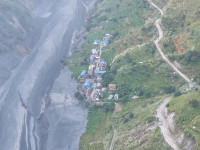
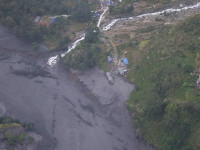
Deep beneath the mud and debris of Nepal’s Trishuli corridor, hundreds of hydropower workers are believed to be trapped in tunnels and underground powerhouses.
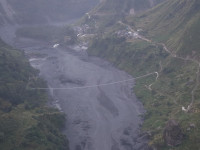
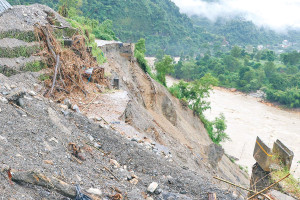
Three days after Wednesday’s catastrophic flood, rescuers are still struggling to reach some of them. Roads and bridges have been swept away, tunnel entrances buried and, in some cases, authorities do not know exactly where the workers are.
A video circulating widely on social media and in Nepali media offers a glimpse of one such rescue. It shows Nepali Army soldiers working through thick, frozen mud inside a tunnel, with one soldier pulling a trapped worker while another pushes him from behind.
The footage, filmed during the rescue of workers at the 216-megawatt Upper Trishuli-1 hydropower project, has drawn widespread praise for the Army. Soldiers have been working since Wednesday to rescue people trapped at hydropower projects and inside tunnels across the flood-hit Trishuli corridor.
But the dramatic rescue is only one part of a much larger crisis.
The Independent Power Producers’ Association, Nepal (IPPAN), says 934 people linked to 11 hydropower projects, including those under construction, remain unaccounted for. The precise number of people trapped at individual sites is still unclear, reflecting the difficulty of reaching facilities cut off by the flood.
At the 22.1MW Chilime Hydropower project, promoted by Chilime Hydropower Company Limited, eight people, including employees, remain out of contact. Six are believed to be inside a tunnel.
“We have not been able to carry out a rescue. The tunnel is filled with mud, and it is impossible to enter,” said Baburaj Maharjan, executive director of Chilime Hydropower Company. “We are working to mobilise a rock-climbing rescue team.”
The project’s tunnel and powerhouse have also been damaged, he said.
At Rasuwagadhi Hydropower Company, 49 employees remain out of contact, according to information officer Narayan Nath Neupane.
“There were 56 or 57 people at the dam site and powerhouse, and we have not been able to contact any of them,” he said. “We estimate that three to six people may be inside the six- or seven-storey underground powerhouse. We are hoping they are safe as long as the oxygen pipes have not been blocked.”
The Nepal Army has so far rescued 254 people from Upper Trishuli-1 and 18 from the 20MW Langtang Khola Hydropower project. But workers at several other projects, including Rasuwagadhi and Chilime, were still awaiting rescue.
Officials associated with the projects say access remains the biggest obstacle and have criticised the government for not giving the rescue effort sufficient priority.
Bijaya Mohan Bhattarai, promoter of Langtang Hydropower, said the project could now be reached only by helicopter after bridges on the approach roads were washed away.
“Bridges at several points leading to the project have been swept away. There is no way to get there by road,” he said. “Forty-two people are still unaccounted for. The government must make their rescue a priority.”
The Ministry of Energy, Water Resources and Irrigation said 350 people, including hydropower workers and residents, had been rescued from various projects by Friday.
The ministry also said it had information that more than 100 people were still trapped inside tunnels and that Nepali Army teams were continuing rescue operations.
“An update on the status and details of employees and workers at the affected hydropower projects was discussed at a meeting with project managers, IPPAN and representatives of the Nepal Electricity Authority (NEA), and efforts are underway to keep the details updated,” the ministry said in a statement. “Preliminary information suggests that more than 1,000 employees working at power projects in the affected area are currently out of contact.”
The uncertainty has prompted increasingly desperate appeals from colleagues and relatives.
Abhishekh Chauhan, an NEA employee, wrote on social media urging authorities to prioritise the rescue of people trapped at the 60MW Upper Trishuli-3A project.
“I am exhausted from repeatedly appealing to the authorities for rescue. I am no longer in a position even to write or speak about it,” he wrote. “Three days have passed, and they are still unaccounted for. With more than 35 people waiting for rescue inside and outside the tunnel, every passing second must be unimaginably painful and terrifying.”
Chauhan said a properly equipped operation involving enough personnel and specialised rescue experts had still not begun despite the passage of time.
The Energy Ministry said, however, that a special operation was underway to rescue employees trapped inside the underground powerhouse of Upper Trishuli-3A.
The entrance to the cable tunnel leading into the powerhouse has been buried, and the ministry said the Army and technical teams were using excavation equipment to clear it.
Dirgahyu Kumar Shrestha, acting managing director of the NEA, said more than 200 people working at several hydropower projects remained unaccounted for.
“We have been unable to contact 15 to 20 people at Chilime, more than 100 at Rasuwagadhi, 40 to 45 at the Upper Trishuli-3A powerhouse and 20 to 25 workers at Upper Trishuli-3B,” Shrestha said. “Because of the flood, we cannot even determine where some of the powerhouses and tunnels are.”
Some of those workers are believed to be trapped underground. Shrestha said getting oxygen into the tunnels could improve their chances of survival.
The flood has also knocked out 430MW of generating capacity from 14 or 15 hydropower projects along the Trishuli corridor. Shrestha said the shutdown would not immediately affect electricity supplies because domestic demand was still being met.
“We are meeting demand within the country, so there is no immediate problem,” he said. “We are discussing various options for restoring electricity supplies to the Dhunche area of Rasuwa.”
At the 37MW Upper Trishuli-3 project, 213 people, including insurance employees, security personnel and students undertaking internships, were initially reported missing. The project’s developer, Trishuli Hydropower Company Ltd, said it had contacted the relevant agencies on Wednesday seeking help with the search and rescue operation. It said 85 people had since been rescued.
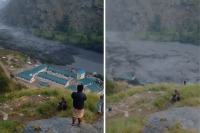
The project office and construction site have been completely buried under flood debris and effectively turned into a riverbed, the company said.
Anand Dhungel, executive director of Trishuli Hydropower Company, said heavy excavation equipment would be needed to search the site, but there was no road access.
The company is working through government agencies to bring an excavator to the area, he said.
The flood has inflicted losses running into billions of rupees on hydropower projects and transmission infrastructure, but officials say the immediate priority is finding survivors, rescuing the missing and restoring electricity generation.
Rajan Dhakal, NEA spokesperson, said the scale of the destruction was immense.
“An unimaginable loss of life and property has occurred,” he said. “The Rasuwa hydropower project has been completely swept away. The Chilime hydropower project has also been buried.”
He said the authority’s preliminary estimate put the damage at billions of rupees.
Brigadier General Manoj Thapa said the Army was giving priority to search and rescue operations in 19 hydropower tunnels.




 24.85°C Kathmandu