Internal party disputes delay cabinet expansion in Lumbini, Karnali
Disagreements over ministerial appointments have left both provincial governments struggling to complete their cabinets, with delays already affecting government business and budget implementation.
Internal disputes within the Nepali Communist Party over the distribution of ministerial posts have delayed cabinet expansion in Lumbini and Karnali provinces, leaving both governments struggling to get fully operational.
In Lumbini, dissatisfaction has emerged among lawmakers from the former Nagarik Unmukti Party and CPN (Unified Socialist), now part of the Nepali Communist Party, after the NCP recommended three former Maoist leaders for ministerial positions.
The three lawmakers from the former Nagarik Unmukti Party and one from the former CPN (Unified Socialist) joined the NCP after the parties merged. They now say they were used only to secure the chief minister’s vote of confidence and have threatened to sit in opposition.
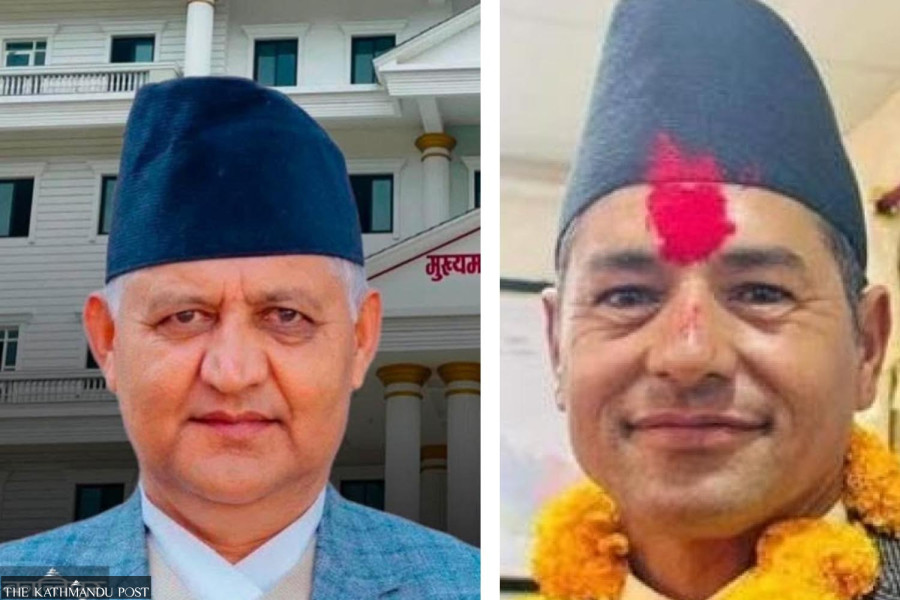
Chief Minister Chet Narayan Acharya has sent the proposed list of additional ministers and changes in ministerial responsibilities to provincial head Krishna Bahadur Gharti. The new ministers are expected to take the oath on Monday.
According to a source close to Acharya, Indrajit Tharu of Dang is set to become minister for economic affairs and planning, Dipendra Pun ‘Sijal’ of Rolpa is expected to take charge of health, and Krishna Kushma Tharu of Bardiya is likely to become minister for agriculture, land management and cooperatives. All three are former Maoists, while Tharu and Pun have previously served as ministers.
Naramaya Dhakal, a provincial lawmaker from the former Nagarik Unmukti Party, said they were preparing to “rebel” because they had been excluded from the cabinet despite supporting the government.
“We were apparently used only to secure the vote of confidence,” she said. “The names were recommended secretly, in a closed room, without informing us. According to the reports circulating outside, all three nominees are former Maoists.”
Dhakal said she had asked the speaker to arrange opposition seats for the lawmakers, arguing that they had been used merely to provide the numbers needed for the vote of confidence.
The NCP and UML had agreed to share power after forming the coalition. Under the agreement, the UML is to hold the chief minister’s post and the ministries of physical infrastructure, social development, and forests, environment and tourism. The NCP is to receive the ministries of economic affairs and planning, health, and agriculture, land management and cooperatives.
The five-member Janata Samajbadi Party-Nepal has been allocated the ministries of urban development, water supply, energy, water resources and irrigation, and internal affairs, law, industry and transport.
From the JSP-Nepal, Rupandehi’s Santosh Kumar Pandey is set to become minister for urban development, water supply, energy, water resources and irrigation, while Banke’s Bhandari Lal Ahir is expected to head internal affairs, law, industry and transport.
The cabinet reshuffle will also change the portfolios of UML ministers. Acharya will remain chief minister, while Ratna Bahadur Khatri is expected to take charge of physical infrastructure, Ramji Ghimire of social development, and Tulsi Prasad Chaudhary of forests, environment and tourism. UML lawmaker Dilli Raj Bhusal of Gulmi, who currently heads the urban development ministry, is expected to be retained as a minister without portfolio.
The provincial government had decided through its policies and programmes to limit the cabinet to eight ministries. However, the proposed arrangement has increased the number to 10.
Ghimire, who is also the government spokesperson, said no new ministries would be created but responsibilities were being rearranged for the time being.
“According to the government’s decision, there are nine ministries,” he said. “The ministers are scheduled to take the oath on Monday, after which everything will be finalised.”
He said the minister-without-portfolio arrangement would be temporary.
Dilli Bahadur Chaudhary, leader of the main opposition Nepali Congress, criticised the government for expanding the cabinet to maintain its hold on power.
“I had asked at the meeting where the government sought the vote of confidence why the number of ministries had been increased from eight to nine,” he said. “Now I hear that a 10-member cabinet is being formed. That is extremely wrong.”
He said the opposition would seek an explanation for the increase once the government provided a clear breakdown of the cabinet.
Karnali cabinet remains incomplete
In Karnali, Chief Minister Mangal Bahadur Shahi has also been unable to complete his cabinet because of disputes within his own NCP.
Shahi was appointed chief minister on July 28 and secured a vote of confidence last Wednesday, 23 days after taking office. He then appointed three UML lawmakers as ministers, but disagreements within the NCP have prevented him from filling the remaining posts.
The delay has created uncertainty in the provincial government, affecting budget implementation, public service delivery and development projects. The provincial assembly has also been left without legislative business.
No cabinet meeting has been held since Shahi became chief minister. According to Laxmi Kumar BK, secretary at the Chief Minister’s Office, only two decisions have so far been taken at the chief ministerial level.
“Preparations are under way on the necessary agenda, and the government may hold its meeting tomorrow,” BK said on Sunday. “The chief minister was alone for nearly three weeks. Even after three ministers were appointed, the cabinet has not met.”
Karnali has seven ministries. Before Shahi sought the vote of confidence, the NCP and UML had agreed to divide the ministries, with the NCP receiving the chief minister’s post and three ministries, and the UML getting three ministries.
The UML has already finalised its nominees and appointed them. Tek Raj Pachhai is minister for economic affairs and planning, Kal Bahadur Hamal heads water resources and energy development, and Jit Bahadur Malla heads social development.
The NCP has been allocated the ministries of physical infrastructure and urban development, industry, tourism, forests and environment, and land management, agriculture and cooperatives, in addition to the chief minister’s post.
But the party has yet to agree on its nominees.
An NCP provincial lawmaker said the large number of aspirants had made it difficult to complete the cabinet. The party’s recent merger has also complicated the process, with a lawmaker from the former CPN (Unified Socialist) seeking a ministerial post.
“The party has just been formed through a merger, which has created some difficulties,” the lawmaker said. “There is also one lawmaker from the former Unified Socialist who wants to become a minister. Almost everyone from the former Maoist faction is also aspiring for a ministerial position, so an agreement has not been reached.”
The former Unified Socialist faction has also insisted on being represented in the cabinet as a way of demonstrating the unity of the newly merged party.
The NCP has 14 lawmakers in the 40-member Karnali provincial assembly.
Chief whip Krishna Bahadur GC said the party was preparing to send new faces to the cabinet rather than lawmakers who had previously served as ministers.
“The cabinet also needs to be inclusive,” he said. “All three UML ministers are men and from the Khas Arya community. We need to ensure gender and social inclusion, which is why the selection has taken some time. The issue should be resolved within two or three days.”
The prolonged uncertainty could affect government operations throughout the financial year, according to former deputy secretary Khamb Prasad Thani.
“This is the time when the chief minister should be signing performance agreements with ministers and ministries should be preparing plans for implementing the budget,” Thani said. “The cabinet also needs to take policy decisions to address problems that may arise in development projects. But here, it is already taking nearly a month just to form the government.”
Kamal Lamsal, an assistant professor at Mid-West University, said the disputes at the beginning of the government’s tenure could have lasting consequences for its performance.




 14.82°C Kathmandu