Arghakhanchi to issue hunting licences to curb wild boar, deer menace
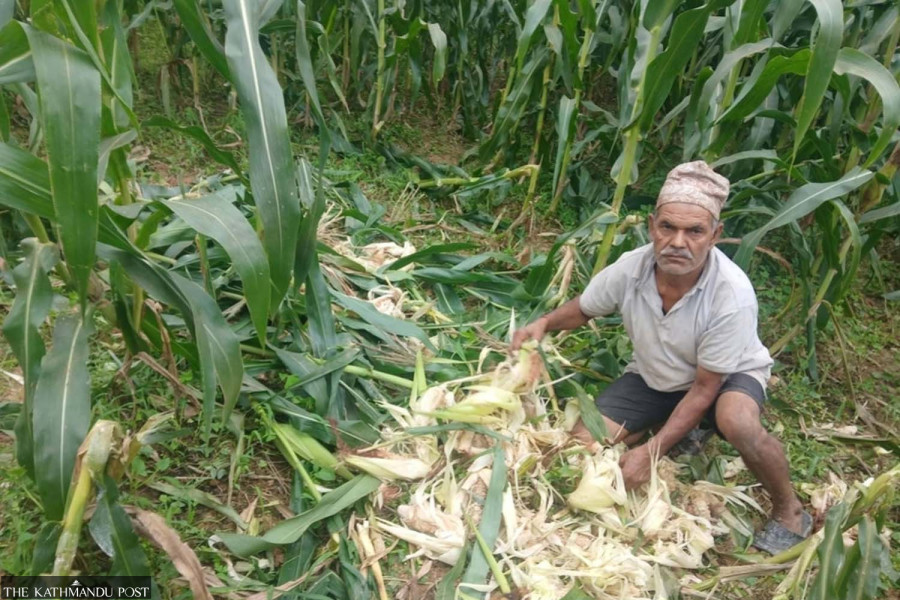
As crop destruction has reached a point of displacing farmers from their villages, the goal is to protect food crops, says forest officer. A farmer shows a maize crop raided by wild boars in Arghakhanchi district. Birendra KC/TKP
The Division Forest Office in Arghakhanchi is all set to issue licences to hunt wild boars, barking deer, and spotted deer. The decision follows a surge in grievances from farmers who suffer heavy crop losses due to the wild animals.
The forest office has invited applications from interested Nepali citizens for hunting licences in a bid to control the menace.
The office decided to issue hunting permissions after farmers across various areas in five local units of Arghakhanchi, a hill district of Lumbini Province, grew frustrated by persistent crop destruction by wild boars, deer and other animals.
On Friday, the forest office issued a public notice asking individuals willing to hunt wild boars, barking deer, and spotted deer using arms permitted by law to apply by August 26.
According to Senior Divisional Forest Officer Narayan Dev Bhattarai, the call aims to minimise damage to major crops. The notice specifies that applicants must submit a copy of their Nepali citizenship certificate, a valid licence for their firearm, and other documents required by law.
The forest office stated that licences will be issued under Rule 9 (1), Schedule 1 of the National Parks and Wildlife Conservation Rules, 1973, and Section 11 of the National Parks and Wildlife Conservation Act, 1973.
“As crop destruction has reached a point where farmers are being displaced from their villages, the goal is to protect food crops and support farmers,” said Bhattarai.
Although hunting of barking deer and spotted deer is permitted under the rules, priority will be given to killing wild boars based on complaints raised by farmers. Once the application deadline passes, hunting permits will be granted following discussions within the District Security Committee, headed by the Chief District Officer.
“Hunters will be allowed to cull wild boars whether in farmlands or in the forest. Hearing gunfire will not only scare wild boars but also drive away monkeys, which will help protect crops,” said Bhattarai.
Individuals receiving permission from the forest office will be allowed to hunt for a maximum of 10 days. Due to peace and security considerations, hunters will be deployed under strict conditions specifying designated areas, timeframes, and terms. Bhattarai emphasised that the primary objective is to safeguard agricultural output by controlling the soaring population of wild boars.
“Entire villages face the risk of desertion due to wild animals. To protect crops and support farmers, we have adopted this legal mechanism,” said Bhattarai. He added that legal provisions allow hunters to consume the meat of the wild boars they kill.
Keshar Khadka, information officer at the Division Forest Office, noted that sub-division offices identified 22 high-risk locations in the district where wild boars cause severe damage. Hunting permissions will be granted specifically for these affected areas. According to Khadka, the hardest-hit areas include six locations in Sitganga Municipality, three in Panini Rural Municipality, and several sites across Sandhikharka Municipality, Chhatradev Rural Municipality, and Malarani Rural Municipality.
Only individuals holding valid firearm licences will be eligible to hunt. Khadka explained that decisions regarding how many hunters will be deployed and in which specific areas will be finalised during the licence distribution process.
“Under current provisions, a single person can hunt a maximum of two wild boars in a year. Applicants must pay Rs7,000 for the licence and an additional revenue fee of Rs5,000 to the government for each wild boar killed,” said Khadka. Selected hunters will be dispatched to designated forest areas under strict terms regarding territory, duration, and timing after technical assessments of submitted applications.
In Arghakhanchi, wild animals such as wild boars, monkeys, barking deer, and spotted deer cause year-round damage to food grains, vegetables, spices, and fruit crops. While monkeys raid maize fields during the day, wild boars cause havoc at night.
“In our village, wild animals destroying crops now outnumber humans,” said Pitambar Khanal, a farmer from Balkot. “An individual cannot chase away troops of monkeys or herds of wild boars alone. They do not just destroy farms; they enter homes, wreck cooked meals, and ruin clothes.” Khanal added that farming has become nearly impossible as crops cannot be protected.
However, the authority’s plan to control wildlife menace by issuing hunting licences may hit a snag with the very limited licensed firearms in the district. According to Chief District Officer Toya Narayan Subedi, only four people in Arghakhanchi currently hold valid firearm licences. Since hunters from outside the district may also apply, the forest office will make decisions based on applications received within the deadline.
“There is no legal provision to issue new firearm licences. We will proceed with further discussions on hunting permits based on how many applications we receive from existing licence holders,” said Subedi.
Monkey menace on farms is also unchecked in Arghakhanchi. To mitigate wildlife intrusion, the Division Forest Office deployed 26 monkey watchmen in Sitganga Municipality this year, funded by community forest user groups operating under conservation frameworks. There were 20 monkey watchers last year.




 25.92°C Kathmandu