Tensions flare in Susta after Indian personnel dismantle flood barrier
Residents say Indian security personnel crossed into Nepali territory and tore down a makeshift embankment built to protect the border settlement from flooding. The incident comes two months after Indian authorities objected to Nepal’s construction of a permanent flood-control embankment in the same area.
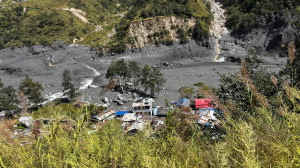
Tensions resurfaced along the disputed Nepal-India border in Nawalparasi West on Sunday after Indian security personnel crossed into Nepali territory and dismantled a makeshift embankment that residents had built to protect their village from flooding, prompting a confrontation with locals.
The incident comes just two months after Indian border personnel halted the construction of a permanent flood-control embankment being built by the government in the same area.
Videos circulating on social media show heated exchanges between residents of Susta in Nawalparasi West district and men identified by locals as Indian security personnel.
According to residents, a group of Indian personnel in plain clothes entered Nepali territory carrying spades and began digging up an earthen embankment that villagers had recently built to reduce the risk of floodwaters from the Narayani river inundating the settlement.
Residents rushed to stop them, triggering a standoff before Nepal’s Armed Police Force intervened to prevent the situation from escalating.
“We came together to stop Indian security personnel as soon as we saw them entering our land,” said resident Sarar Sah. “We protested as they arrived with spades and began destroying the embankment.”
He said the Armed Police Force later calmed the situation.
Residents say they could not remain silent while foreign security personnel entered Nepali territory and damaged structures built to protect their homes. A video filmed by Sah has since gone viral online.
Rabindra Jaiswal, spokesperson for the Susta Protection Campaign, said villagers had constructed the temporary earthen embankment only after Indian authorities blocked Nepal from building a permanent flood-control structure along the Narayani river.
“When the permanent embankment was stopped, residents piled up earth as a temporary measure to reduce flood risks,” he said. “Indian security personnel in plain clothes then crossed over and began digging it up.”
Chief District Officer Dipak Raj Nepal confirmed that a dispute had broken out between residents and Indian security personnel over the embankment. He said officials from both sides are expected to hold discussions on Monday in an effort to resolve the issue.
Long-running border dispute
The latest confrontation highlights the unresolved territorial dispute surrounding Susta, one of the most sensitive stretches of the Nepal-India border.
While 16 border pillars mark most of the Nepal-India boundary in Nawalparasi West, none exist along the roughly 24-kilometre Susta stretch.
Instead, the two countries rely on natural features such as rivers and trees to indicate the boundary, leading to recurring disputes over land ownership and cultivation. A silk cotton tree currently serves as the de facto boundary marker in part of the disputed area.
Residents say the Narayani river’s changing course over decades has further complicated the border.
Sunday’s incident follows a similar dispute on May 31, when India’s Border Security Force (SSB) entered ward 5 of Susta Rural Municipality and objected to the construction of a permanent embankment being built by Nepal’s Ministry of Energy, Water Resources and Irrigation.
The Rs140 million project aims to protect settlements from erosion and flooding.
Residents said about a dozen Indian security personnel arrived at the construction site and warned workers not to continue.
According to Chief District Officer Nepal, the dispute centred on a new 132-metre section of embankment planned about 50 metres east of an existing structure, still within Nepali territory.
Hari Pant, the engineer overseeing the project, said Indian security personnel, who arrived in uniform, instructed workers to stop construction before leaving.
Jaiswal said Indian authorities had objected specifically to the 132-metre extension, despite the broader project covering about one kilometre along the river.
The embankment project was launched after former Energy Minister Kulman Ghising visited Susta eight months ago and directed authorities to prioritise flood protection for the vulnerable settlement.
Susta is surrounded by the Narayani river to the north and west and India’s Bihar state to the south and east.
India maintains three SSB outposts near the area, while Nepal has a Border Security Post staffed by the Armed Police Force under the command of an inspector.
Residents say Indian authorities have repeatedly challenged Nepal’s activities in the area, citing the absence of clearly demarcated border pillars.
Historical roots
Susta has been at the centre of Nepal-India border tensions for decades.
In 1965, then-King Mahendra settled around 400 families, including retired soldiers, in the area to strengthen Nepal’s presence along the frontier.
Residents say Indian authorities opposed the settlement from the beginning.
In 1970, an Indian group reportedly chased away a Nepali government team that had travelled to distribute land ownership certificates. Nepal later deployed police to complete land surveys and issue titles to roughly 400 families by 1974.
However, after the Narayani river changed course in 1977, much of the settlement turned into riverbed, forcing many residents to relocate. Locals say India has since taken advantage of the shifting river and the absence of permanent border markers to expand its presence.
Adam Kha, acting chairman of the Susta Protection Campaign, said residents have little confidence in district-level meetings between Nepali and Indian officials.
“Can a meeting between district administrators resolve an international boundary dispute?” he said. “People who know Susta best are rarely included in these discussions. The issue requires a high-level bilateral mechanism backed by historical records and proper boundary surveys.”
Security concerns intensify
Repeated confrontations over the embankment have prompted Nepal to strengthen its security presence in Susta.
Over the past two months, senior officials from the Nepali Army, Armed Police Force and Nepal Police have visited the area to assess the situation.
The home ministry has also instructed district authorities to address long-standing concerns raised by residents, including difficulties in obtaining citizenship certificates.
One visit by senior Nepali Army officers in plain clothes drew particular attention from the Indian side.
According to a senior Nepali security official, Indian security personnel questioned the purpose of the team’s presence after noticing unfamiliar faces in the border village.
“They were naturally curious when they saw new people in such a sensitive area,” the official said.
The inspection team, led by senior Nepali Army officer Yam Bahadur Adhikari, visited Susta on July 6 to assess conditions on the ground.
Brigadier General Rajaram Basnet, spokesperson for the Nepali Army, said thesaid the visit was part of nationwide assessments of monsoon-related disaster risks and had no other objective.
“It was purely to assess monsoon and disaster risks,” Basnet said.
Armed Police Force Additional Inspector General Anjani Pokharel and Lumbini Province Police Chief Deputy Inspector General Bhupendra Bahadur Khatri have also inspected the area separately.
Nepal has increased the number of Armed Police personnel stationed in Susta from 25 to 40 in response to growing tensions.
Residents seek stronger protection
Residents have stepped up pressure on the government to improve security and address long-standing administrative problems.
Two weeks ago, 52 residents led by Susta campaigner Munna Kha travelled to Kathmandu and staged a protest at Maitighar Mandala, demanding stronger state protection.
During a meeting with Home Minister Sudan Gurung, they urged the government to establish a Nepali Army security post in Susta, alleging years of harassment by Indian security personnel.
Following the meeting, the home ministry instructed the district administration to reinforce security in sensitive areas of Susta and to begin processing citizenship applications for eligible residents who lack citizenship documents.
Local authorities say work has already begun to compile the necessary records for issuing citizenship certificates to eligible residents.




 14.82°C Kathmandu