How video calls have become the new daily ritual for lonely Nepali parents
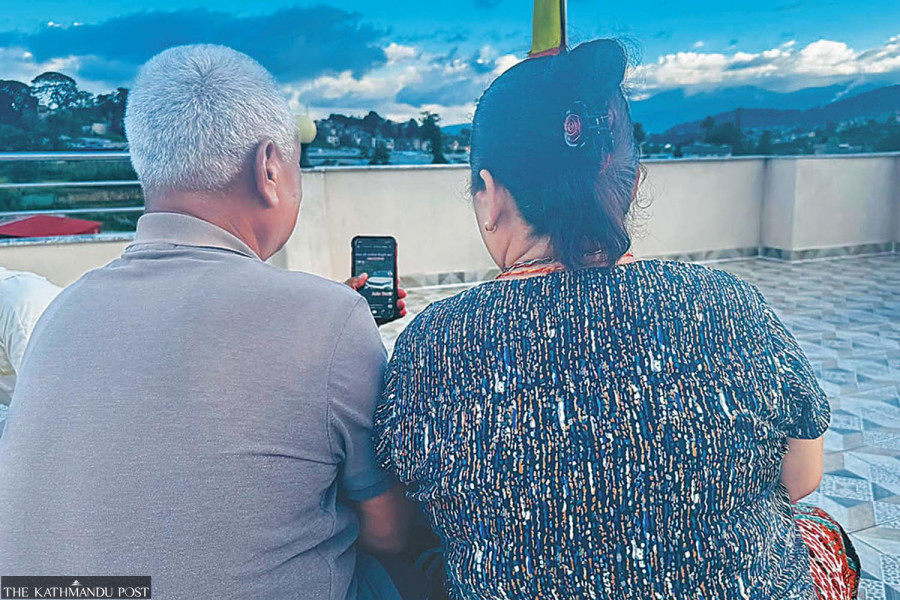
As more young Nepalis build lives abroad, aging parents are relying on daily video calls to stay connected while grappling with the loneliness of an empty home.An elderly couple whose children live abroad scrolls through social media on their phone. Post Photo
Every evening, Kamal Nath Dahal waits for the same thing.
It is not a visitor at his door. It is not the sound of footsteps in his hallway.
It is the glow of a mobile phone screen.
When his sons, daughters-in-law and three-year-old granddaughter appear on the screen from Japan, the quiet room where he lives alone in Kathmandu suddenly feels less empty.
For a few minutes, the distance between Nepal and Japan disappears.
Dahal asks about their day. He watches his granddaughter’s expressions. He listens to his sons’ voices.
Then the call ends, and the silence returns.
The 68-year-old from Melamchi, Sindhupalchok, has built a routine around that silence. Each morning, he performs his prayers, prepares his meals, reads books, listens to the news and goes about his work.
“Work is the one thing that keeps my mind busy,” he said.
But staying occupied does not erase the feeling of missing his family.
“We talk on the phone a lot. I know everything happening in their lives. But the happiness of sitting together in Nepal, eating whatever is cooked in the same kitchen, cannot be compared with a video call.”
For Dahal, the hardest moments come during festivals.
“When you see everyone gathering with their families, you wonder how wonderful it would have been if my sons were here with me,” he said.
Yet the same technology that reminds him of the distance also helps him endure it.
“The mobile phone has become like a god for people like us. It brings distant people close,” he said.
The phone has also become a way for him to preserve a connection with his granddaughter, who was born in Japan and is growing up far from Nepal.
Whenever she appears on screen, Dahal asks her the same question.
“Say ‘Ba’,” he tells her.
The little girl responds.
“Ba.”
He smiles.
He has taught her other Nepali words too—“Aama” (mother), “Kaka” (uncle) and “Kaki” (aunt). He worries that children growing up abroad may lose their connection to their family’s language and culture.
“Wherever children live, I want them to remember their country and their language,” he said.
His sons have invited him to visit Japan several times, but he has not been able to go.
His bigger hope is different: that one day they return home.
“Foreign countries are places to learn, not places to spend your entire life,” he said. “Work there, gain experience, but invest in your own country.”
For now, the phone screen is his window into the lives of the people he loves.
But his real wish remains unchanged.
“One day, I hope my sons return to Nepal permanently, and we can sit together in the same kitchen and eat again.”
Dahal’s story is becoming increasingly common.
As thousands of young Nepalis leave for education, employment and better opportunities abroad, many parents are growing older in homes where their children’s voices now arrive through a screen.
In Pokhara’s Ratnachowk neighbourhood, 69-year-old Saraswati Maharjan lives among reminders of the family she misses.
Photographs of her parents, daughters, sons-in-law and grandchildren cover the walls of one room in her two-storey house.
Her elder daughter has lived in Japan for 13 years. Her younger daughter lives in Janakpur.
Although one daughter is still in Nepal, Saraswati says distance can exist even within the same country.
“When my elder daughter came from Japan, my younger daughter also came to meet her,” she said. “Even though she is in Nepal, it feels like she is abroad. She has not come since.”
Her husband, once a chef at a Pokhara hotel, suffered a health emergency several years ago. Both daughters returned during his treatment, but eventually left again.
Today, he can walk around the house but has lost his ability to speak.
“Earlier, we would spend time talking together. Sometimes we would go out during fairs and festivals,” Saraswati said. “That is no longer possible.”
Technology helps her stay connected with her daughters.
The family has a Messenger group where they regularly talk through video calls.
“I do not feel like my daughters are far away,” she said.
But festivals remain painful.
“Dashain, Tihar and Teej are the hardest,” she said. “When daughters and relatives return to everyone else’s homes, my house feels empty.”
Still, she understands why her daughters left.
“We struggled to educate our children,” she said. “Once they studied and grew wings, we had to let them fly.”
For Hari and Mina Gurung (names changed), the empty spaces left behind by migration have become part of daily life.
The couple, aged 64 and 61, have lived alone in Kathmandu’s Tokha area for nine years.
Their daughters moved to Australia, one for higher education and another for work.
Hari once encouraged them to leave, believing foreign education would create opportunities.
Today, he understands the cost.
“At that time, we thought studying abroad would give our children better opportunities,” he said. “But after finishing their studies, they begin thinking about settling permanently. That leaves you with a strange emptiness.”
Their days now follow a quiet rhythm—morning walks, exercise, newspapers, household chores, gardening and caring for chickens.
Their daughters remain close through regular calls.
“They call us, send voice messages and leave messages,” Hari said. “That alone reassures us.”
But Mina says the absence becomes more frightening during illness.
“When we were alone, we worried about what would happen if both of us fell sick at the same time and our children were not around,” she said.
Not every parent experiences distance as a loss.
For 63-year-old Dr Samjhana Dhakal of Kupandol, Lalitpur, her son’s life abroad is something she accepts.
Her son lives in Scotland, but daily conversations have kept their relationship strong.
“I speak with my son, daughter-in-law and grandchildren every day,” she said. “Technology has made the world much smaller.”
Dhakal believes parents must allow their children to pursue their futures, even when that means living far away.
“As parents, we cannot think only about wanting them beside us,” she said. “A child’s progress is the greatest happiness for a parent.”
Having lived abroad herself for education, she understands the choices her son made.
For many Nepali parents, migration has created a new reality.
Their children may be thousands of kilometres away, but they remain only a phone call away.
Technology has shortened the distance.
But for parents like Dahal, the dream is still simple: not another video call, but a family meal at the same table, in the same kitchen, once again.
When children and families live far apart, their relationships are likely to weaken, says Laxman Prasad Sharma, Associate Professor of Sociology at Tribhuvan University. While technology allows parents in Nepal to stay in touch with children living abroad through video calls and messaging apps, he argues that digital communication cannot preserve the emotional closeness that comes from living together.
Technology may create the impression that families remain connected, Sharma says, but “social, family and emotional relationships have become increasingly fragile as migration has grown.” Beyond physical distance, he warns, prolonged separation weakens family intimacy, disrupts the transfer of cultural values between generations, and shapes how children are raised and socialised—processes he considers fundamental to a healthy society.
Although Sharma acknowledges the benefits of technology, he believes it cannot replace face-to-face interaction. “Technology can be a tool for building a modern society, but it cannot be an end in itself,” he says.




 15.7°C Kathmandu