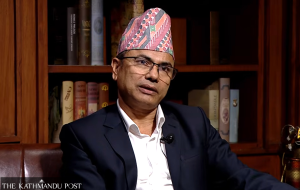
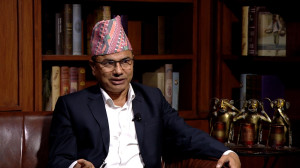
This is not standard flooding; it is a Himalayan Tsunami: Foreign Minister Shisir Khanal
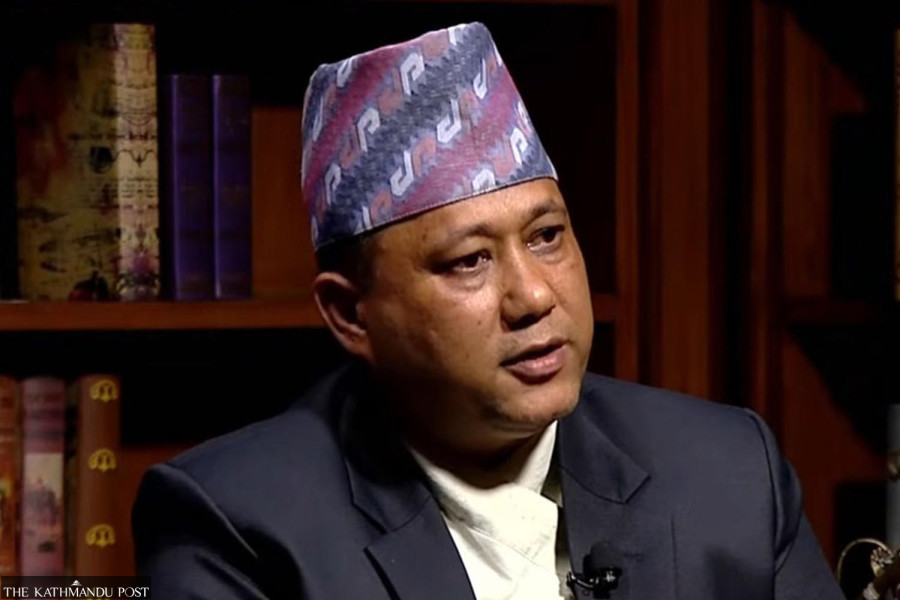
As specialised multi-national rescue teams battle shifting topographies to reach buried hydropower tunnels, Foreign Minister Shisir Khanal explains why Nepal is demanding legal climate compensation for a catastrophic “Himalayan Tsunami” it did not create. Foreign Minister Shisir Khanal
Following the unprecedented disaster in Rasuwa and surrounding northern districts, Nepal finds itself in the grip of a profound humanitarian and infrastructural crisis. Foreign Affairs Minister Shisir Khanal speaks about the scale of the disaster, the logistical nightmare of high-altitude tunnel rescues, and why Nepal is shifting its diplomatic posture from requesting humanitarian aid to demanding climate compensation.
This Q&A has been edited for clarity and length, and is based on an interview on Kantipur TV’s Fireside by Rupesh Shrestha.
Minister, you recently returned from a field visit to Nuwakot. What is the real-world scale of this disaster?
When the first reports came in around 9am, our immediate conceptual imagery of a “flood” was a standard seasonal rise in river levels. But having spent the day in Nuwakot, I realised how limited our vocabulary is.
This was not a standard flood. With wave heights reaching 20 to 30 meters and speeds clocked at 180 kilometres per hour, this was a disaster of tornado-like velocity—what many are rightly calling a “Himalayan Tsunami”. It is a scale of disaster that is entirely outside the living memory of Nepal.
The damage is immense. Early assessments indicate that ten municipalities across Nuwakot, Rasuwa, and Dhading—spanning 30 to 32 wards—have been heavily impacted, with additional damage downstream in Gorkha and Chitwan. We are looking at tens of thousands of damaged private homes, alongside heavily hit schools and multi-billion-rupee hydropower projects.
There has been criticism that the government was slow to seek international help, choosing instead to rely on its own resources. How do you respond to this?
There was absolutely no delay or rigidity on our part. The disaster unfolded rapidly. By 11am, while the floodwaters were still surging toward Dhading, the prime minister convened the National Disaster Council and mobilised security forces for immediate search and rescue.
Our initial priority was saving lives on the surface. By the second day, as our ground teams assessed the buried hydropower projects, they reported a critical need for highly specialised tunnel rescue support. We communicated this need immediately.
Because of high-altitude weather and transport limitations, airlift was the only viable option. Despite heavy cloud cover on the third afternoon that delayed flights, the Indian specialised tunnel rescue team arrived on the ground by the evening of the third day. The Chinese specialised team arrived by the afternoon of the fourth day, and a South Korean team is actively working at the Upper Trishuli site. Within 72 hours of identifying the need, international specialised rescue operations were fully operational on-site.
What is the status of the rescue operations at the buried hydropower tunnels, such as Trishuli 3A and Chilime? Is there still hope of finding survivors?
We must maintain hope and exhaust every possibility. Historically, there are global precedents—such as the 2018 Thailand cave rescue, or tunnel incidents in India in 2023 and China in 2021—where survivors were rescued after 14 to 18 days due to natural air pockets. Even if a tunnel is partially blocked, if there are air pockets, survival is possible.
However, the public must understand the extreme complexity on the ground. This is a highly complex disaster. These are not simple horizontal cave openings. The entire topography has shifted; hillsides have sheared off, leaving vertical cliffs covered in deep, unstable debris. In some areas, our rescue teams are literally sinking into quicksand-like mud.
At Trishuli 3A, teams had to locate the buried tunnel entrance using engineered maps because the surface construction was entirely erased. Instead of drilling horizontally, rescuers had to dig a vertical shaft—like a 30-foot well—just to reach the concrete crown of the tunnel. Once they breached it, they immediately began pumping in oxygen.
Currently, the Chinese team is working at the Trishuli 3A site, the Indian teams are deployed at Chilime and Langtang, and the South Korean team is coordinating at Upper Trishuli. While our security forces successfully cleared and entered the final points of the Rasuwagadhi tunnel on Monday, unfortunately, no survivors or bodies were recovered there. We are continuing to mobilise every local and international resource available.
The Rasuwagadhi-Kerung border is closed, and there are reports of temporary closures at Tatopani. How is the government managing bilateral trade and stranded travellers, particularly Mansarovar pilgrims?
Our northern supply chains and tourist corridors have been severely disrupted. Because the Tibet Autonomous Region is highly sensitive, Chinese regulations typically dictate that travellers must exit through the exact border post they entered.
To bypass this restriction, we actively negotiated with Chinese authorities to allow stranded Nepalis and foreign tourists to exit via alternative crossings. Stranded Nepalis have already begun returning through the Hilsa crossing in Humla. Furthermore, we have formally requested that the Korola border crossing in Mustang be used to evacuate foreign tourists who cannot return via Rasuwagadhi.
Regarding trade, hundreds of cargo trucks are currently stranded on the Chinese side of the Rasuwagadhi border. We have requested permission from Chinese authorities to reroute these cargo flows through the Tatopani and Korola crossings to prevent a total collapse of our northern supply lines.
You have stated that Nepal will no longer treat post-disaster assistance as mere “humanitarian aid” or bilateral grants. What is the government’s new diplomatic strategy?
Nepal’s greenhouse gas emissions are virtually negligible. Yet, we are paying the ultimate price for a global crisis we did not create. The rapid melting of glaciers and these catastrophic mountain tsunamis are direct consequences of global climate change.
We are shifting our diplomatic framework from “aid” to “justice and compensation”. This is not a matter of charity; it is a matter of legal and moral liability. The major industrial emitters—such as China, which is the world’s top emitter, the United States at number two, and India at number three—have a historical responsibility to compensate vulnerable nations like Nepal.
To this end, the Ministry of Finance has officially dispatched a formal climate compensation claim letter to our international partners. We will be raising this issue with absolute firmness and clarity at every upcoming international forum. This is a matter of civilisational survival. If our Himalayan glaciers disappear, the water security of over two billion people in South Asia—dependent on rivers like the Ganges and the Trishuli—will be permanently compromised. We are advocating not just for Nepal, but for the survival of South Asian civilisation.
There is a strong perception that the government is more active on social media than on the ground, and that citizen deaths are treated merely as statistics. Why does Prime Minister Balendra Shah use his personal Facebook page to disseminate official government updates instead of official institutional channels? What about citizens who are not on social media, or cannot read?
For those whose family members are still missing or out of contact, their grief and frustration are completely understandable, and the government’s sole objective is to mobilise every available resource to find them. A citizen’s life is never just a number to us; it represents a family’s entire future, hope, and happiness.
Regarding the prime minister’s communications, his personal Facebook page has been his primary political platform since the very beginning of his public career. It has millions of followers, making it mathematically the most immediate and effective channel to reach a massive audience. While the Prime Minister’s Office maintains its own official communication handles, the reach on his personal page is far greater. These updates are immediately picked up by mainstream newspapers, television networks, and radio stations. This broadcast ensures that regular video and audio reports are generated, effectively reaching citizens who are not on social media or are illiterate.
Many citizens stranded in temporary camps, such as Laharepauwa, complain that while they see helicopters flying overhead, actual relief supplies—food, clothing, and sanitary products—are not reaching them. How is the government regulating relief distribution?
We recognise these grievances and are working to streamline the supply chain. In the initial rescue phase, helicopter flights are centralised and highly fluid—sometimes flying to extract a single stranded individual, which is highly inefficient from a resource perspective but necessary to save lives.
For the relief phase, we have established a strict coordination mechanism. Relief materials are dispatched only after direct coordination with local Ward Presidents to ensure they go where they are actually needed.
Regarding financial transparency, the Prime Minister’s Disaster Relief Fund has already received over Rs5 billion in public and diaspora contributions. This fund is heavily regulated and will be strictly channelled into immediate relief operations and long-term reconstruction. We are fully committed to ensuring that not a single rupee of these public donations is wasted on unnecessary administrative overheads or government luxury travel. We will stand firmly with our citizens through the rescue, relief, and eventual reconstruction phases.




 15.88°C Kathmandu