Samrat Upadhyay on Nepali identity, writing across continents and the stories still left untold
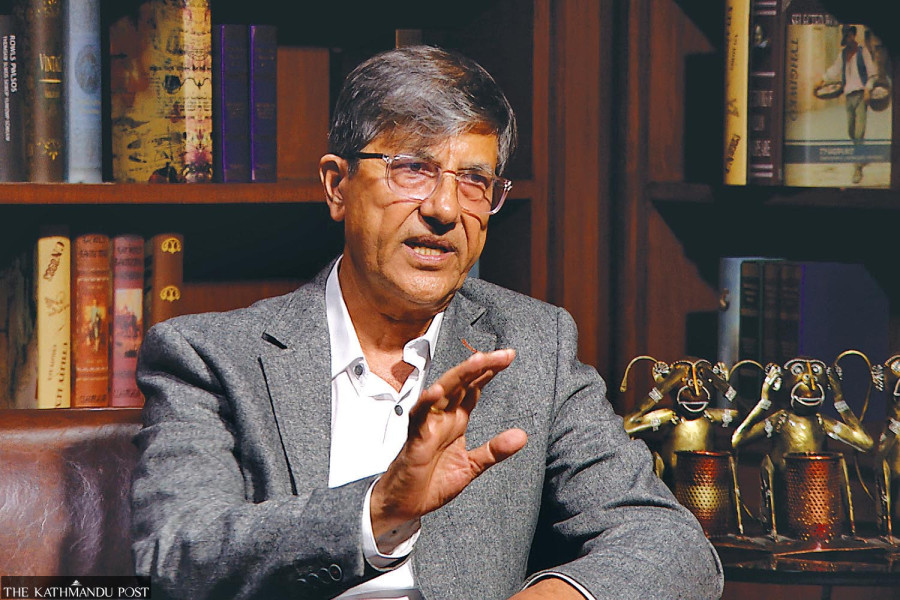
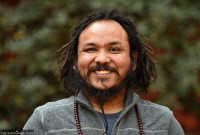
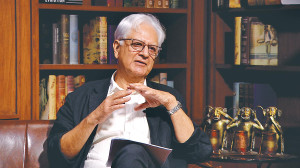
In an interview with Kantipur, the acclaimed author reflects on his seven-book literary journey, the influence of American academia, his latest novel, and the universal psychology at the heart of his fiction.Samrat Upadhyay, acclaimed author Post photo
Born in Nepal and now based in the United States, acclaimed author Samrat Upadhyay stands among the few writers of Nepali origin shaping international literature in English. Leaving for America in 1984, his creative roots have remained steadfastly anchored to his homeland. Currently a professor of Creative Writing at Indiana University, his celebrated bibliography, culminating in his latest work Dark Motherland, consistently explores the nuances of the Nepali context for a global audience.
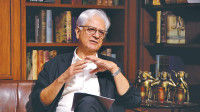
In this expansive conversation with Kantipur TV’s News Chief Rupesh Shrestha, Upadhyay reflects on decades of writing across continents, the shifting landscape of Kathmandu, and the enduring resilience of the Nepali psyche in an increasingly interconnected world. Excerpts.
When you look back at the Nepal you left and compare it to the country you visit today, what are the most striking differences?
There is an immense difference. I was born and raised in the Kathmandu of the early eighties, which was a far more spacious and walkable city. Today, that has changed entirely. Technology has transformed the landscape over the years. Through social media, Zoom, and WhatsApp, we feel much closer to the rest of the world even while sitting here. One thing I find absolutely fabulous now is the restaurant scene in Nepal. I brought a group of my students here recently, and we found world-class cuisine. There is a unique skill here where a single restaurant can serve authentic Nepali dal bhat alongside pizza and pasta, and it is all genuinely delicious.
The infrastructure has also seen a massive shift. I took my students to Mustang during this trip, and seeing the highway to Muktinath looked amazing. It looks very much like the highways we have back in the US.
While the physical transformation is significant, certain attitudes—the Nepali psychology, if I may—remain the same. There is a specific kind of kindness and a social nature inherent to Nepali people that hasn’t changed, which I find very beautiful.
You often mention your early days writing for ThePost. Even after decades abroad, the stories of Nepal seem to never let go of you. Why is that?
It is something of a mystery, really. A writer is often attracted to certain subject matters instinctively. I lived in Nepal for the first twenty-one years of my life, so my attachment to this place is constant. For many in the diaspora, that longing actually intensifies once they are away. It becomes mixed with a certain kind of nostalgia.
Beyond that, I feel there are still so many stories about Nepal that remain untold, particularly in the English language. I enjoy exploring those narratives. I have just published my seventh book, yet I feel as though I haven’t even begun to exhaust the stories I want to tell. For a writer living in the US, the Nepali story is ‘exclusive’. Non-Nepali writers who attempt to write about this place have a very different understanding. Even though I have spent most of my adult life in America, my internal identification remains firmly Nepali.
At what point did you start seeing yourself as ‘Nepali American’ rather than just ‘Nepali’?
In the beginning, when the American media started identifying me as a ‘Nepali American’ after I got my citizenship, it felt quite strange. I thought to myself, “Am I really a Nepali American?” I always considered myself just Nepali.
Taking an American passport was actually a very practical decision. For the longest time, all the way through my PhD, I was on an F1 student visa. Even when I got my first job, the green card process was only just starting. My wife used to ask me why I hadn’t sorted it out after so many years. The primary motivation was travel. With a green card, I had to drive four hours to Chicago just to get a Schengen visa for Europe. An American passport simply opened up the world for me. Now, with the Non-Resident Nepali citizenship being available since last year, I feel I have the best of both worlds. It is a privileged position that allows me to do a lot.
Does it ever feel contradictory or difficult to balance those two identities—living in the West but mentally residing in the stories of the East?
As a writer, you understand that these situations are often best explained through creative language. My identity isn’t exclusive; it is hybrid. If I count the years, I have actually lived in America longer than I lived in Nepal, so I owe something to my American readership as well.
This hybridity is very evident in my daughter. She was born in the US, and while we taught her the culture and the language—she speaks Nepali well—a large part of her identity is American. Some people in the diaspora are surprised she speaks Nepali, even if she has a bit of an accent. She can navigate Kathmandu, go shopping, and even bargain in the ‘Nepali style’. People here are often charmed by that—a girl who looks Nepali, speaks with an accent, but knows exactly how to haggle. That hybridity is part and parcel of the modern diasporic life.
In today’s world, does a writer need a ‘global’ passport to become a truly international talent?
That is a complex question. I wouldn’t say it is an absolute necessity because the publishing industry has become more fluid. There are Indian writers living in India and Nepali writers living here who are publishing successfully in the US while holding their original passports. However, I think the length of time I have spent in America and the discipline of my writing have helped me more than the passport itself.
That said, the passport does help in practical ways, such as when you are invited to international literary festivals. When they ask about your citizenship for payment structures, having that status simplifies things. It allows me the freedom to focus on what I want to do: writing.
Your first book, Arresting God in Kathmandu, was a global success in 2001, even being reviewed by theNew York Times. Now, your seventh book, Dark Motherland, is out. How do you view this journey over the last two decades?
It has been an amazing journey, but one filled with many challenges. When I started, I had a certain naivety. I thought that once I published one book, the path would be paved with gold and every subsequent book would be easy because I had ‘mastered’ the craft.
The reality has been exactly the opposite. Each subsequent book has become more challenging, sometimes even a kind of mental torture. You want to become a better writer with every project. If you don’t challenge yourself, you atrophy. Each novel teaches you how to write it. There is no guarantee that because you wrote one good book, the next one will follow the same format. You are a new writer and a student of writing every single time. Even as a professor of creative writing, I feel like I am starting from scratch with every new book.
Is it difficult to maintain the psychological authenticity of Nepali characters while living so far away?
That aspect isn’t as difficult as people might think. There is criticism that one cannot write accurately about Nepal while living in America, but for me, the greater challenge is the structural integrity of the book itself. I am a writer of human psychology, and that doesn’t change. A person in the 14th century had the same basic aspirations and emotions as someone today. Technology and settings change—perhaps the relatives have moved to Europe or the houses are bigger—but the core psychology of happiness, sadness, and family dynamics remains universal.
When you bring your American students to Nepal, do you notice a difference in how they perceive the world compared to students here?
Culturally, there are differences, but the underlying psychology is similar. Everyone wants similar things, though they might manifest differently. An American student might immediately dream of becoming a millionaire, while a Nepalese student might dream of becoming a karodpati, but the ambition is the same.
When Arresting God in Kathmandu was first reviewed in the New York Times, the reviewer mentioned they hadn’t realised people in Nepal struggled with the same things as people elsewhere. I found that quite funny. Of course they do! Why would that be a surprise? But the old Western image of Nepal was a ‘Shangri-La’ where people were poor but spiritually happy. I think my work helped diffuse that exoticism.
The primary difference I see is in the method of education. In Nepal, the system is often lecture-oriented, where students take notes, and the teacher provides inherited knowledge. In the US liberal arts system, everything is based on conversation and the room to experiment. When I first went to the US, I intended to study commerce, but I discovered I could follow my interests into theatre, journalism and literature. My classes now are very discussion-oriented. My students often disagree with me, and that is a democratic process where new knowledge is created through dialogue.
How do you react when a student tells you they think you’re wrong?
I view it as just an opinion. I am still a student of writing myself. While my immediate instinct might be to think ‘I know better’, it is entirely possible the student is right. In art, unlike perhaps in factual science, there is no absolute right or wrong. It’s all part of a larger conversation that helps us understand how to build a society where we can manage disagreements. In my classroom, we discover things together.
Does that same sense of disagreement apply to your own work? Do you ever look back at what you wrote the day before and hate it?
Constantly. You might write something with great passion and think it’s brilliant, only to look at it two days later and think it’s rubbish. Then, two days after that, you might decide it’s not so bad and try to extract something useful from it. That is the torture I mentioned—the constant self-doubt. I am my own harshest critic. But that dialogue with your own work is what prevents the illusion of mastery. A reflective life, where you challenge your own opinions, makes you a better person and a better artist.
Your latest book, Dark Motherland, took about a decade to write. It feels like a departure from your earlier realism. What sparked that change?
It was supposed to be a different novel entirely—a story about a Manglik widow. But then the Gorkha earthquake happened. It was devastating. My parents were here in Nepal, living in a tent, and for a while, we didn’t know who was alive or dead. Real life intruded in a profound way, and I couldn’t continue with my original vision.
I started thinking: What would happen if a dictator took advantage of such devastation to come to power? That is how the character ‘PM Papa’ was born. At the same time, we were seeing the rise of Donald Trump in America. Many people viewed him as a clown initially. I remember being in Europe and confidently telling someone he would never become the nominee. Well, we know what happened. I once spoke to a Hispanic audience in Minnesota who told me they called him ‘Cornhair’ in Mexico, so I stole that for a character called ‘President Cornhair’.
So, Dark Motherland became this sprawling novel that challenged me. I let myself go because a novel has to teach you how to write it. It is probably the most hybrid of all my works.
You’ve moved from realism to exploring more fantastical or dystopian elements. Did you feel realism wasn’t enough this time?
I used to be a strictly realist writer, influenced by authors like Raymond Carver and William Trevor. But many of my American students now write science fiction and pure fantasy. That influenced me, as did reading dystopian works like Orwell’s 1984. For the subject matter of Dark Motherland, pure realism felt inadequate.
However, even when I write about politics or use magical moments, my focus remains on how these forces affect the individual. In some South Asian or African literature, politics can become so overwhelming that the author ends up preaching or being didactic. I want to avoid that. I want to show the human condition through the lens of politics, not the other way around.
Given the recent Gen Z movement in Nepal, have your colleagues or students in America asked you about the changes happening here?
They have. The biggest news out of Nepal for Westerners used to be the Royal Massacre, but this movement also alerted people. My colleagues in the academic community take a great interest in world affairs. When they saw what was happening, they were amazed. Some even joked that they needed that kind of revolution in America because of their unhappiness with the current political climate.
From the perspective of the diaspora, there is a real sense of excitement that change is finally possible in Nepal. For the longest time, we saw the same old leaders being recycled since the eighties and nineties. But this hunger for new faces is also happening in America with the rise of younger, more progressive leaders. It seems a shift is happening in both countries.




 17.65°C Kathmandu