24 days after flood, hunger grips three Rasuwa wards
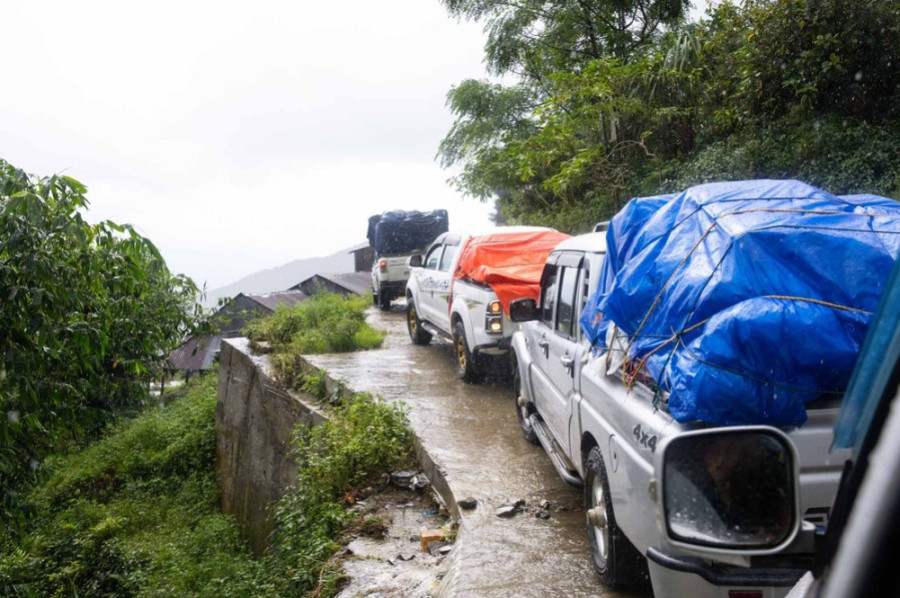
Food is running out in villages cut off after the Bhotekoshi flood swept away bridges. In this file photo, pickup trucks laden with relief materials head to Dhunche, the district headquarters of Rasuwa. Photo: Nepal Photo Library
It has been 24 days since Tashi Wangden, husband of Jandra Tamang from ward 2 of Amachhodingmo Rural Municipality in Rasuwa district, went missing in the devastating Bhotekoshi flood.
Tashi, a labourer, was on his way to Kerung (Gyirong in China) and had reached Rasuwagadhi, the Nepal-China customs point, when the devastating flood swept him away on August 26.
Jandra has six children, the youngest just five years old. But no relief has reached the village so far.
The food at home has now run out.
“We have been surviving on potatoes in the morning, during the day and again in the evening,” said Jandra's brother, Lakpa Kami Tamang. “We are now starving. On top of the pain of losing a family member, we are suffering because we cannot feed our children, who cry from hunger.”
Twenty-four days after the flood, residents of wards 1, 2 and 3 of the rural municipality remain largely without adequate food as destroyed bridges have cut them off from regular relief supplies.
Lakpa Kami Tamang is also the ward 2 chair in the rural municipality. He himself lost eight family members, including his 22-year-old son, in the flood.
He said families who lost members in the disaster had so far survived by borrowing food, but their neighbours are also running out of food now. Some of the rice transported by helicopter to the district headquarters was later sent to the villages, but it arrived rotting, according to Tamang.
The Bhotekoshi flood washed away bridges, including suspension bridges, leaving Amachhodingmo Rural Municipality's Gre village cut off from the rest of the country.
“Only after repeated appeals did some relief reach wards 4 and 5, but we have still been unable to deliver relief to wards 1, 2 and 3,” said rural municipality chair Buchung Tamang. “In a ward with 300 households, we have sent only 40-50 sacks of rice. How can we distribute that among so many households? If we give each household even one sack, there will be nothing left. Hunger has already begun to spread in the villages.”
According to Chairperson Tamang, ward 1 has around 270 households, but only about 30 sacks of rice have been delivered. Even that rice was distributed to families who had lost members in the disaster. The remaining households have been told that relief will be distributed only after enough rice arrives for everyone.
Ward 2 has 388 households, but only around 70 sacks of rice have been delivered. Ward 3 also has around 300 households, but relief has yet to reach all of them.
“We are counting the households where people are still living,” said Chairperson Tamang. “If we also include those who have gone to Kathmandu and other places, the number would be even higher. People are asking us, ‘Get us out of here. We will go to a displaced persons' camp and try to survive.’”
According to ward 2 chairperson, wards 4 and 5 have received some food assistance through the World Food Programme, transported by large helicopters. Affected people there have received at least one round of relief.
But wards 1, 2, and 3 are harder to reach. Only smaller helicopters can reach these areas, and they cannot carry more than 15 sacks of rice on a single trip.
“I even called the chief district officer and requested him to send relief, but he told me that they had already sent it,” he said. “I asked where it had been sent, because nothing has arrived in our area. There is no place to buy food and people have no money, yet relief is not arriving. Whatever little relief has reached has already run out. With so little relief and so many affected people, we have not even been able to distribute it properly.”
The situation at Gre Secondary School is even more precarious. Its hostel, which houses around 200 students, has remained closed since the flood because there is not enough food to reopen it.
“The number of students has increased further. Displaced people from places including Syaphrubesi have also come here,” he said. “There is no food at the hostel and no food at home.”
He said that the chief district officer of Rasuwa stopped responding to phone calls. “Please help us solve our problem,” he said.
So far, 1,410 bodies have been recovered, while 6,145 people remain missing in the floods.
The flood swept away most settlements along the banks of the Trishuli River in Rasuwa, Nuwakot and Dhading districts.
Arjun Poudel is a health reporter for The Kathmandu Post. Before joining the Post, he worked for Sagarmatha Television, Naya Patrika, Republica and The Himalayan Times.




 14.78°C Kathmandu