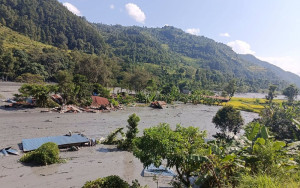
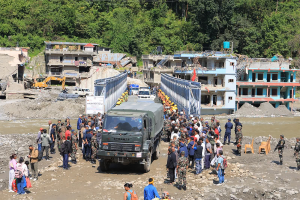
Nepalis continue to face difficulties cooking due to ongoing gas shortages. The crisis began with the US–Israel war against Iran. Subsequently, the government decided to distribute half-filled cylinders. Just as the Nepal Oil Corporation resumed the supply of full 14.2kg cylinders, a landslide at Krishnabhir along the Prithvi Highway—the main supply route to the federal capital, Kathmandu—disrupted deliveries again. Kathmanduites are forced to line up outside depots with empty cylinders once again, register their names, collect coupons and return home without the certainty of when and how they will be able to cook.
However, the corporation claims that gas is reaching the Kathmandu Valley through alternative routes after being refilled at various plants in Tarai-Madhesh. A total of 63,383 cylinders entered the Valley on Friday and Saturday last week.But this doesn’t match the reality on the ground; the shortages are very real. Meanwhile, dealers complain that they are receiving insufficient supplies and therefore cannot meet demand. Such a contradiction has left consumers wondering: If gas is reaching Kathmandu, where is it going?
A majority of the country’s population depends on liquefied petroleum gas for cooking. It is also an essential commodity for restaurants and small eateries that are now on the brink of closure. For many people living in rented accommodation across the Valley, there is no convenient alternative to LPG. Electricity in the federal capital is still unreliable, and inconsistent meter pricing across households further discourages them from switching to electric alternatives. It’s high time for the government to intervene by examining where and why the supply chain is breaking.
While it is understandable that a major road collapse disrupted gas supply in the Valley, this alone cannot explain everything. Authorities can’t keep citing the same problem without examining why the supply chain is failing. It is important to look into people’s tendency to stockpile gas out of fear of shortages, as well as the influx of empty cylinders into the market after a short crisis, which overwhelms existing distribution channels. Additionally, dealers are blamed for creating artificial shortages and engaging in black marketing, which invariably contributes to gas scarcity. This exploitation is likely to continue with the biggest festivals approaching. Furthermore, Nepal lacks a policy governing how many cylinders a family or commercial entity can own.
Increasing imports should be the very first step, but since the problem appears soon after the gas enters the country, authorities should seriously—and aggressively—track the movement of LPG from the point of dispatch to the depot and ultimately to kitchens. The government has decided to establish a ‘command post’ involving district administrations, the oil corporation, gas industries and police. This is a much-needed step that must be implemented well. It is equally vital to introduce a policy to limit the number of cylinders one can possess to discourage hoarding and hold accountable anyone deliberately creating scarcity or exploiting consumers.
That said, fully relying on non-renewable energy sources and fossil fuels will not help the public. The long-term focus should be on finding clean alternatives to LPG. Nepal is rich in water resources and can generate enough hydropower to serve the country. Leveraging this resource and subsidising induction and infrared gases, along with other cooking technologies, would encourage their adoption among renters in Kathmandu. But that is not all. Given the vulnerability of hydropower plants, as evidenced by the recent Bhotekoshi flash floods and various studies, we need to consider other energy alternatives like solar heating and cooking systems. For now, authorities should clearly communicate to the public that they will guarantee access to cooking gas.




 24.63°C Kathmandu