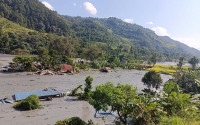
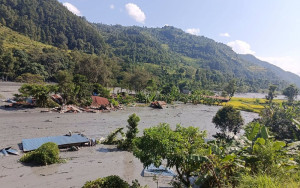
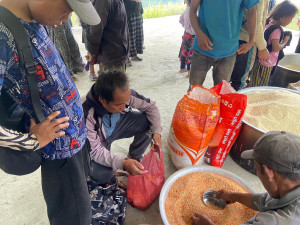
On August 26, when a massive glacial collapse occurred at 8:37 AM in the high Himalayas, Nepal’s national disaster authority, NDRRMA, did not dispatch text alerts until 9:15 AM—a devastating 38 minutes later. In some remote areas, warning messages crawled in as late as 9:42 AM, an hour after the collapse. In steep terrain where flash floods surge with terrifying rapidity, every second wasted dictates the boundary between survival and catastrophe. For families in the affected areas, this delay was a systemic betrayal.
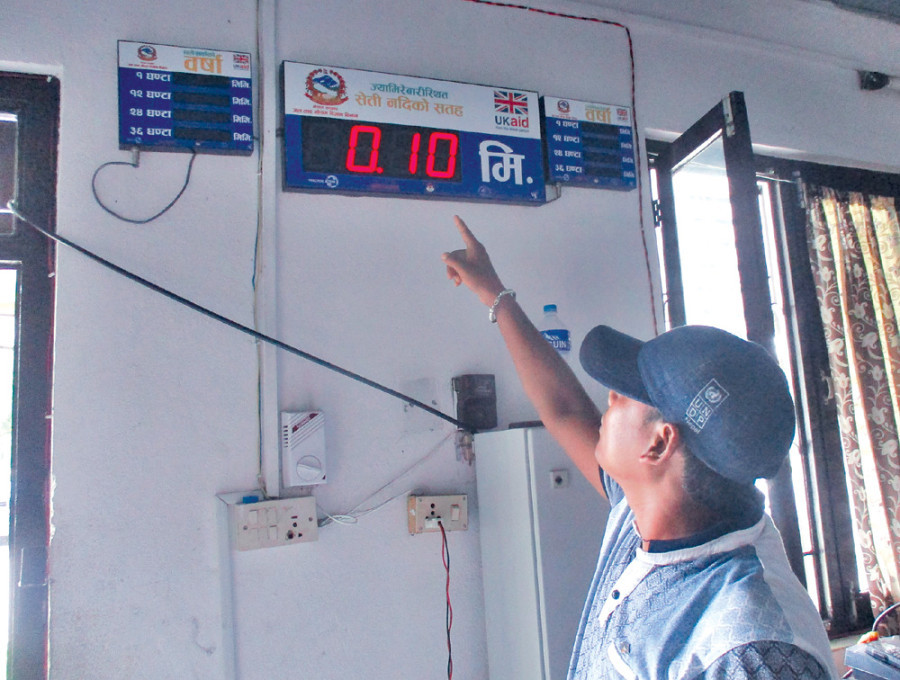
According to geologists, Nepal’s physical detection instruments are deeply flawed. Prakash Pokhrel, research geologist at NDRRMA, says conventional river-level gauges installed in Nepal, like the one at Syabrubesi, are designed for gradual water rises. They cannot monitor flash floods. Furthermore, while the Department of Mines and Geology recorded a 4.4 magnitude seismic event, it could not send public alerts because the tremors did not match typical earthquake frequencies. Nepal’s outdated detection system cannot even differentiate between a tremor sent by a glacial collapse and one generated by an earthquake.
Beneath these physical failures also lies a crippling legal vacuum. The Department of Hydrology and Meteorology forecasts weather, but lacks legal authority to mandate evacuations. Without binding laws or Standard Operating Procedures (SOPs) linking forecasts to mandatory local action, evacuation orders rely on individual discretion and bureaucratic hesitation, wasting precious minutes.
To break this cycle, legal reform must consider a legally binding, resilient defence framework with SOPs ensuring that hydrological thresholds automatically trigger mandatory local evacuation orders, bypassing bureaucratic bottlenecks.
More importantly, the government needs to invest in the installation of a state-of-the-art early warning system (EWS) which includes a network of technologically up-to-date stations that can detect flash floods in addition to gradual water level rises, mechanisms to meticulously monitor glacial lakes, and educate communities on how to act when they receive warning alerts.
Technically, a dense network of telemetry stations must be rebuilt with resilient sensor arrays and equipped with autonomous fuel cells and backup VSAT satellite linkages. Simultaneously, machine learning must be deployed to analyse real-time seismic waves, enabling scientists to separate background noise from impending landslides.
Nepal also needs to invest in real-time monitoring of glacial lakes in the Himalayas. There is much to be done in the surveillance of glacial lakes identified previously as risky. The monitoring system has to regularly assess the risks of permafrost melting in the lakes using satellite and thermal imaging in tandem with a combination of real-time analysis of moisture content, critical slopes vulnerable to avalanches and tectonic shifts.
Because these hazards are transboundary, monitoring cannot end at the border either. The government must negotiate formal agreements with China and India, establishing a systemic data pipeline for real-time sharing of upstream barrier lake data and glacier shifts. These sensitive borderlands should be transformed into shared environmental monitoring zones.
Finally, the state must recognise that the ultimate shield lies with frontline communities. While automated systems failed, decentralised, community-based early warning networks saved thousands of lives in August 2026. The local caretaker and gauge model, employing paid local readers to monitor river levels and alert downstream leaders via backup satellite or CDMA lines, must be funded nationally. Predefined phone trees, manual sirens, and simulated evacuation drills must be scaled up to ensure warnings translate into active behavioural responses. From the government’s side, safe spaces for evacuation must be identified and communicated to local communities.
An alert that arrives 38 minutes late is a monument to bureaucratic negligence. As global temperatures rise and Himalayan glaciers melt at double the rate seen since 2000, catastrophic cascades will only accelerate. The solutions are clearly mapped, technically viable, and economically achievable. What is missing is the political will to act. The government of Nepal must invest in these reforms immediately.




 14.83°C Kathmandu