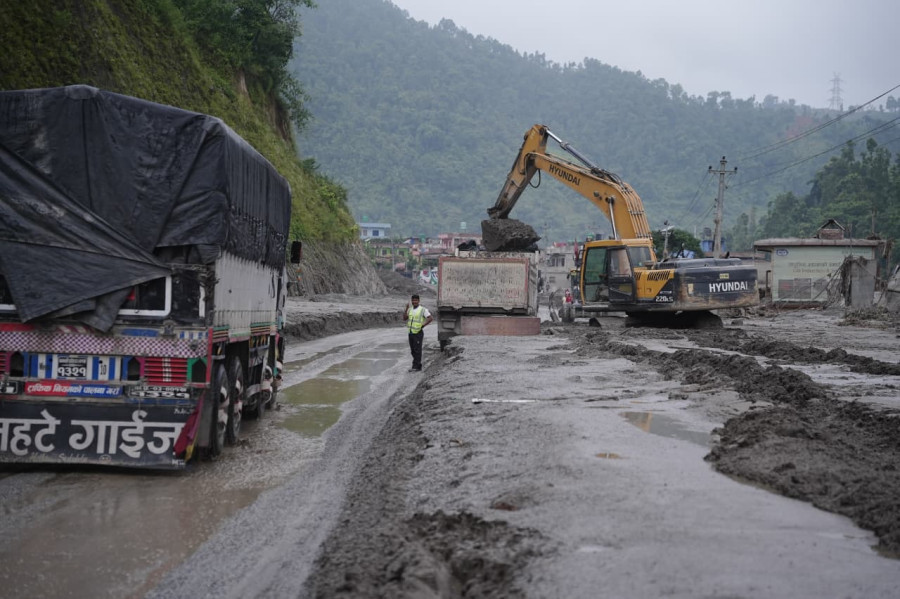
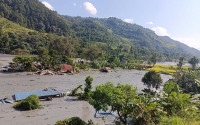
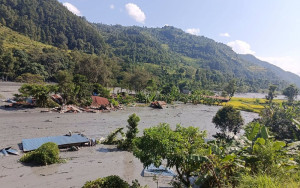
In less than one week, the Bhotekoshi flood’s gargantuan waves and consequent rainfall-induced landslides have caused a collapse of the road transport network in Nepal’s central mountainous and hilly region, paralysing the state’s ongoing emergency response. Across the rugged terrain of Rasuwa and Nuwakot—the districts at the centre of Nepal’s worst natural disaster in a decade—roads that could have been traversed to carry people, food, fuel and rescue equipment have been cut off.
The Trishuli–Mailung–Syabrubesi Road has been washed out at Khalte. Landslide debris has buried the Pasang Lhamu Highway. Farther south, huge landslides at Krishna Bhir and Parewa Bhir have blocked the Prithvi Highway, the main link between Kathmandu and the rest of the country. Amachhodingmo Rural Municipality is now completely isolated. The physical blockage of these transit routes directly triggers a severe failure across the emergency rescue operations, as road connectivity serves as the backbone of disaster response, and without it, the entire rescue apparatus is rendered ineffective. For the more than 4,000 people still missing, every hour matters. And the broken roads have become the biggest obstacle to the massive, race-against-time rescue operation.
The government has deployed more than 20,000 security personnel on the ground, but numbers alone cannot rescue people trapped beneath mud and concrete. Excavators and other heavy machinery cannot simply be flown into remote mountain valleys with helicopters spread thin between rescue operations. The Nepali Army has had to dismantle equipment before airlifting it—a necessary improvisation, but one that costs precious time. The delay and disruption in transporting the necessary machinery has forced rescuers to dig by hand, in sites like the Upper Trishuli 3A project, through deep mud and debris.
The consequences extend far beyond the rescue sites. Ambulances cannot move trauma patients to specialist hospitals. At the Trishuli-3A hydropower project, specialised drilling equipment must reach teams attempting to rescue workers trapped in flooded underground tunnels. Every delay carries a human cost. The longer the roads remain closed, the greater the humanitarian danger. Stranded villages could run out of food, water, medicine and fuel within days. Helicopters cannot fill the gap. Monsoon fog and poor visibility can ground them for hours or days, while their weight limits make them unsuitable for moving the tonnes of supplies needed by thousands of displaced people. The possible consequent fuel crisis could be just as dangerous as the flood itself. If tankers cannot reach affected areas, rescue vehicles, generators and communications towers will soon run short. A blackout could bring rescue machinery and communications to a halt.
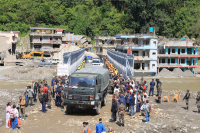
The government must therefore make road connectivity restoration its first logistical priority—not as a construction project, but as a life-saving operation. The Ministry of Infrastructure Development needs to give the Department of Roads a single, clearly coordinated emergency mandate. Crews must be mobilised to work around the clock to clear the worst blockages, while security forces could undertake the dangerous blasting and debris removal required at unstable highway chokepoints. Temporary Bailey bridges must be installed immediately at critical bottlenecks, including Betrawati, Trishuli Bazaar and Devighat. Nepal’s bridge stocks are already depleted, so the government must accelerate the delivery of the 30 units pledged by China rather than allow procurement and customs procedures to become another delay.
The state should also keep alternative routes open. The loop through Kathmandu, Tokha, Chhahare, Lachyang, Saramthali, Kalikasthan and Dhunche may not withstand heavy freight, but it could keep light rescue vehicles moving. That could mean the difference between a village receiving medicine today or waiting until the next road collapse is cleared. This is not an argument for opening roads recklessly. Nepal’s mountain roads are vulnerable precisely because too many have been built without adequate attention to unstable slopes, drainage and local geology. Emergency access must be restored now, but reconstruction must make the network safer and more resilient—not recreate the same danger before the next monsoon. For the moment, however, the priority is clear. Roads are the arteries of Nepal’s rescue effort. Until they reopen, the state cannot reach the people it is trying to save.




 14.83°C Kathmandu