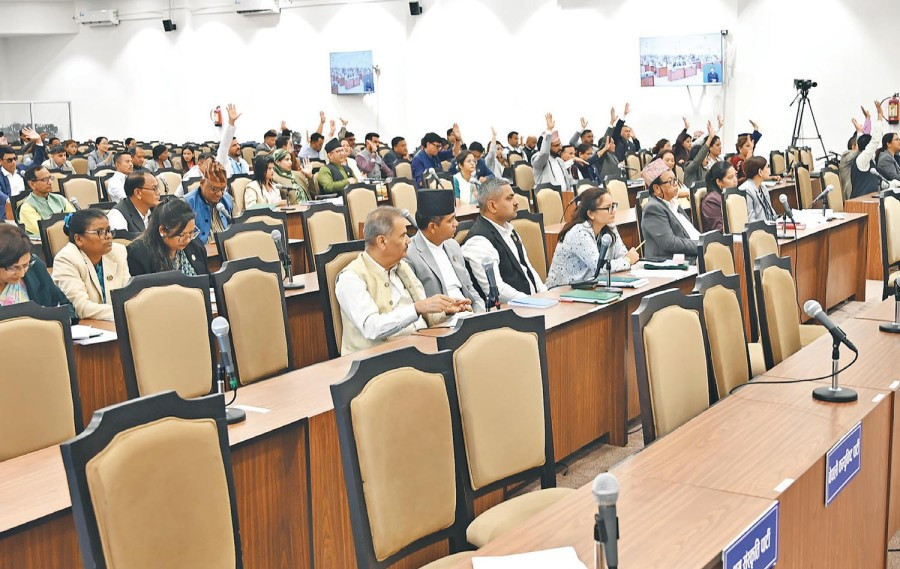
Last week, a meeting of the House of Representatives scheduled to discuss a bill was adjourned due to the absence of the minimum number of lawmakers required to conduct the meeting. Nepal’s statute requires at least one-fourth of the total strength, or 69 lawmakers, to be present for a House meeting to commence. However, only 61 lawmakers were present, prompting the Speaker to adjourn the meeting. While it is the responsibility of every lawmaker to ensure regular attendance, the onus of ensuring that the House functions smoothly lies with the ruling party. The Rastriya Swatantra Party commands 182 seats, which is two and a half times the minimum number required for the House to get down to business.
It was complete negligence on the part of a party with close to a two-thirds majority to leave Parliament without the minimum presence of lawmakers just four months after the House began its work. Even though this was the first such incident involving the full House, meetings of House committees have previously been postponed for the same reason.
However, in a timely intervention, the party is taking serious measures to ensure that its lawmakers do not merely mark their attendance and skip House proceedings. It has asked every lawmaker to fill out a Google Form providing details of their attendance and to notify the party in advance if they cannot attend a meeting. The party leadership believes the move will make parliamentary meetings more organised and effective, and rightly so.
The RSP rose to power by capitalising on the ineffective performance of the legacy parties on multiple fronts, including Parliament. The two previous HoRs elected after the promulgation of the Constitution of Nepal were not productive. The internal feud within the then Nepal Communist Party disrupted the functioning of the House elected in 2017. Then Prime Minister KP Sharma Oli dissolved the House twice, effectively cutting its working period by about a year. The House elected in 2022 also became mired in repeated obstruction. The Nepali Congress blocked proceedings for weeks, demanding a probe into RSP chair Rabi Lamichhane’s alleged involvement in cooperative fraud. The RSP later obstructed the House, seeking an investigation into the visit visa scam, while the CPN-UML did the same over alleged gold smuggling.
That House eventually met an early demise following its dissolution after the Gen Z protests in September. Most of the tenure of previous two Houses was spent in the making and unmaking of governments, with less focus on its core job of enacting laws and holding fruitful discussions.
As a result, the previous Houses could not even promulgate the laws necessary for the full-fledged implementation of the Constitution. History should not repeat itself. The third House since the promulgation of the Constitution needs to correct the shortcomings of its predecessors. The initiative the RSP is taking to keep track of its lawmakers’ attendance is a positive step towards that effort.
The Balendra Shah government has set a target of promulgating 166 laws through Parliament in the current fiscal year. Making that happen requires effective functioning of Parliament and its mini-Houses—the parliamentary committees. That, in turn, requires the active participation of lawmakers and proper facilitation by the government. The RSP leadership seems to have understood this fact. Now, it needs to translate that understanding into implementation.




 14.7°C Kathmandu