CAN plans to revamp women’s cricket with Harshal Jayant Pathak on driving seat
Pathak, who has signed a two-year deal, will be working on developing women’s cricket overall in Nepal, from the grassroots to the senior team. Head coach of Nepal women’s cricket Harshal Jayant Pathak (centre) speaks to journalists during his official reveal at the Upper Mulpani Cricket Ground in Kathmandu on Tuesday. Angad Dhakal/TKP
“Harshal has been appointed not only as the head coach of the senior women’s team but of overall women’s cricket,” Binod Kumar Das, cricket manager at the Cricket Association of Nepal, informed at the official revealing of Harshal Jayant Pathak during a press meet at the Upper Mulpani Cricket Ground on Tuesday.
According to Das, the Cricket Association of Nepal (CAN) is planning to revamp women’s cricket in the country. “And Harshal will lead it,” he added.
For now, Pathak has joined for a two-year contract. Pathak, who was leading Thailand cricket, was revealed as the new head coach of Nepal women’s cricket on December 16. He landed at the Tribhuvan International Airport on Sunday.
“I wanted to be part of Nepal’s cricket, which I have been following closely, because of their passion for the sport,” said Pathak. “I am aware of their strength as well as limitations.”
While he has a long-term vision for Nepal, Pathak’s first responsibility is itself a challenging one. He will be leading the senior women’s team in the T20 World Cup Global Qualifier at home. The TU International Cricket Stadium and Upper Mulpani Cricket Ground are hosting nine teams—Bangladesh, Ireland, Papua New Guinea, Namibia, Scotland, Thailand, Zimbabwe, the Netherlands and the USA—for the event, which begins on January 18 with 10 warm-up matches on January 14 and 16. The fixtures were revealed on Tuesday.
Each of the 10 participating teams will play two warm-up matches. Nepal will be warming up against Ireland at the Lower Mulpani Cricket Ground on January 14 and with the USA at the TU International Cricket Stadium on January 16. After that, Nepal will face Thailand, the Netherlands, Zimbabwe and Scotland in the group stage of the qualifier.
“There is a fair chance for us to qualify for the T20 World Cup,” said Pathak, who took Thailand to their maiden World Cup in 2020. “There are several reasons to back this statement. First, the qualifier is at home, so I hope we will have a loud support. Second, Nepal have experience of playing with the opponents before.”
‘Impressed with the team’
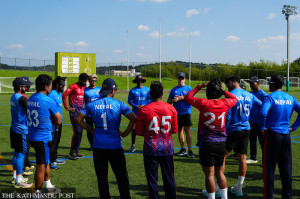
Before sitting down for the press meet, Pathak had a long talk with Nepal’s skipper Indu Barma. The team had just finished their training session at the Upper Mulpani Cricket Ground.
“I just witnessed a super over in the practice match,” Pathak said with a wide smile. “I saw the players perform, and they were good. They had the most important thing needed in cricket: the intent. They did not want to get out when they had the bat, and they wanted wickets with the ball. It shows their competitive nature.”
However, Pathak accepted that the team needed more work on batting and fielding fronts. And he has less than a month to work on those areas before the Global Qualifier begins.
“We cannot bring drastic changes overnight. Cricket needs time, and so do our players,” said Pathak. “Yet, we will be working on improving the areas where the players are lagging. And by the time of the qualifier, the players will have improved to a certain level, though not wholly.”
The new head coach added that he saw tremendous potential in the players. “The CAN also has state-of-the-art training facilities. I went to the TU Stadium recently, and the infrastructure, including the nets, is good,” said Pathak, who is the first full-time foreign head coach for women’s cricket in Nepal.
But Pathak argued that even if Nepal did not qualify, it would not show Nepali women’s cricket’s failure. “It [Global Qualifier] is a tournament we want to win. Even if we don’t, it is not the end of the world,” said Pathak. “There will be better days ahead.”
Revamping women’s cricket
“I hope so,” Pathak replied when the Post asked if he was in Nepal for a good amount of time. And when inquired about his long-term plans for Nepali women’s cricket, he added, “We need to develop talents from a young age. So we will be investing more in junior cricketers.”
With Nepal’s men’s team earning global recognition for its development, the CAN expects a similar result from the women’s team. “There will be other coaches working with the women’s teams, while Harshal will guide them and work on other sectors,” Das said. “He has a bigger role in CAN’s plan to revamp women’s cricket.”
And as part of his bigger responsibility, Pathak said imparting the basics of cricket to younger talents will save the trouble in the future. “We will instil the right cricket habits and values in younger players,” he said. “If players understand the technicalities of cricket early, it will help them master the skills later.”
Pathak shared that he was happy to hear CAN’s vision for women’s cricket. “We had some talks, and I was interested in what CAN had in store for women’s cricket,” he said. “Our visions aligned.”
He also expressed excitement to work in a free environment. “I have found that there is an environment here where the CAN backs players and coaches when they make the right calls.”
As part of the vision, Pathak said that he will work on improving the bench strength of the women’s team. “We need good players on the bench too,” he added. “For that, we need more players and have a competitive environment at the grassroots.”
Pathak stressed that there are many ‘variables’ in cricket. “We need to focus on different areas before realising the dream of a great cricket team that can challenge the world heavyweights,” he said.
Nayak Paudel covers sports for The Kathmandu Post. He previously worked at the Post (2018–19) and spent over five years at The Rising Nepal. His reporting spans crime, health, education, and social issues.




 12.67°C Kathmandu