



 14.82°C Kathmandu

Thu, Oct 22, 2026
Columns
Nepal’s Gen Z movement succeeded through masculine violence—but that must change
Will Nepal secure a successful movement in the future by expunging violence and shifting from a hyper-masculine violent movement to a feminised non-violent movement?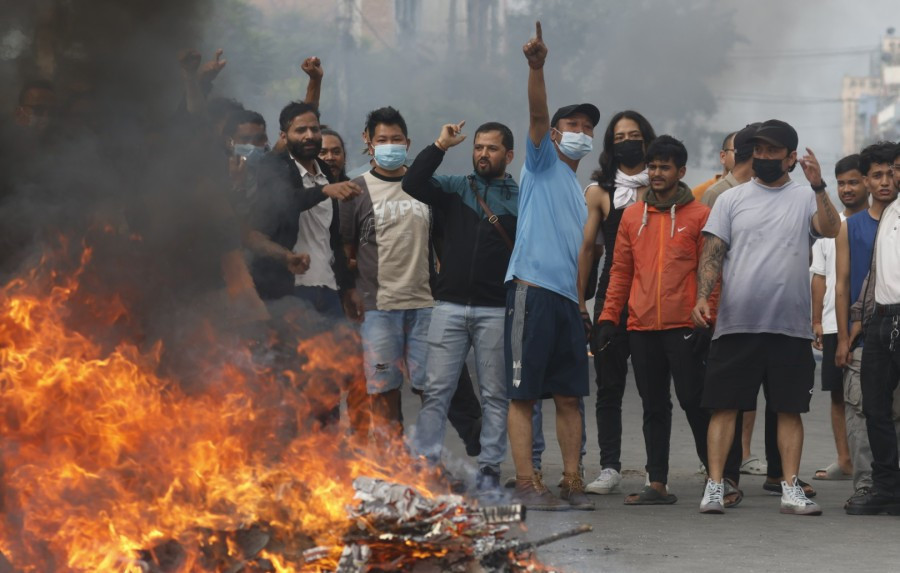
bookmark
Krishna Man Rai
Published at : September 9, 2026
Updated at : September 9, 2026 21:39
This September 8 marked the one-year anniversary of Nepal’s anti-corruption Gen Z movement. Violence defined this major political upheaval—a precipitated regime change at the expense of massive destruction accompanied by unprecedented loss of human lives.
As men remained at the centre of the violence, the movement revealed pronounced gender differences. It illustrated and reinforced the feminine and masculine normative constructs, demonstrating that men are more violent. Although hyper-masculine violence has proven to be a potent force in major political movements in Nepal, it is vital to examine how its deployment undermines women’s equal political participation.
Gender death gap
The gender death gap resulting from major political uprisings and movements has not received as much attention as the gender pay gap, gender stratification and equal gender participation in politics, particularly in reports, news coverage and academia. A total of 76 people (including 63 protestors, 10 escaped prisoners, and three police officers) lost their lives in two days of violence. Of the 63 protestors killed, men’s share is disproportionately higher than women’s. All 19 protestors who fell to state brutality on the first day (September 8) were males. The subsequent events on September 9 claimed additional lives, yet men’s numbers dominated.
Nepal’s historical record reveals that the Gen Z movement is not the first one when it comes to staggering male deaths. State crackdowns have routinely killed more men in major uprisings, including People’s Movement I (1990), People’s Movement II (2006), and the Tarai-Madhesh movement (2015). Despite equal gender participation in the major political movements, the gender death gap persists. This gap is explained by differences in violent orientation between men and women. High involvement of men in violence increases the likelihood of higher death tolls.
Gender violence gap
Men remained at the centre of the violence that defined the Gen Z movement. On the first day, some impulsive and belligerent men completely changed the momentum of the protest—they crossed police barricades, mounted the prohibited Federal Parliament wall, torched the front Parliament gate and vandalised the surrounding railings—forcing the security forces to deploy tear gas and water cannons. Tension escalated when police opened gun firings at 12:37 pm, and violence assumed centre stage.
In response to the multiple rounds of firing that killed protestors, agitated men retaliated with a display of hypermasculinity expressed in patriotic violence. As usual, men’s repertoire of violence included stone pelting, tear gas redirecting, vehicles torching, arson attacks, and whatnot. The following day, masculine aggression was writ large, as men stormed ministers’ private residences, torched major government complexes, attacked police stations, business complexes and media houses, and looted banks. Impassioned men mounted the top of the Singha Durbar, waving the national flag triumphantly.
Despite seemingly equal gender participation, the number of women involved in violent activities was, if not absent, negligible. By contrast, confrontational men crowded the frontline, exposing themselves to state violence. This proximity to danger increased the chances of men getting hurt, seriously injured and killed. Not a coincidence that the 19 people dead on the first day were males. Both genders had equal opportunity for confrontation and violence, yet their choices revealed gender behavioural differences. While men’s high death toll is directly proportional to fight response (retaliation), women’s lower death toll is proportional to flight response (retreat).
More than any other generation, Gen Z has a strong affinity for progressive gender ideology. They are known to challenge and redefine traditional gender norms and roles. Yet, Gen Z youth defenestrated the newly acquired gender behavioural norms and reverted to their dominant traditional roles and expectations. They found it challenging to liberate themselves from the masculine and feminine social arrangement and abandon the deeply encoded gender roles.
Towards non-violent movements
At the other end of the spectrum, women resonate with movements attuned to hyper-femininity. Women tend to participate significantly in non-violent mass movements more than in violent ones, and their participation fosters successful mass movements, ultimately leading to a more egalitarian democracy.
Non-violent mass movements maximise equal gender representation. However, any mass movements that embrace violence become disadvantageous to women, affecting their political visibility and contributions. This was precisely what happened during the Gen Z movement. As hyper-masculinity-coloured violence started to take the centre stage, women found themselves pushed to the margin. Men encroached on the space, forced their will, took over the movement away from women, steered it in a direction of their interest, controlled it, and ultimately made it their own—thanks to violence. This impeded women from thriving or shining politically and being equal stakeholders in the outcomes of the Gen Z protest.
Nepal has had its fair share of regime-changing political uprisings, movements and revolutions. Similar movements will likely emerge in the future. But it’s time we recognised that change remains possible through non-violent means. Taking references from the previous movements, notably People’s Movement I & II and the Tarai-Madhesh movement, including the Gen Z movement, the modus operandi of gratuitous hyper-masculine violence must be avoided, as it invariably ends up killing men. Violent movements often yield Pyrrhic victory, won at immense human, physical and financial cost. To prevent men from turning into death statistics, a more sensible approach must be embraced. To ensure that future movements and revolutions remain gender-friendly and conducive to equal gender participation, the temptation to resort to violence must be resisted and rather employ constructive and innovative methods of protests.
Yet, the overriding question that cannot be brushed under the rug remains. Would a non-violent movement, shaped by feminisation, have triumphed in forcing the then prime minister KP Sharma Oli to resign, lift the social media ban, and subsequently precipitate a regime change? To be sure, the success of the Gen Z movement owes to men-led destructive violence between September 8 and 9—change founded on the ashes or blood of men.
Will Nepal secure a successful movement in the future by expunging violence and shifting from a hyper-masculine violent movement to a feminised non-violent movement? While Gandhian non-violent, peaceful movements should be an ideal, the historical record suggests the indispensability of violence. Hyper-masculinity, powered by violence and aggression, is evolutionarily too embedded to go out of fashion soon.
Krishna Man Rai
Rai holds an Erasmus Mundus Master’s degree in Religious Diversity in a Globalised World.





Most Read from Columns




Editor's Picks




E-PAPER | October 22, 2026

×