The streets were jam-packed and commuters looked flustered in the sweltering May heat and amid the deafening cacophony.
Security forces were deployed around the college premises.
A lanky biker, blocked by the mob, mumbled to his adjacent biker, “What’s with these people?” The adjacent biker chose to remain quiet, perhaps for fear that any remark could put him on the receiving end of the mob.
“These students are the biggest culprits,” the tall biker said. “They play a big hand in turning this country into a sorry state.”
The adjacent biker might have kept his words to himself had the mob not advanced ahead. “True,” he said, looking around. “These students embolden those in power. The youth of this country will never learn.”
Slowly, the rowdy group entered the campus gate, finally clearing the streets for upset commuters.
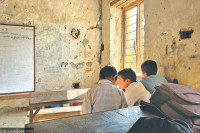
Five students held a rectangular red banner promising elusive agendas. Others followed these students to the massive ground, where a group of ten students were passing a ball around. A run-down building with peeled walls and broken roofs overlooked the dusty ground. Other buildings on the campus looked no different. Perhaps this old temple of knowledge was operated with the notion that the physical structures played no significant role in the dissemination of education.
As the group of wannabe political progeny approached the goalpost, everyone playing on the ground paused, as if readying themselves to listen to some profound wisdom. In the eyes of these student leaders, the ones playing games were easy prey—all they cared about was the abundant supply of their playing gear. The leaders—shrewd and calculative—could easily lie about how they could bolster the sports infrastructure better than their rivals. The playing group had no political ideology to speak of. Sometimes, they wondered if these leaders were just like them, only pretending to be wise and prophetic. As long as the promises were made, the players were ready to stop their games and listen to the overzealous candidates contesting in the student election.
After a quick announcement of their sports agendas with the players, the group charged towards the library, where caution and peace were demanded. On their way to the library, the mob's liveliness was met with the silence of a small mass of their arch-rival. The rival group had it sorted that they would scatter everywhere to reach as many students as possible. Having got the chance to exhibit their cohesiveness, the crowded group roared in unison. To everyone’s surprise, a small group of the rival party walked with an air of confidence—unbothered and calm. It somehow surprised the united group.
The passion with which Abhi was chanting slogans, pump-fisting in the air, reminded him of his role in the bygone general election. The way Abhi had actively participated in the campaign of the general election assured everyone that he had a knack for politics. He went as far as convincing those with disabilities, saying that their party had special provisions for them. Abhi said the only party that cared about the youths’ sentiments was theirs.
The whole neighborhood knew that the cuts on his forehead were the result of his response to the brutal attack waged by the rival party. Come the student election in the college, Abhi carried the same energy and intensity for his party's student wing. Though he believed that he deserved the candidacy of the president, he kept it to himself—the candidate selected for the presidential post was diplomatic and studious, so Abhi felt it was a wise decision. There was nothing wrong with the post of secretary. What was important was to claim victory at any cost.
Abhi's energy stemmed from the exaggerated compliments of his close comrades, who would incite him, saying, "In you, we see the future. You've got it all—both calmness and fierceness within you. When the situation demands, you can break bones too, no?" Abhi, stretching his physique, would relish the past memories when the minister had ruffled his hair after the ward chair had applauded him for his loyalty and bravery. "This is how you come through the ranks," the minister had proudly stroked Abhi's head. The public meeting held to convey thankfulness had witnessed thousands of partisans and cadres. Amidst the sea of people, when scrutinised by countless pairs of eyes, the minister's touch had Abhi swelling with pride. The crowd had cheerfully clapped when Abhi had bent to touch the minister’s feet in deep reverence. When Abhi rejoined the crowd, he had overheard the whispers about how Abhi would be the next big thing. What would stop him from being the minister one day?
When Abhi's group reached the library building, one of the contestants—a girl studying LLB—suggested that only a few of them go to the library. Her argument was that a campaign should be carried peacefully in a place like the library. “We should show our unity wherever we go. If we walk in fragments, our rivals will ridicule us like we have done earlier,” a guy yelled from behind. Just as his words dropped on the floor, everyone offered him a long, cold stare.
When the group of five people, including Abhi, slid in through the library door, the air was so thick with silence that the dropping of a pen would have sounded like a mini crash. It was Abhi's idea to try winning the credibility of book nerds. “We have to declare that our party will work on providing students with enough textbooks and beyond. Those bookaholics will definitely buy our promises,” Abhi had put forward the idea during a tea session outside the college. “Abhi is right, we shall do that,” others endorsed his strategy.
A greying librarian in a red kurta lay asleep in a round chair, her face bright and seemingly relaxed. For someone who frequented the library, it wasn't a new sight. When students would complain to her about her sleeping habit, she would point out teasingly, “How many of you come here to this place? I almost know everyone who visits the library. Here, no one is interested in reading books.”
Abhi was not accustomed to the musty smell of old volumes in the library. As Abhi scanned the library, he felt alienated—like someone leaving his native land for the first time. Had he been one of the regulars in the library, he would have at least passed the exams. His father wouldn’t have nagged him for his utter failure in academics. But now wasn't the time to worry about his studies, he ruminated, and let go of the worries.
Seeing just a solitary figure in the far corner of the library, Abhi's gang regretted going there. Why were they there anyway? Didn't they have common sense to understand that it was no less than a crime to demand votes and make noise in the library? Just as the group was exiting the library, a solitary reader appeared in the doorway, whom Abhi recognised as his girlfriend’s distant relative. He hurried down the steps, avoiding the gang. “That Dai will be something special in the future,” Abhi’s girlfriend had once said. “Can you believe he can study for hours without even raising his head?” And there was hardly anyone in the college who didn’t recognise the guy and his gifts. Just at the age of 25, his thought-provoking write-ups about national affairs had already garnered widespread attention. No leaders of the parties’ student wings could look him in the eye, for his insights had the power to crush their hypocrisy.
Abhi’s group once again assembled at the playing ground and made rounds of other buildings, promising this and that. Their rivals were seen doing the same. At 5, when the students had already gone home, Abhi and his party's candidates dashed outside the college, into their favourite tea shop. There, like always, they ordered tea, talked highly of their party, and strategised their victory. Their arch-rival, another strong contender in the election, sat across from the tea shop they were in. With only ten days remaining for the election, both parties stepped up their campaigns—more students were invited from the pavements and more cups of tea were ordered.
As for tea shops, the aging owners were indifferent to the excitement stirred by the election. How long had they been witnessing such students take up politics with lofty ambitions? A few had made it. But most had found themselves disillusioned, while continuing the daily grind, either in Nepal or around the world.




 16.94°C Kathmandu