Saudi Arabia issues wide-ranging security alerts after week of strikes
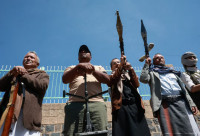
Security alerts in Mecca and Jeddah come as Houthi attacks and advances along Yemen’s Red Sea coast raise new threats to Saudi oil exports and global shipping. Mock drones put on display at Tahreer Square in Sanaa, Yemen September 15, 2026. Reuters
Saudi Arabia issued security alerts over a range of territory on Tuesday, including in the holy city of Mecca and its second-largest city Jeddah, following a week of attacks from Iran-aligned fighters that have drawn it deeper into the Middle East war.
The alerts were swiftly lifted and Saudi authorities did not immediately report whether any incoming projectiles had landed, nor was there any immediate claim of responsibility for attacks.
But the alerts were the widest-ranging since an escalation in the conflict last week, and the alarm in Mecca was the first of the war in a city that houses shrines sacred to all Muslims.
The Iran-aligned Houthis have seized control of parts of Yemen’s Red Sea coast in recent days overlooking the Bab el-Mandeb, one of the world’s most important shipping straits, threatening Saudi oil exports rerouted from the Strait of Hormuz.
As the fighting intensifies in new theaters in the Middle East, it has strengthened Iran’s hand in its seven-month war with the US that has already slowed shipping through the Strait of Hormuz to a trickle, further jeopardising global oil supplies.
The Houthis have announced a number of major attacks on Saudi Arabia over the past week, including strikes on an air base on Monday they said were in retaliation for airstrikes on Yemen.
Saudi Arabia has blamed a separate pro-Iranian movement, based in Iraq, for an attack on Friday that knocked out one of the Kingdom’s most important oil transport routes, the East-West Pipeline across the Arabian desert.
Crude oil should be flowing through the pipeline within days, US Energy Secretary Chris Wright told CNBC on Tuesday.
A Saudi-led military coalition fighting against the Houthis in Yemen said 13 civilians had been wounded in the Houthis’ attacks on Saudi Arabia on Monday.
The Houthis launched a lightning advance along Yemen’s western coast last week, culminating in the seizure of an island in the mouth of the Red Sea.
New oil threat
Officials from a Saudi-backed Yemeni government, which is based in the south of the country and opposes the Houthis, said the Saudi and Yemeni air forces had been responding to Houthi advances by stepping up aerial bombardment of Houthi targets. That included strikes near the historic Red Sea port of Mocha, which the fighters captured last week.
But the Yemeni officials acknowledged that the Houthis had now taken effective control over almost the entire western coast of the country along the Red Sea.
Saudi Arabia’s 1,200-km (745-mile) East-West Pipeline, which links its Gulf oil fields to the Red Sea, has been the Kingdom’s principal export route while shipping through the Strait of Hormuz has been disrupted by six months of war.
Since the pipeline was shut after Friday’s attack, traders say a prolonged closure could cut off as much as 4% of global oil supply.
Riyadh has not said when operations might resume, but Wright said on the sidelines of a G20 energy meeting in Houston that he thought “it will be measured in days.”
He said Saudi Arabia was taking steps to move more oil out of the Strait of Hormuz with assistance from the US military.
The new Houthi presence in the Bab el-Mandeb, or “Gate of Tears”, the strait at the mouth of the Red Sea, could further jeopardise that crucial export route.
Oil prices have risen since last week to levels unseen since May. Brent crude oil futures rose above $108 a barrel on Tuesday, while the politically sensitive average retail price of diesel in the US hit a new all-time high of nearly $6.27 a gallon.
The United Nations Security Council discussed the worsening crisis in the Bab el-Mandeb on Tuesday.
Deputy US Ambassador Jennifer Locetta told the council the Houthi advances near the strait threaten global energy security, and that their maritime attacks have already killed mariners and endangered international trade. She urged the council to halt Iran sending weapons and financial assistance to the Houthis in violation of UN arms embargoes.
Saudi UN Ambassador Abdulaziz Alwasil said the Houthi militia is “militarising international straits to blackmail the global economy.”
Americans hesitant to step in
Saudi Arabia has led a coalition battling the Houthis since 2015. The conflict had largely quietened under a ceasefire in recent years, but fighting reignited this month, with the Houthis pushing back forces aligned with the internationally recognised government.
The US, which bombed the Houthis for two months last year, now faces a dilemma: whether to stand by and risk new threats to the global economy, or offer military support to the Saudis and risk being pulled into another costly theatre of war.
Saudi Arabia’s Crown Prince Mohammed bin Salman met Egyptian President Abdel Fattah al-Sisi in Cairo on Tuesday. A statement from the Egyptian presidency after the meeting said the leaders stressed the need to ensure freedom and security of navigation in the Bab el-Mandeb and the Red Sea.
The crown prince met the US regional military commander, Admiral Brad Cooper, in Jeddah on Monday, and phoned President Donald Trump last week seeking military support, which so far has been limited to intelligence aid.




 17.5°C Kathmandu