Flood destroys equipment, pushing back Siddhababa tunnel opening
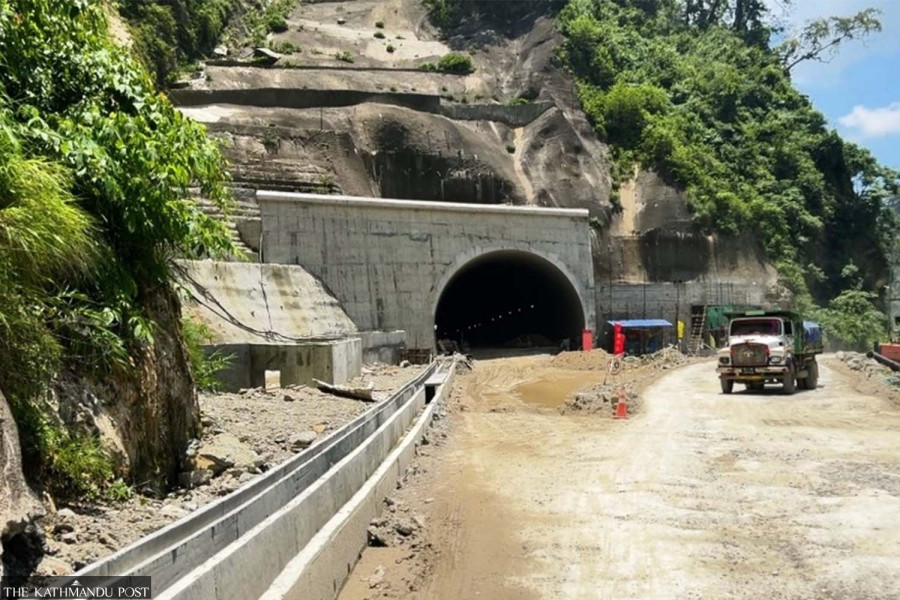
Replacement electromechanical equipment must be brought through the Korala border, delaying the planned start of traffic by at least a month. The Siddhababa area and the tunnel under construction in Tinau Rural Municipality-3, Palpa. Madhav Aryal/TKP
Motorists will have to wait at least another month to use the new Siddhababa tunnel after floods swept away equipment needed to put it into operation.
The contractor must now replace the electromechanical equipment, which was being transported through the Rasuwagadhi border, and bring it in through the Korala border instead. The project is now targeting mid-December for traffic to start using the main tunnel, a month later than originally planned.
The project had been working towards opening the tunnel by mid-November. Project chief Navaraj Bastola said the revised deadline could still be met if the replacement equipment arrives on time and the contractor completes the installation of jet fans, ventilation systems and other electrical equipment.
“The Bhotekoshi floods washed away some of the electromechanical equipment needed for the main tunnel while it was being transported from the Kerung border,” Bastola said. “The contractor will have to bring the replacement equipment through the Korala border, which will delay the work by at least a month.”
The contractor has already started the process of bringing the equipment through the Korala border in Mustang.According to the project, if the equipment arrives within 15 days, the installation of the main tunnel's jet fans, ventilation, and other electrical equipment can be completed on time.
“If the contractor completes the work on time, vehicles can start using the main tunnel by mid-December,” Bastola said. “We had planned to open the tunnel before Dashain and then move on to the rock shed and rockfall barrier works.”
The delay means the dangerous Siddhababa section of the Siddhartha Highway will continue to pose a threat to motorists.
On Tuesday, a falling rock struck a car travelling near Bypass Tunnel 1, injuring two passengers and heavily damaging its rear. The area had received heavy rain before the incident. After the rain stopped, a rock fell from above and hit the car. Police said they stop vehicles from the Dobhan side during periods of heavy rain as a precaution.
“The Siddhababa area remains risky during heavy rain,” said Deputy Superintendent Bhimlal Bhattarai, information officer at the Palpa District Police Office. “We therefore make arrangements to stop vehicles coming from both Butwal and Palpa.”
The Siddhababa section of the Siddhartha Highway between Butwal and Palpa has seen repeated rockfalls this monsoon. One person has died and six have been injured in incidents in recent months, while three vehicles have been damaged.
The tunnel project was launched to reduce such risks, but construction has slowed markedly over the past three months.
About 95 percent of the main tunnel has been completed, Bastola said. Overall physical progress stands at 69.57 percent, while financial progress is 63.55 percent against a target of 76.30 percent. The project is 6.73 percentage points behind its overall target, he said.
Physical progress had reached 69.25 percent by mid-July after all road construction work inside the 1,126-metre tunnel had been completed. By mid-September, progress had reached only 69.57 percent. Financial progress has remained unchanged since mid-July.
The main tunnel, being built at Siddhababa in Tinau Rural Municipality-3 of Palpa district, is 1,089 metres long, 10.4 metres wide and about seven metres high.
According to the project office, excavation and support work has been completed along the entire 1,089-metre main tunnel. Excavation of the three bypass tunnels, built to provide emergency access, has also been completed.
The first bypass tunnel is 148.095 metres long, the second 158.376 metres and the third 128.381 metres.
The project has completed 1,126 metres of lining and cut-and-cover work on the main tunnel, including 1,089 metres inside the tunnel and 37 metres of cut-and-cover section.
Some lining work remains on the bypass tunnels. The first bypass has 3.595 metres of lining and 1.7 metres of cut-and-cover work left. The second has 0.576 metres of lining and 2.4 metres of cut-and-cover work remaining. The third has 3.581 metres of lining and 1.2 metres of cut-and-cover work left.
The project has completed 1,126 metres of road surfacing inside the tunnel. Work on the DLC and PQC layers is complete, but paving remains on the roads connecting the tunnel to the existing highway at both ends.
Concrete paving is planned on the Chidiakhola-Siddhababa Temple section of the Siddhartha Highway and on the road from the tunnel’s northern portal to Paithyedanda in Dobhan.
The planned paving covers 911 metres between Chidiakhola and Upper Siddhababa and 557.89 metres between the headbox and Paithyedanda in Dobhan.
Construction of retaining walls is also incomplete. Along the first main-road section, 196 metres of the planned 581 metres have been built, leaving 385 metres. On the second section, 292 metres of the planned 368 metres have been completed, with 76 metres remaining.
On one side of the main road, three of the four planned box culverts have been completed, leaving one. All three box culverts planned for the other side have been completed.
Work has yet to begin on the 10 box culverts proposed for the rock shed. All eight pipe culverts, four on each side of the road, have been completed.
The technical buildings at the southern and northern ends of the project are also nearing completion. The building at the southern end, at Siddhababa, is 85 percent complete, while the one at the northern end, at the headbox, is 88 percent complete, Bastola said.
The project plans to begin more advanced measures to protect the road from falling rocks only after traffic starts using the main tunnel.
One of those measures is a 780-metre rock shed, the first planned in the Siddhababa area. The structure is designed to shield vehicles and the road from falling rocks and landslides.
At locations prone to landslides, the project will build reinforced-concrete or steel roofs over sections of the road. Loose rock and debris falling from above will pass over the structure and into the river or down the slope, allowing vehicles to continue travelling underneath.
Rock sheds are planned at both tunnel portals because the approaches are prone to landslides.
The design of the 780-metre rock shed is in its final stage. The contractor has submitted the design to the Department of Roads and held discussions with officials, but has been asked to make some revisions before resubmitting it.
“The contractor submitted the rock shed design to the Department of Roads and discussions have already taken place,” Bastola said. “Some improvements are needed, so we have asked them to revise and resubmit it.”
According to the project office, reinforced wire mesh is expected to withstand rocks weighing up to 10 tonnes.
China State Construction Engineering Corporation, the Chinese contractor, signed a Rs7.34 billion contract to build the tunnel. The agreement was signed in February 2022, with the project scheduled for completion within five years.
Once completed, the tunnel is expected to provide safer travel for people in more than a dozen districts in Lumbini and Gandaki provinces.




 22.89°C Kathmandu