



 8.12°C Kathmandu

Sat, Dec 6, 2025
Opinion
Strange bedfellows
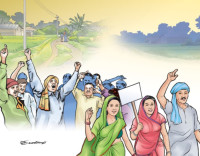
Communists practicing in a democratic polity must accept intra-party rivalries as normal
bookmarkThe last couple of weeks, the media has been full of stories of bitter infighting among leaders of the two largest communist parties. New polarisations have been in the making and old ones have been breaking or changing.
Jainendra Jeevan
Published at : February 9, 2014
Updated at : February 9, 2014 08:53
In the CPN-UML, KP Oli and Bamdev Gautam, who did not see eye-to-eye in the past, formed an alliance against the grouping of party president Jhala Nath Khanal and senior leader Madhav Kumar Nepal, leading Khanal to lose the election for leader of the parliamentary party to Oli. But it is not just Oli and Gautam; even Khanal and Nepal are strange bedfellows. Both spared no opportunity to dislodge each another from the post of prime minister during last five years. While Oli and Nepal have been vocal opponents of the Maoists, Khanal and Gautam have been relatively softer. Khanal would never have been prime minister, or possibly even party president, without the Maoist's help, both overt and covert. Gautam narrowly refrained from joining the UCPN (Maoist) some three years back so his alliance with Oli—the foremost critic of the Maoists—has surprised many.
Maoists too
Within the UCPN (Maoist) too, the fight for the leadership reached its pinnacle. Subsequent to the party's defeat in the last Constituent Assembly polls, the leadership of Pushpa Kamal Dahal, the all-powerful party chairman, has come under severe criticism from across the party rank-and-file. Although he has managed to retain most of his authority at least temporarily, thanks to his Mach-iavellian tactics and monopoly over the party funds, he is likely to become weaker in the days to come. Unlike in the past, the challenges posed by Baburam Bhat-tarai and Narayan Kaji Shrestha combined—another strange bedfellow duo—could be a little too much for Dahal.
Wise people have rightly said that only interests are permanent in politics, friends and foes are not. But the problem with communists is that they think or claim that, as communists, they are immune to such ills. They believe or pretend to believe that only bourgeois politicians fall victim to (self) interest. However, the reality is that communists fight for their self-interests as acrimoniously as the bourgeois, sometimes even worse. But when it comes to admitting reality, they first refute that there is any disagreement amongst themselves. But when the infighting becomes too obvious to be denied, they paint and present them in ideological colours. Each warring faction accuses the other of ideological deviation, the worst sin among communists. And what could be a more effective weapon than labeling one's enemy a ‘sinner’, for followers of any ideology?
Although it is difficult for communists to acknowledge that there are, and can be, differences in issues, personalities and performances, in democracies, they are neither unusual nor unwarranted.
In fact, the success of a democracy depends on how inter and intra-party differences are managed. In the absence of healthy scepticism and differences, democracy gradually becomes dead or defunct, where free people are reduced to obedient subjects. On the other hand, in the absence of the judicious management of such differences, democracy gives way to anarchy.
Bourgeois ideals
In this country, there is a plethora of communist parties whose leaders and cadres fight tooth-and-nail for power, positions and prestige. Look at the severe disputes that have taken place between Bhattarai-Shrestha and Dahal, the top leaders of the UCPN (Maoist), a party that is more communist than ‘bourgeois democratic’. What was ideological in their differences? Nothing. Every issue Bhattarai and Shrestha raised or fought for was, if seen from a positive perspective, for a rule-based functioning of the party, collective leadership and transparent handling of party funds. All of these norms are more ‘bourgeois democratic’ than communist. And, if seen from a negative or cynical perspective, all this was for sharing power, positions and prestige.
Similarly, the issue on which the Oli-Gautam and Khanal-Nepal alliances were divided, namely the balanced allocation of positions and transfer of leadership, along with the method they adopted to resolve these issues—free elections—were very unconventional for communist parties. They were very much bourgeois.
The communist formula
Communists have their own way of managing intra-party disputes, prescribed by no other than Lenin. They have great admiration for the modus operandi known as ‘democratic centralism’, which allows cadres to differ with, or even go against, the main party line during the course of deliberations on the subject. This is the ‘democratic’ component. (That communist regimes, especially under the likes of Stalin, have a history of killing and punishing millions of fellow communists on account of such defiance is a different story.) But once the dissent is rejected, one has to fully comply and cooperate with the line that prevails. Thereafter, one cannot even whisper one's dissent; or else one gets punished—this time, officially and not-so-secretly. This is ‘centralism’.
On the face of it, the Leninist formula sounds ok. However, it doesn't work. For, differences in the 21st century, especially in modern democracies, cannot be tackled that mechanically. They need to be handled subtly, progressively and differently in each case. Moreover, democratic centralism was meant for communists operating under communist regimes, not for communists politicking within a democratic framework. The democratic system is full of resolution of all kind of disputes—political, social, inter-personal, inter-party, intra-party etc. In a democracy, a new and separate set of rules for communists is both unwarranted and ineffective. Now that the communists have begun, wilfully or reluctantly, to practice in a democratic polity, it is time that they accept intra-party rivalries as normal and resolve their
differences according to the time-tested rules of democracy without reservations of any kind.
jeevan1952@hotmail.com


Editor's Picks
Government pushes to free universities from political grip

Most patients reach hospital after taking multiple antibiotics
%20(1).jpg&w=300&height=200)
Karki government finds itself mired in controversies
School dropout Achham youth returns from India, passes SEE and seven PSC exams
Nepal closer to 5G auction as regulator seeks ministry nod
E-PAPER | December 06, 2025

×