‘An attack on the constitution’: Police detention of journalists draw widespread condemnation
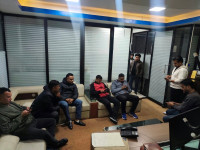
Press Council demands legal grounds for journalists’ arrests and calls for the immediate release of those held without due process. Naya Patrika's newsroom pictured after police officers detained the daily's reporter Nawaraj Mainali on Friday. Yam Bam's Facebook
Journalists, press freedom advocates and political leaders have condemned police entries to newsrooms and the detention of journalists, saying that attempts to identify news sources by taking journalists into custody violate constitutional and legal protections for press freedom.
Plainclothes police officers visited the offices of Nepal Press, Naya Patrika Daily, Diyo Post and Motivate News on Friday, seeking journalists associated with reports concerning senior government and judicial officials.
Police took Nepal Press journalist Bishwamani Subedi from his newsroom to the Cyber Bureau for questioning. Officers also barged into Naya Patrika’s office in Putalisadak looking for reporter Nawaraj Mainali, while another team went to Diyo Post’s office in Anamnagar seeking its editor-in-chief Sudeep Bishwakarma and news coordinator Madan Dhungana. The officers left Diyo Post after failing to find the journalists. Police also detained Shovaraj Baral, editor of Motivate News.
Khagendra Pant, news editor at Naya Patrika, said four or five plainclothes officers had arrived, identifying themselves as members of the Metropolitan Crime Division. They said they wanted to take Mainali to the Cyber Bureau for questioning. The officers who visited Diyo Post identified themselves as members of the Valley Crime Investigation Office, according to a journalist working there.
Superintendent of Police Deepak Awasthi of the Cyber Bureau told Kantipur that Subedi and several others had been brought in for questioning.
The Press Council Nepal expressed serious concern over the police action, particularly the entry into newsrooms after office hours and attempts to detain journalists ahead of two consecutive public holidays.
In a statement, the council said the police had not clarified the reasons for the arrests, presented arrest warrants or shown evidence of court authorisation. It also questioned whether a formal complaint had been filed in connection with the alleged offences.
The council demanded that authorities make public the legal grounds for the detentions and immediately release journalists held without a legal basis. It said complaints concerning published news content and alleged violations of the journalists’ code of conduct should be addressed through the council’s established mechanisms rather than direct police intervention.
Taranath Dahal, executive director of Freedom Forum, said detaining journalists to find out who supplied them with information was illegal. If information had been leaked from within the police organisation, he said, investigators should look into their own system rather than question journalists through arrests.
Dahal said obtaining information from different sources on matters of public interest was a fundamental part of journalism. Complaints about published reports should be taken to the Press Council, he added, arguing that such disputes did not warrant the involvement of the Cyber Bureau.
Binod Dhungel, a journalist and representative of Reporters Without Borders, also said journalists could not be arrested simply for reporting and publishing news. He warned that the police action could be an attempt to intimidate the media and discourage critical reporting.
Shiva Gaunle, a former president of the Federation of Nepali Journalists, said that if police were entering newsrooms to identify sources and arrest reporters, the action amounted to an attack on the constitution itself. “We can continue fighting for press and freedom of expression, but first we have to fight to save the constitution,” he told Kantipur.
Political leaders also criticised the police intervention. Yubaraj Dulal, chief whip of the Nepali Communist Party, demanded the unconditional release of detained journalists and an end to what he described as state intimidation of the media. Niraj Acharya, head of the publicity department of the CPN-UML, condemned the newsroom visits and detentions, calling them undemocratic. Nepali Congress leaders also condemned the intervention.
Meanwhile, the prime minister’s secretariat said neither Prime Minister Balendra Shah nor his office or secretariat had any involvement in the incident or prior knowledge of it. It said Shah had instructed the concerned authorities to immediately release the detained journalists and refrain from entering newsrooms or harassing media workers.
The reports published by the outlets included claims that the government had sought the resignation of Inspector General of Police Dan Bahadur Karki, WhatsApp exchanges between Supreme Court Justice Hari Phuyal and Inam Sapkota, and a purported financial transaction document bearing the names of Chief Justice Manoj Sharma and Rastriya Swatantra Party lawmaker Bishwaraj Pokharel. The allegations contained in those reports have not been independently established.
Timothy is a copy editor for The Kathmandu Post. Previously, he was a reporter on the Features desk and deputy editor on the National News desk. He joined the Post in 2015.




 15.27°C Kathmandu