Constitutional bench in limbo as Supreme Court struggles over formation amid disagreements and boycotts
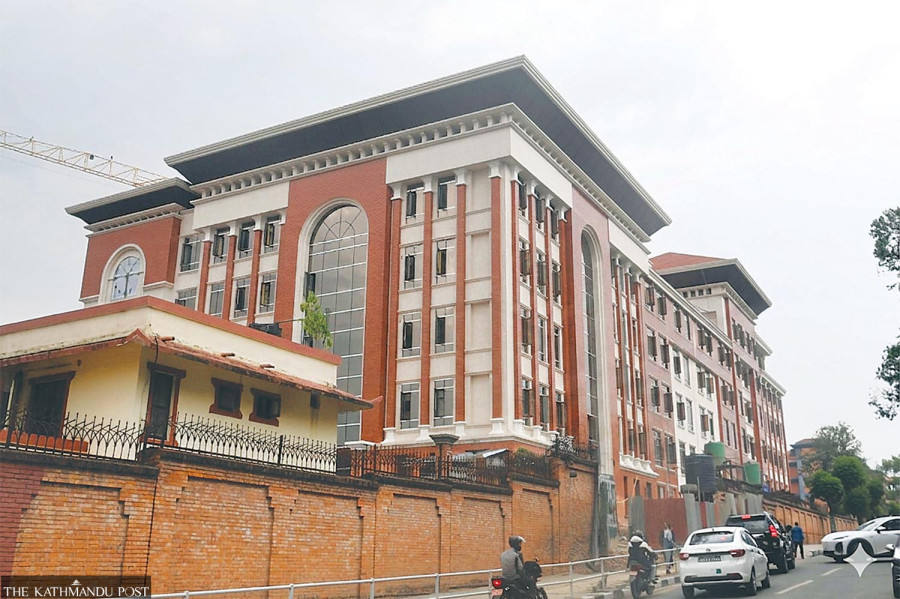
When Chief Justice Sharma formed the bench on October 7, Justice Phuyal refused to sit, leading to the suspension of proceedings.Nepal’s new constitution mandates the Constitutional Bench within the Supreme Court. Post File Photo
The Supreme Court conducted nine joint benches and two single benches on Wednesday, but Chief Justice Manoj Kumar Sharma refrained from participating in the lottery system for case allocation.
Following a long Dashain vacation, the court reopened on Monday, with the constitutional bench scheduled to be formed on Wednesday. However, anticipating friction and controversy during its formation, CJ Sharma neither took up a bench himself nor formed the constitutional bench.
The last time CJ Sharma formed the constitutional bench was on October 7. On that occasion, Justice Hari Prasad Phuyal stated he could not sit on the bench, leading to the suspension of proceedings. With the bench failing to materialise following the extended holiday, growing uncertainty surrounds whether the special bench will resume its duties. Serving Supreme Court justices have begun expressing concerns over the deadlock.
CJ Sharma maintains that consultations are ongoing and that several justices are currently on leave, delaying the bench’s formation. He claims that the bench will resume after Tihar holidays.
Senior-most Justice Sapana Pradhan Malla and Justice Abdul Aziz Musalman, both on the constitutional bench roster, were absent from the court on Wednesday, while benches were assigned for the remaining justices.
Understanding the complexity in forming this mandatory constitutional bench requires a look at its composition. Established under Article 137 of the Constitution of Nepal, the bench is a specialised division within the Supreme Court. Before the promulgation of the 2015 constitution, constitutional disputes were handled by a special bench. The new constitution instituted a separate entity for such disputes, which convened on December 8, 2015.
Unlike regular litigation, the constitutional bench resolves critical disputes concerning constitutional interpretation and state governance. It has five justices including the CJ. From a roster of 10 justices recommended by the Judicial Council, the CJ selects four others—an established practice. The roster currently lists CJ Sharma alongside justices Malla, Kumar Regmi, Hari Prasad Phuyal, Nahakul Subedi, Saranga Subedi, Abdul Aziz Musalman, Mahesh Sharma Poudel, Tek Prasad Dhungana, and Sunil Kumar Pokharel.
While regular Supreme Court benches employ a lottery system for case assignment, the constitutional bench does not. Because the constitution explicitly mandates that the CJ designate the four accompanying justices, names are not drawn as lots. This absence of clear constitutional criteria regarding selection basis, the weight given to seniority, or rotation continuity has repeatedly thrust the formation method into controversy.
This history of friction is not new. Disputes arose during former CJ Cholendra Shumsher Rana's tenure over accusations that he handpicked preferred justices for specific hearings. The issue also surfaced during Prakash Man Singh Raut's tenure, when he proposed introducing a lottery system for case assignments. The bench faced further controversy following discussions involving former justice Krishna Jung Rayamajhi on constitutional appointments, which was eventually resolved after an agreement to assign justices based on seniority.
The current dispute represents the third major standoff. Discontent within the judiciary surfaced soon after Sharma, fourth in seniority, assumed office amid allegations of bypassing established practices. Critics argued that by invoking his constitutional authority to adopt a ‘pick and choose’ approach for the constitutional bench, Sharma assigned sympathetic justices to specific cases. This tension surfaced during a full court meeting called on September 28 to discuss the arrest of former CJ Rana. The subsequent boycott of the constitutional bench hearing further escalated the dispute.
Justices are currently divided. The majority favours implementing a lottery system for the constitutional bench as well, while others argue that since the constitution empowers the CJ to designate justices, a full court resolution cannot legally curtail that authority.
Internal viewpoints among justices fall into three main categories: first, that the CJ alone should designate justices; second, that assignments should follow seniority; and third, that the bench should be formed via lottery. Insiders note that these three options lie before CJ Sharma, with solutions likely emerging from two of them.
CJ Sharma stands firm on his position, asserting that forming the bench must remain within constitutional bounds. “The constitution mandates that the chief justice must form the constitutional bench. How can we form a bench bypassing the constitution? Doing so raises legal questions regarding constitutional violations,” said Sharma.
“We must find a resolution within the framework of the constitution. I am holding consultations with all stakeholders, including the Nepal Bar Association and justices. At present, general public cases face a larger backlog, and with fewer justices available, the constitutional bench was not scheduled.”
However, senior justices disagree with this interpretation. Critics allege that the CJ intends to stall the dispute temporarily until public attention fades, allowing him to form a favourable bench later.
“Instead of sitting down promptly to find a solution, the chief justice is inclined to drag the matter out until the controversy cools down,” remarked one justice. “Otherwise, a solution could easily have been reached by convening everyone for discussions.”
Justices close to CJ Sharma report that he prefers resolving the issue through consensus with all justices rather than bringing the matter to a full court vote. A justice who discussed potential solutions with him following the Dashain break suggested a resolution might be reached within days.
Meanwhile, avenues for dialogue have opened with the bar. CJ Sharma held discussions with Nepal Bar Association executives before Dashain holidays and has continued informal consultations with representatives from the Nepal Bar and the Supreme Court Bar.
Supreme Court Bar Secretary General Raman Karna stated that a meeting with Supreme Court Bar executives is scheduled for Friday. Noting that the Bar previously acted as a mediator during constitutional bench disputes, Karna expressed confidence that a resolution will be found, reiterating that the Bar supports two primary options.
Nepal Bar Association President Bijay Prasad Mishra also affirmed that only two viable alternatives remain: forming the bench through lottery or on the basis of seniority. He expressed optimism that the chief justice will soon decide to allocate hearings through the lottery system.
These two pathways highlighted by the Bar align with recommendations offered by most justices.
The first alternative involves committing to form the bench based on seniority among roster members. Proponents argue that this represents a seamless solution because it aligns with historical practice. A justice currently on the constitutional bench roster views this as a straightforward and constitutional approach.
“The constitution specifies that the chief justice shall designate members. Assigning members by seniority removes suspicion, preserves past practice, and maintains transparency,” said the justice. “If someone is absent, an alternate can automatically be designated. That is precisely why the roster exists.”
Bar President Mishra agrees this option can resolve the dispute, provided the CJ Sharma acts in good faith. “This is one viable solution, but we must have assurances that the Chief Justice will not engage in tactical manoeuvring,” said Mishra. “Past problems persisted because leadership lacked honesty; we now need a permanent resolution.”
The second pathway is introducing a lottery system for the constitutional bench. However, justices remain divided on whether this requires a formal decision by the full court. A justice argued that because the constitution explicitly assigns the selection power to the chief justice, a full court resolution cannot override it.
“The constitution cannot be amended by a full court decision. Implementing a lottery through the full court would appear to violate the constitution,” the justice said. “If this dispute reaches the Supreme Court in the future, how could justices who participated in that full court decision hear the case?”
Conversely, another justice dismissed this argument, drawing parallels to the Special Court, where presiding judges historically held allocation powers before rules were amended to implement solutions.
“Provisions can be made via regulations to assign constitutional bench hearings through a lottery,” the justice argued. “This provides a long-term solution. If regular cases can be handled via lottery, it can apply to the constitutional bench as well.”
Another justice, who came in contact with Kantipur, asserted that implementing a lottery system has become a system rather than a personal choice.
“Some chief justices abused the constitutional intent behind the formation of the constitutional bench, operating far beyond its founding principles. The worst misuse occurred during Rana's tenure,” the justice said. “Although leadership changed, the underlying systemic trend persisted. Failing to learn from those lessons has caused the constitutional bench to fall into repeated controversy.”
A justice not on the constitutional bench roster described the controversy—the resulting necessity for justices to publicly refuse assigned benches—as deeply unfortunate. “It feels as though we are returning to the days of boycotting benches assigned by Rana,” the justice said. “We must find a resolution quickly. Delays will only breed deeper problems.”
Expressing concern over such conflicts erupting within three months of the CJ taking office, the justice emphasised that immediate dialogue is necessary to resolve it.
“Ignoring past problems resulted in prolonged court shutdowns, extended protests by the Nepal Bar, and justices joining demonstrations,” the justice recalled. “Such events should not recur. The chief justice must resolve this issue before things reach that stage.”
The justice concluded that the solution is straightforward and achievable through a decisive administrative choice by the leadership.




 14.39°C Kathmandu