Returning home for Dashain, only to face trouble at the border
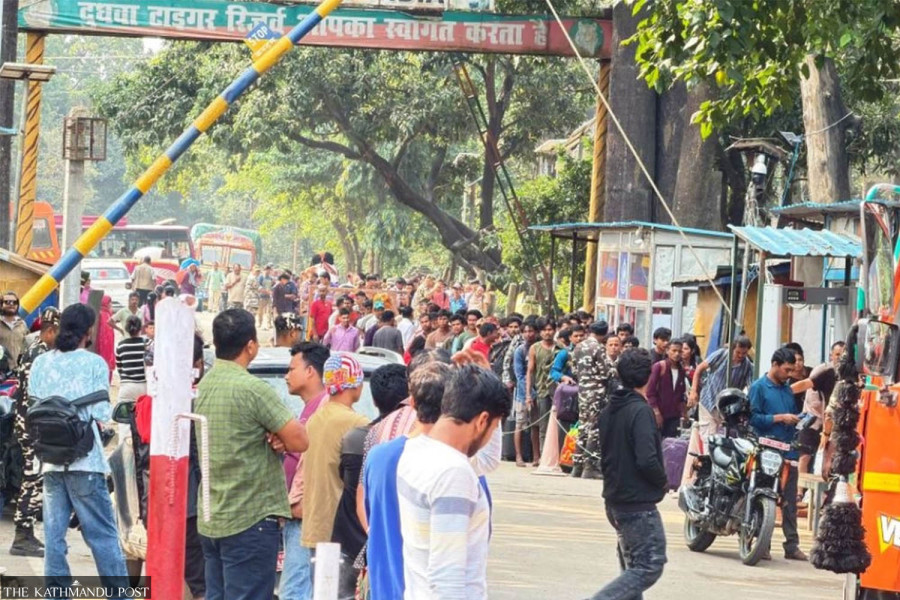
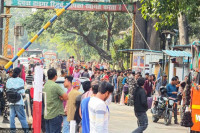
Thousands of Nepali migrant workers are returning from India for the festival, but exorbitant transport fares and harassment at border crossings are making the final leg of their journey difficult. Nepalis returning home for Dashain crowd the Gauriphanta crossing on the Indian border in Kailali. Arjun Shah/TKP
When Bhim Prasad Khatri of Chaurjahari, Rukum West, crossed the Jamunaha border into Nepalgunj on Friday morning, it felt as though Dashain had arrived. Returning home after four years away, he had savings from his labouring job in India’s Himachal Pradesh and was eager to celebrate the festival with his family. “Spending time with my family matters more than money,” he said. “I’ll finally get to enjoy Dashain with them after four years.”
Like Khatri, hundreds of Nepali migrant workers are returning from Indian cities to celebrate Dashain at home. Since the start of the festival season, traffic has increased at the Gauriphanta and Gaddachauki crossings in Sudurpaschim province and the Jamunaha crossing in Banke district in Lumbini province.
Some are reuniting with their families after years away, while others have returned with money saved to cover the festival expenses. But after travelling long distances, many face another struggle before they can reach their destinations. Auto-rickshaw drivers are accused of charging arbitrary fares and leaving passengers stranded along the way.
Prem Oli of Surkhet travelled to India’s Uttarakhand state after finishing his farming work at home to earn money for Dashain. After spending four months in Shimla, he returned on Friday carrying his belongings. “I’ve brought enough money to celebrate Dashain,” he said. “For poor people, festivals are an opportunity to meet their families and spend time together.”
Sijang Nepali, 21, from Chamunda in Dailekh, had gone to Bageshwar in Uttarakhand two months earlier to work for daily wages. With Dashain approaching and fellow villagers heading home, he decided to return and celebrate Dashain and Tihar with his family. “Everyone from our village was starting to return, so we came too,” he said. “We’ll celebrate Dashain and Tihar at home, then head back to India.”
Nepali has travelled between Nepal and India for work since he was 16, taking jobs in Ranikhet, Garhwal and other parts of Uttarakhand. After Tihar, he hopes to move to Bengaluru in search of better opportunities. “I’m thinking of going to Bengaluru after Tihar,” he said. “How long can I keep doing labouring jobs? I want to see whether I can find other work.”
Dhan Bahadur Daulyal, from Durgathali in Bajhang, also returned on Friday after collecting pine resin in Bageshwar. He has worked in the trade for a decade and travelled to Bageshwar last February. “Once everyone started leaving, we also stopped working and came home,” he said. “The places where we worked are now deserted,” Daulyal said. He earned 1,900 Indian rupees for every quintal of resin collected, with monthly collections of around 40 to 50 quintals. He and his wife, Parbati, who worked alongside him in Bageshwar, plan to return to India after Tihar, once they have completed their farming work at home.
Other migrant workers are returning after even longer absences. Sarjan Bahadur Saud, 50, from Kuskat in Achham, has come home after seven years. He worked at Kashmere Gate in New Delhi and returned with his brother and other family members. “We’ve come as a family,” he said. “We’ll celebrate Dashain and return to India soon afterwards.” Saud has worked in India for 37 years. He left home because his earnings in the village were not enough to support his family.
Bir Kesh Saud, also from Kuskat, has returned after 12 years away. “More than 60 people from our village are coming home,” he said. “We came hoping to enjoy the festival together in the village this year.”
Like them, people from Achham, Bajura, Bajhang, Doti and Kailali are returning through the Gauriphanta crossing. Migrant workers from the hill districts of Sudurpaschim, as well as Kailali and Kanchanpur, commonly travel to Indian cities including Punjab, Mumbai, Bengaluru, Gujarat and Surat for work.
Heavy traffic at the crossings
At the Jamunaha crossing in Nepalgunj, people enter Nepal in large numbers from 6am until 10pm. Rajan Prasad Bhattarai, chief of the Jamunaha Area Police Office, said around 10,000 people were returning home through the crossing each day, with numbers rising as Dashain approached. More than 50,000 Nepalis had returned through the crossing in the previous five days alone, he said.
The crossing serves people returning to Lumbini, Karnali and Sudurpaschim provinces. Many spend three to five days travelling by bus and train from India before reaching the border. Despite their exhaustion, the prospect of seeing their families often outweighs the fatigue of the journey.
But the final stretch is not always easy. Rickshaw drivers jostle to attract passengers, while hotel operators from Nepalgunj also approach people at the crossing to solicit customers.
A passenger assistance desk has been set up at Jamunaha to help returning travellers reach their destinations safely. Dil Kumar Tamang, Banke’s chief district officer, said the service was intended to prevent robbery and fraud in the border area and provide assistance to passengers. “We have implemented a security plan with public safety as our priority,” he said. “The assistance desk will provide information, coordination and support as needed.”
Inflated fares at the border
Some returning migrants say they are being overcharged even after entering Nepal. At the Trinagar customs point near the Gauriphanta crossing in Kailali, the set auto-rickshaw fare is Rs30 to Dhangadhi’s Traffic Chowk and Rs40 to the bus park. Police, however, say some drivers demand between Rs500 and Rs1,400.
Aditya Khadka, who returned from India’s Tamil Nadu state, said an auto-rickshaw driver demanded 800 Indian rupees to take him from Trinagar to Dhangadhi bus park. Traffic police took the driver into custody after Khadka lodged a complaint.
A few days earlier, Kamal Pariyar of Ramaroshan in Achham was also charged 800 Indian rupees for the same journey. Police recovered the money and returned it to him.
Yogendra Timilsina, spokesperson for the district police, said officers had been deployed at the border and other locations after complaints of passengers being cheated. Police intervene when travellers report overcharging or other problems, he said.
Assistant Sub Inspector Santosh Singh, chief of the Trinagar police post, said an assistance desk had been established and monitoring intensified to make travel easier. “Action is initiated when drivers are found charging more than the prescribed fare,” he said. More than 4,000 passengers were arriving from India through Gauriphanta each day, Singh added.
Security personnel have also increased surveillance at Jamunaha in Banke. The Armed Police Force has deployed officers in plain clothes to monitor the area.
Assistant Sub Inspector Yagya Bhandari said officers did not check every passenger but inspected those they considered suspicious. “People arrive at the border exhausted after long journeys. Everyone is in a hurry to get home,” he said. “We help facilitate their passage and check only those we suspect.”
Travellers crossing through Gaddachauki in Kanchanpur face similar problems. Auto-rickshaw drivers sometimes drop passengers halfway to their destinations or charge two to three times the prescribed fare.
The set fare from Gaddachauki to Mahendranagar is Rs50, but some drivers demand more, using passengers’ luggage as a pretext to raise the price.
Police have established assistance desks at the border and at the bus park in Mahendranagar to protect travellers from fraud. Complaints received at the desks, however, remain few.




 20.73°C Kathmandu