



 21.03°C Kathmandu



Fri, Oct 9, 2026
National
Storms and heavy rain destroy crops just before harvest
Farmers in Kailali, Bardiya, Salyan and Dang have suffered losses to paddy, fruit and vegetables, raising fears of lower yields and increasing demands for government relief.
bookmark![]()
Post Photo ![]()
Ranjana BC, Kamal Panthi, Biplab Maharjan & Amar Kshitiz Bhandari
Published at : October 9, 2026
Updated at : October 9, 2026 13:11
Kailali, Bardiya, Salyan, Dang
Heavy rain and strong winds over the past two weeks have damaged crops across western Nepal, ruining paddy ready for harvest in the Tarai and destroying fruit and vegetables in the hills. Farmers who had been preparing to bring in their harvest have watched months of work go to waste, while local governments have begun sending agricultural technicians to assess the damage.
In Kailali, rain arrived just as farmers were cutting and drying their paddy. Ramdin Chaudhary of Kanari in Dhangadhi-15 had cultivated paddy on 10 kattha of land this year. After the crop ripened, he cut it and spread it out to dry in the field. But continuous rain on Tuesday and Wednesday flooded the fields before he could bring the harvest home, submerging the cut paddy.
Local resident Alpana Chaudhary said the harvested rice had remained under water for three days and had begun to sprout after being soaked for so long. Ramdin’s neighbour, Prabhu Chaudhary, also suffered losses from the flooding.
“We had cut the paddy and left it in the field to dry. After several days of rain, it had already started sprouting,” Alpana said. “Now, not only the rice but also the straw has become unusable.”
Nanda Saud of Godawari-8 said the paddy she had grown on 14 kattha of land had also been ruined by the rain. With the crop damaged just as she was preparing to harvest it, she said a year’s hard work had gone to waste. Farmers in Bhajani, Ghodaghodi, Dhangadhi and Kailari have also reported damage to their paddy fields.
Tek Bahadur Bista, information officer at the Agriculture Knowledge Centre in Kailali, said the prolonged rainfall was likely to reduce the district’s paddy output.
“Both early- and late-maturing varieties are grown in the district,” he said. “The rain has particularly damaged the early-maturing varieties.”
Kailali has around 65,000 hectares under paddy cultivation this year, with production initially estimated at 296,100 tonnes. The Agriculture Knowledge Centre said output could fall by 5 to 7 percent because of the rain.
In Bardiya, ripe paddy has been damaged in several local units, including Badhaiyatal, Gulariya, Bansgadhi and Thakurbaba. Heavy rain on Wednesday hit farmers who were harvesting their crops, washing away rice cut and left to dry in the fields. Residents said paddy was floating in floodwater in some places.
Badhaiyatal Rural Municipality estimates that paddy worth around Rs50 million has been damaged. Dipendra Shrivastav, an agriculture officer at the rural municipality, said about 500 hectares of paddy had been lost.
In Bansgadhi Municipality, around 10 percent of the paddy crop has been damaged by persistent rain and strong winds, according to agriculture officer Asmita Oli. A technical team deployed by the municipality is collecting details of the losses, she said.
Mahadev Sah, an agriculture officer at Gulariya Municipality, estimated that about 10 percent of the municipality’s paddy crop had been destroyed. Strong winds had flattened crops, while flooding had submerged fields. Around 150 hectares of farmland in Gulariya have been inundated, he said.
Paddy had already suffered damage during continuous rainfall from September 25 to 27. Farmers fear the latest spell of heavy rain on Wednesday will further reduce this year’s harvest.
Chet Ram Yadav, a resident of Gulariya-11, said storms and flooding had devastated his crop.
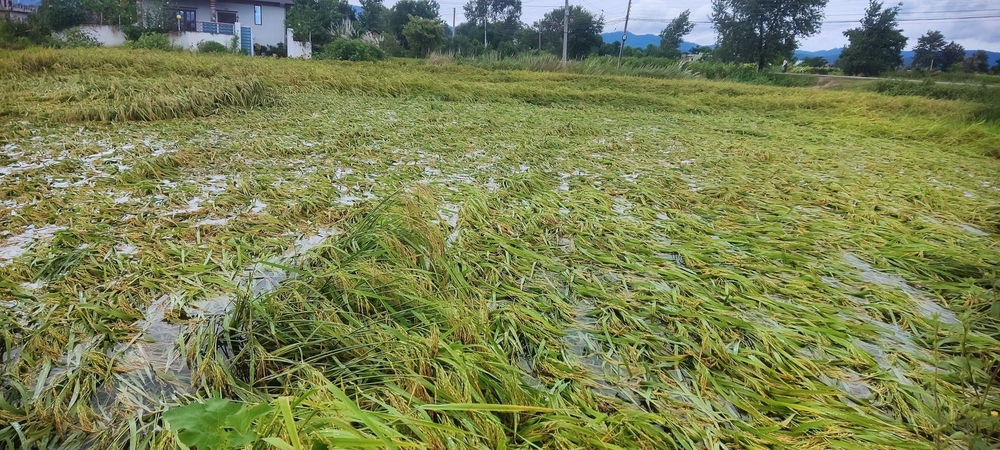
“Paddy planted on three bighas of land has been submerged,” he said. “The losses are enormous. Without compensation from the government, it will be difficult to feed my family.”
Farmers in Salyan and Dang have faced similar losses. In Salyan, strong winds during the fourth week of September, followed by repeated spells of rain, have damaged maize, oranges, kiwi fruit, timur pepper and paddy. Figures provided by local governments indicate that agricultural produce worth more than Rs50 million has been destroyed across the district.
Ram Bahadur Rawat of Kumakh-3 in Salyan lost paddy grown on 15 ropani of land when flooding in the Ikhre stream followed several days of continuous rain.
“I would normally harvest around 50 muri of paddy from those 15 ropani,” he said. “That would easily feed my family of six or seven for the whole year.” One muri of unhusked paddy rice is approximately 50 to 53 kg.
Heavy rain on Tuesday and Wednesday also damaged paddy that had been cut and left to dry in Kalimati-7. Around 250 hectares of harvested paddy were affected, said ward chair Mitralal Rijal. About 300 families have been affected, he added.
In the Deukhuri area of Dang, persistent rain and strong winds flattened paddy that farmers had been preparing to harvest. Much of the ripe crop has been soaked in the fields, many of which are now waterlogged.
Farmers in the area planted paddy as early as June because irrigation was available and had expected to harvest it around this time. Some had planned their harvesting around weather forecasts, but continued rain accompanied by strong winds disrupted their preparations.
With ripe paddy flattened and fields submerged, farmers fear lower yields and food shortages for their families. The damage has been reported across much of Lamahi Municipality and Rapti and Gadhawa rural municipalities, where fields had turned yellow as the crop ripened.
Farmers say they face similar problems almost every year. Sometimes rain soaks paddy that has been cut and left ready for collection; in other years, strong winds and flooding destroy crops before they can be harvested. They have called for solutions to recurring inundation and access to agricultural insurance.
Local governments have said they will begin collecting damage assessments immediately and provide relief to affected farmers wherever possible.
The storms have also hit farmers who depend on commercial fruit and vegetable production for their livelihoods.
Dhan Bahadur Kawar of Gairibang in Kapurkot-1, Salyan, has grown off-season vegetables on 15 ropani of land for two decades. He usually earns around Rs1.5 million a year from tomatoes. But strong winds on Asoj 10 devastated his crop.
Kawar had invested Rs400,000 in tomatoes and other vegetables and managed to sell produce worth Rs100,000 from the first harvest before the storm struck.
“The storm destroyed the vegetables, wiping out both my investment and expected income,” he said. “I have started worrying about how we will celebrate the festivals.”
Balaram Khadka, ward chair of Kapurkot-1, said strong winds had caused more than Rs10 million in damage to fresh vegetables grown by over 300 farmers, as well as to polytunnels, houses and a school. Those who depend on vegetable sales for their income have been particularly hard hit, he said.
In Chaurpani, Chhatreshwari-5, Salyan, Dipendra Kawar has more than 800 orange trees in his orchard. He earned Rs1.9 million from orange sales last year and had expected another good harvest this season.
“The oranges had grown exceptionally well this year,” he said. “The storm on Asoj 10 knocked them all down, ending my hopes of earning a good income.”
Tej Bahadur Yogi of Gurase in Chhatreshwari-2 said strong winds had knocked more than four quintals of kiwifruit from his trees. He had been negotiating with buyers to sell the fruit for Rs150 per kilogram when the damage occurred.
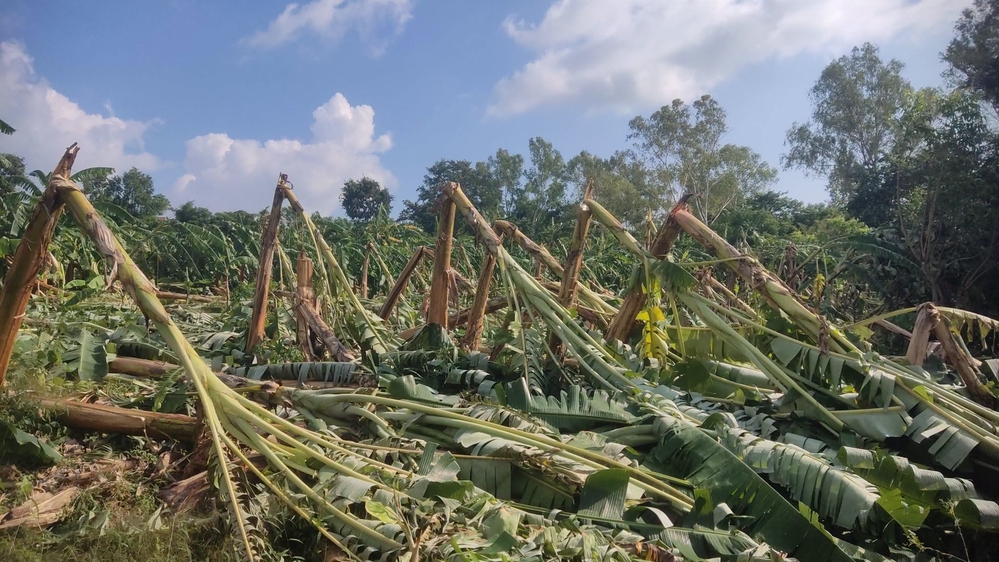
Banana farmer Hom Bahadur KC of Ghorahi Sub-Metropolitan City-12 in Dang has also suffered major losses. Continuous rain from September 24-28, followed by strong winds, devastated his four-bigha banana plantation, undoing years of work.
Around 90 percent of the banana plants on his land have fallen. Of the roughly 2,000 plants of various sizes that had filled the plantation, many are now broken or uprooted.
Some 1,300 fruit-bearing plants, whose bananas were nearing readiness for sale during Dashain and Tihar, have been completely destroyed.
KC estimates his direct losses at around Rs1.5 million.
Biplab Maharjan
Biplab Maharjan is the Salyan correspondent for Kantipur Publications.



Most Read from National

Balendra Shah UN speech: Full transcript of Nepal prime minister’s address to the 81st UN General Assembly
Heavy rains cut off key roads to Kathmandu

The speech Nepal — and the world — had been waiting for

For 26 years, India has searched passengers at Kathmandu airport. Nepal can’t say why

14 Nepalis missing on Himlung after avalanche as bad weather hampers rescue
Editor's Picks

What triggered the Rasuwa flood? Scientists piece together a complex chain of events

The floods keep coming. Nepal keeps starting over

In a settlement destroyed by the Bhotekoshi flood, a disabled couple offer strangers the little they have

Nepal working on detailed assessment as Bhotekoshi flood reconstruction could cost up to $5 billion

Rabindra Dhant gave Nepal a reason to smile. Now his camp wants real action behind the praise
E-PAPER | October 09, 2026

×