Government prefers lower house over upper for bill registration
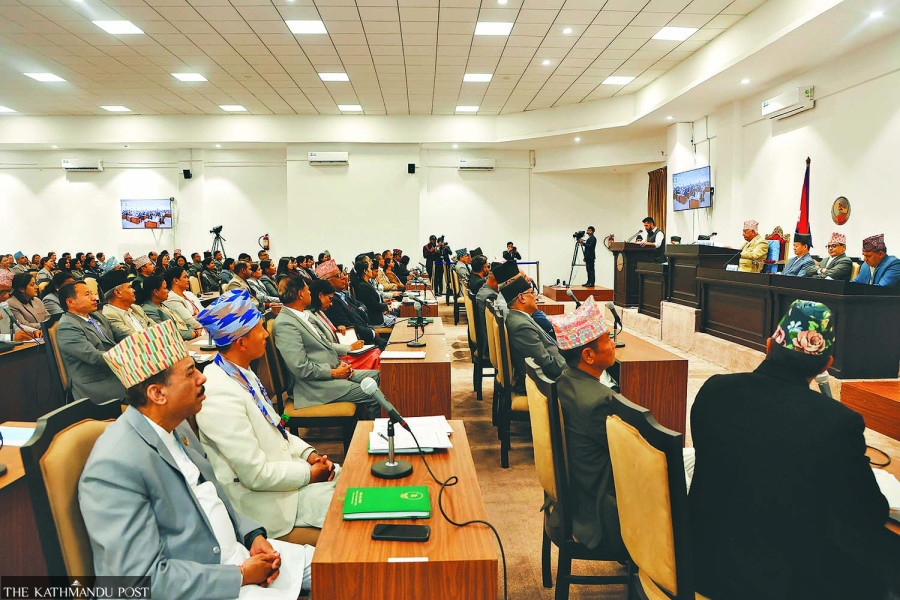
With no representation in the National Assembly, the government registered 21 of its 23 bills in the House of Representatives during the current fiscal year. The meeting of the House of Representatives. File Photo
The government’s absence of representation in the National Assembly is increasingly reflected in the way it conducts parliamentary business, with the upper house receiving only a small share of government legislation despite its constitutional role in the lawmaking process.
The government, which commands a near two-thirds majority in the House of Representatives, has overwhelmingly chosen the lower house to introduce its legislation. Of the 23 government bills registered in federal Parliament during the current fiscal year, 21 were introduced in the House of Representatives and only two in the National Assembly, according to the upper house’s own session summary. The budget session of the federal parliament prorogued on Friday.
The pattern has raised questions in the National Assembly about whether the government is giving the upper house sufficient priority.
The concern became more explicit when Law Minister Sobita Gautam said the government had enough votes in the House of Representatives to pass bills but still had to get them through the National Assembly before sending them to the president.
Speaking at an event marking one year since the Gen Z movement of last September, Gautam said the government had a near two-thirds majority in the lower house and could pass legislation there, but bills then had to go through the upper house.
Her remarks drew criticism from National Assembly lawmakers, prompting her to appear at the upper house and clarify her position.
“We are united when it comes to lawmaking,” she said. “If what I said hurt anyone, I apologise.”
The episode underscored a broader tension between a government firmly rooted in the lower house and an upper chamber in which it has no representation.
The National Assembly held 52 meetings during its 21st session, which lasted 98 hours and 10 minutes. But the chamber complained that it was sometimes unable to conduct regular business because the government did not provide enough legislative work.
“Although this was a budget session, we also had to endure periods when regular meetings could not be held because the government did not provide sufficient business, even though we completed work on government bills and other business on time,” the National Assembly said in its session summary.
The upper house said it had promptly considered and passed the government bills sent to it.
But the chamber did not remain idle in the absence of government bills. Lawmakers used the session to advance issues through private members’ proposals and resolutions.
A resolution proposed by Renu Chand and backed by 18 lawmakers called for policy, legal and institutional measures to prevent and control gender-based violence committed through technology, protect women’s rights and ensure access to justice. The National Assembly unanimously passed the resolution.
Another resolution, proposed by Madan Kumari Shah (Garima) and supported by seven lawmakers, called for legislation to regulate the use of assisted reproductive technology. It too was unanimously passed.
A proposal submitted by Kamala Panta and supported by four lawmakers, calling for greater government preparedness for monsoon-related disasters, was also unanimously endorsed.
The upper house unanimously passed a special resolution drawing the government’s attention to the Bhotekoshi floods and formed a seven-member committee to develop a common position on gender issues and bring those issues into parliamentary debate and advocacy.
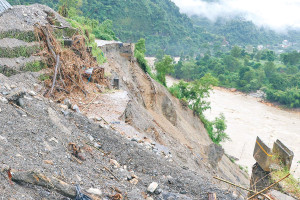
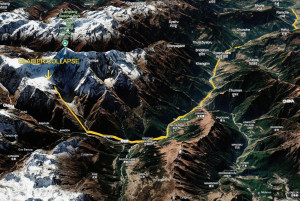
The differences between the two chambers were also evident in their response to the devastating floods and landslides along the Bhotekoshi-Trishuli and Kaligandaki corridors.
The two chambers had discussed forming a joint special parliamentary committee to study and monitor the disasters. Speaker DP Aryal and National Assembly Chairman Narayan Dahal had held discussions on a joint panel, while leaders of the parliamentary parties had also discussed the proposal.
But the two chambers eventually formed separate committees.
Aryal announced a 15-member special committee, dominated by RSP lawmakers, to study the impact of climate change in the Himalayas, climate justice and the Bhotekoshi-Trishuli disaster. RSP parliamentary party leader Parajuli was appointed its chair.
The National Assembly, meanwhile, formed its own nine-member committee to study and monitor the Bhotekoshi and Kaligandaki disasters.
What had been discussed as a joint parliamentary response thus ended with the two chambers pursuing separate mechanisms.
The relationship between the government and the National Assembly was also strained by exchanges between ministers and lawmakers.
Prime Minister Balendra Shah attended the upper house only once during the session. On May 11, he tabled a motion thanking President Ramchandra Paudel for presenting the government’s policies and programmes. Unlike the usual practice, he did not make a speech before the chamber and did not return during the session.
The upper house was later disrupted over Shah’s remarks in the House of Representatives concerning Nepal’s border with India. The National Assembly meeting on June 1 was adjourned without entering its scheduled business after lawmakers objected to his statement.
Home Minister Sudan Gurung also had to apologise to the upper house after lawmakers objected to his response to a question about the investigation into the murder of Nirmala Pant.
Taken together, the events of the session exposed an emerging imbalance between the two chambers: a government with substantial strength and legislative business in the House of Representatives, and a National Assembly with no government representation seeking to assert its role in the parliamentary process.




 24.96°C Kathmandu

.png&w=200&height=120)