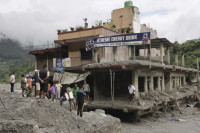
The Nepal government has drawn criticism over a new national climate policy, which, according to many stakeholders, was hastily drawn up after the Bhotekoshi flood and in view of the upcoming United Nations Climate Change Conference (COP 31).
Last week, the Ministry of Agriculture, Forest and Environment circulated a new National Climate Policy–2083 draft and sought comments and recommendations from those interested in it.
Multiple stakeholders found holes in the draft policy on addressing rising temperatures, lessons learnt from the August Bhotekoshi flood, climate governance, establishing institutional mechanisms for policy implementation, monitoring, accountability, and transparency, among others.
But the government clarified that the draft was publicised for inputs and recommendations from multiple sectors. Once the deadline is over, another draft will be proposed incorporating the suggestions received.
On Wednesday, a team of stakeholders led by the Non-government Organisations Federation of Nepal met Minister for Agriculture, Forest and Environment Geeta Chaudhary, climate change department head at the ministry Maheshwor Dhakal and others to register their reservations, Arjun Bhattarai, president of the NGO federation Nepal, told the Post.
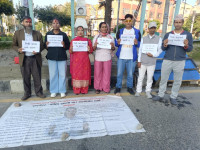
On Tuesday, the NGO federation also called an urgent consultation among civil society members, experts, Nepal SDG Forum, Federation of Community Forestry Users Nepal (FECOFUN), Oxfam and other stakeholders. They discussed the proposed policy and decided to draw the government’s attention.
But Dhakal said that in the course of drafting, the ministry had conducted a wide range of consultations with stakeholders from line ministries, provincial governments, local governments and the donor community.
It’s not true that the policy came without consultations with stakeholders, Dhakal said. “In each province, we organised a consultation process with multiple stakeholders. Each consultation drew 700 to 1,000 people. We tried to make it more inclusive, one that can reflect and represent the spirit and voices of all clusters of society.”
They, according to Bhattarai, urged the government to make the proposed climate policy timely, inclusive, participatory, rights-based, and effective. Participants emphasised that rather than rushing to finalise the policy, the government should undertake adequate and meaningful consultations with all stakeholders, including communities affected by climate change.
Participants said that, as Nepal continues to be directly affected by the impacts of climate change, the proposed policy must be practical and implementation-oriented.
According to a statement issued after the consultation, they also emphasised that the policy should comprehensively address rising temperatures in the Himalayan region, changes in glaciers and glacial lakes, irregular rainfall, floods, landslides, inundation, drought, impacts on agriculture and food security, and increasing risks to livelihoods.
“We have expressed our concerns and reservations to ministers and officials,” said Bhattarai. It looks like the government introduced the policy in a hurry on the pretext of the UN climate change conference (COP 31) being held in Turkey in the second week of November, he alleged.
On Wednesday, Dhakal received two memoranda from different stakeholders on the new draft. “We have given a deadline to furnish the grievances and we will come up with the new draft after vetting those recommendations,” he added.
Stakeholders noted that the recent Bhotekoshi flood and the resulting loss of lives, and social, economic and infrastructural damage call for greater integration of climate risk management, early warning systems, disaster preparedness, and issues ranging from relief to recovery and reconstruction within the climate policy, said the statement.
They also said the proposed policy should not be limited to emissions reduction or environmental protection. Instead, it should place climate justice, adaptation, disaster risk reduction, loss and damage, climate finance, the rights of local communities, livelihoods, gender equality, and intergenerational justice at the centre.
During the discussions, experts and representatives from various organisations and sectors—including Manish Raj Pandey, director of the National Trust for Nature Conservation; Prakash Lama of Clean Energy Nepal; and representatives of the Prakriti Resources Centre—shared their views on the positive aspects of the proposed policy and areas requiring further attention.
According to the statement, the stakeholders demanded ensuring the meaningful participation of and rights of communities affected by and vulnerable to climate change; clearly defining responsibilities for climate governance and implementation among the federal, provincial, and local levels of government; placing the concerns of women, youth, Indigenous Peoples, Dalits, marginalised groups, and vulnerable communities at the centre of the policy and giving policy priority to climate justice, loss and damage, and social justice.
Participants at the consultation said that the formulation of a policy in itself is not an achievement; what matters is its effective implementation and the positive changes it brings to the lives of affected communities. They emphasised that the policy should be finalised only after adequately incorporating the experiences and lessons learned from the Bhotekoshi flood and other recent climate-related disasters.
They also urged the government not to rush out a policy for the sake of some donors and NGOs, said Bhattarai. “We have urged the government to hold more consultations and discussions, listen to the voices of affected communities, and finalise the policy only after incorporating their suggestions.”
The stakeholders also want the policy to ensure the access of local communities and civil society to climate finance; strengthen early warning systems, disaster preparedness, and climate risk reduction; link relief, recovery, and reconstruction with long-term climate resilience; address issues related to community forestry, agriculture, water, energy, biodiversity, and livelihoods in an integrated manner; establish clear institutional mechanisms for policy implementation, monitoring and accountability; and effectively present Nepal’s actual needs and the priorities of affected communities when mobilising international climate finance and cooperation.
In order to prepare a common position, the stakeholders have formed a seven-member task force to collect, analyse, and consolidate the recommendations and present them to the government.
Anil Giri is a Chief Sub Editor covering diplomacy, international relations and national politics for The Kathmandu Post. Giri has been working as a journalist for more than two decades, contributing to numerous national and international media outlets.




 24.34°C Kathmandu