Early Grade 12 results stretch wait for medical entrance exams
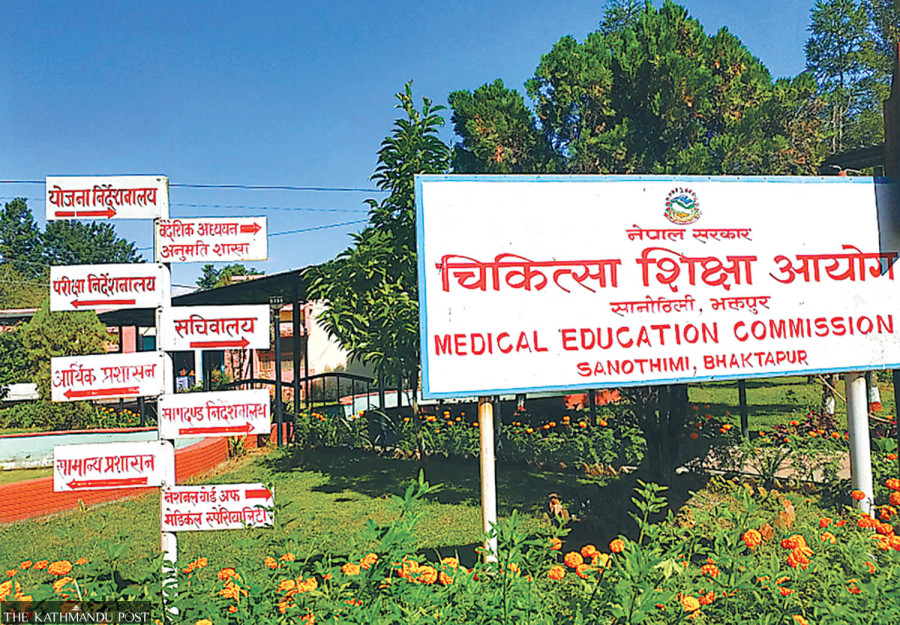
The integrated exams are set to be held on October 31, and this has led many medicine aspirants to enrol in other programmes, despite hoping to secure a medical seat.A total of 77,359 students have applied this year for entrance exams for MBBS, BDS, nursing and other medical education programmes, according to the Medical Education Commission. Post File Photo
Abhishek (name changed) applied to sit the entrance examination for an MBBS programme. But after learning that the examination would be held nearly a month later than expected, he enrolled in an engineering programme at Kathmandu University and has already begun his studies.
“Although the grade 12 results were published early, the medical entrance examination was delayed. So I decided to start studying engineering instead,” he said.
Like Abhishek, many students have enrolled in other universities and academic programmes because of the delay in medical entrance examinations. Entrance tests and admissions for engineering, science and technology, management and other disciplines have already progressed at most universities.
Although the government succeeded in publishing the grade 12 results earlier than in previous years, the Medical Education Commission has not been able to advance the medical entrance examination on a similarly early timetable.
According to the commission’s academic calendar for the 2026–27 academic year, the integrated entrance examination was to be held in the first week of October, with results published by the third week of October. The commission, however, is preparing to conduct the examination only from October 31, making it nearly a month later than the scheduled period.
Last year, the grade 12 results were published on August 4, while the integrated medical entrance examination began on November 1. This year, the grade 12 results were published on June 19—nearly six weeks earlier than last year.
The government has said it brought forward the publication of the grade 12 results to allow university admissions to begin earlier and to bring greater uniformity to academic calendars. According to the Ministry of Education, it previously took around three months to publish the results, but this year the process was completed in about 40 days following the direction of Education Minister Sasmit Pokharel.
Despite the earlier results, however, university and medical education entrance and admission processes have not advanced at the same pace.
The Medical Education Commission opened online applications for the integrated entrance examination for undergraduate medical programmes only on August 10. Arjun Dhakal, information officer and under-secretary at the commission, attributed the delay to the late appointment of its office-bearers.
“It hasn’t been delayed compared with last year. Medical entrance examinations are generally held later than those for other subjects,” he said.
A total of 77,359 students have applied this year for entrance exams for MBBS, BDS, nursing and other medical education programmes, according to the commission, which is currently verifying the applications.
Of the 332,241 students who sat the grade 12 exams this year, 231,770 passed.
The delay in the medical entrance examination has left students keeping their options open. Many plan to pursue medicine if they secure a place, but are also considering engineering, science and technology, management or other fields if they do not.
Dr Buddhi Man Shrestha, vice-president of the Association of Private Medical and Dental Colleges of Nepal, said the failure to follow the academic calendar creates difficulties for both students and parents.
“Students and parents ask colleges to conduct the entrance examination early. There is little we can do. We have to refer them to the commission,” he said.
According to Shrestha, delays in entrance examinations and admissions also increase the risk of students losing an academic year if they fail to secure a medical seat.
“Not all students who apply and pass the examination can secure a seat in Nepal. By the time our entrance examination is held, academic sessions in neighbouring countries may already have begun. Studies in other disciplines in Nepal will also have progressed,” he said. “Students who fail to secure admission face the risk of losing an entire academic year.”
Last year, 9,273 seats were allocated across 16 medical education programmes, including MBBS, BDS, and nursing, but only 8,548 students enrolled.
The commission is currently inspecting medical colleges to determine the number of seats for this year. Last year, 2,635 MBBS seats were allocated, while around 22,000 students have applied for the MBBS entrance examination alone this year.
The number of applicants for nursing programmes is also around 22,000. Last year, 2,430 seats were allocated for BSc Nursing and 1,062 for BNS (Bachelor of Nursing Science). In BDS, where there were 625 seats last year, around 11,000 students have applied for the entrance examination this year.
The number of available seats is not expected to change significantly from last year, and this leaves a substantial gap between the number of applicants and available places. College operators say that unless the entrance examination and admission schedules are kept on track, students are forced to choose between starting studies in another discipline and going abroad for education.
The delay in this year’s medical entrance examination is largely linked to the late appointment of officials at the Medical Education Commission.
The government introduced an ordinance in April that removed the commission’s vice-chairperson and other office-bearers. Dr Devendra Bahadur Khatri was appointed the new vice-chair on July 7, while three directors were appointed on August 29.
Although the commission is supposed to have four directors, one position remains vacant. Dr Sandhya Chapagain, Dr Sangha Ratna Bajracharya and Dr Dipendra Shrestha are currently serving as directors.
Under the Medical Education Act, the directors head the commission’s directorates responsible for standards and accreditation; planning, coordination and academic advancement; examinations; and the National Board of Medical Specialities.
The commission conducts integrated entrance examinations not only for MBBS, BDS and nursing but also for programmes including BPharm (pharmaceutical sciences), BPH (public health), BAMS (Ayurvedic medicine and surgery), BPT (physiotherapy), optometry, BSc MLT (medical laboratory technology), BSc Midwifery, ASLP (Audiology and Speech-language Pathology), BMS and BSc Radiotherapy.
Students are admitted on the basis of their ranking in the entrance examination.
Under the existing system, 75 percent of students in public institutions and 10 to 20 percent in private institutions are eligible for scholarships. Based on last year’s seat allocation, 2,771 students received scholarships at various government and private medical colleges.
At the same time, some seats reserved for foreign students—including those in programmes other than MBBS—remain unfilled.
Of the 9,273 seats allocated last year, 2,428 were reserved for foreign students. In MBBS, 742 students enrolled against 749 seats reserved for foreigners. But in BSc Nursing, only three students enrolled against 640 seats reserved for foreign students.
Although unfilled seats reserved for foreign students can subsequently be offered to Nepali students, commission officials say many Nepali students are reluctant to enrol on a fee-paying basis because they prefer scholarship places.
As a result, when higher-ranked candidates decline fee-paying places, students lower down the merit list may eventually get the opportunity to enrol by paying tuition fees.
The fee for an MBBS programme is currently set at Rs4 million to Rs4.4 million.




 15.69°C Kathmandu