Bhotekoshi floods disrupt schooling for 14,500 children in three districts
More than 9,400 students have been directly affected, while schools being used as shelters are delaying the return to classes for thousands more. A student searches through a mud-caked schoolbag among dozens left behind at Bageshwari Secondary School in Baireni, Dhading, on August 31, five days after catastrophic flooding of the Bhotekoshi and Trishuli rivers. Dipesh Darshandhari/TKP
The Bhotekoshi floods have disrupted schooling and learning for more than 14,500 children at 63 educational institutions in Rasuwa, Nuwakot and Dhading, according to a government assessment.
The education ministry said 9,430 children have been directly affected, including those who lost parents, homes or schools. Thousands more face disruption because school buildings are being used as temporary shelters for displaced residents.
The ministry conducted the assessment with education officials from the federal and provincial governments and teams from UNICEF and Save the Children. It found that 28 of the 29 temporary holding centres in the three districts are operating from school buildings, delaying the resumption of classes. Nuwakot has 22 such centres and Rasuwa six.
Around 2,000 residents are currently living in holding centres across the three districts, according to the National Disaster Risk Reduction and Management Authority.
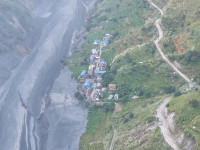
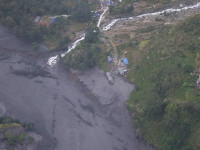
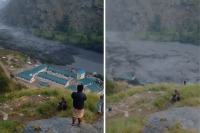
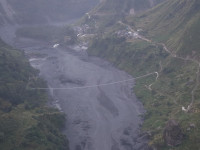
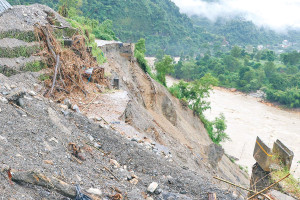
A total of 1,409 bodies of victims have been recovered so far following the devastating floods on August 26, according to the authorities. In the disaster triggered by a glacial collapse, 4,089 people are still missing as communities living on Bhotekoshi and Trishuli riverbanks have been devastated.
At least 100 children have lost both parents, the ministry said. Nearly 500 enrolled students remain unaccounted for, although officials expect both figures to rise as authorities gather more information. The current figures cover only children enrolled in schools, leaving the number of younger children who had not yet entered school unclear.
A total of 1,372 students have been displaced since the floods.
Three assessment teams deployed to the affected districts recommended prioritising children’s safety and a return to learning rather than immediately rebuilding damaged schools.
“We are implementing the report in phases and will work in coordination with local governments,” said joint secretary Shree Prasad Bhattarai, the ministry spokesperson. “We have already begun providing support and relief based on students’ needs.”
Authorities have started setting up temporary learning centres, distributing educational materials and providing psychosocial counselling. Schools that suffered no major damage and are not being used as shelters have already resumed classes, including psychosocial support sessions.
According to the ministry’s Education Sector Response Plan, the floods physically damaged 34 educational institutions. As many as 45 buildings containing 268 classrooms were damaged. Eleven schools have been shut completely because of physical damage or safety concerns, while four are temporarily closed.
The floods also destroyed 82 toilets, water-supply systems and 20 other water sources at schools. They destroyed 3,232 textbooks, 2,227 sets of teaching and learning materials, 4,561 desks and benches, 194 computers and 144 laptops.
Bidur municipality in Nuwakot suffered the most extensive damage, with more than 3,000 students affected. The assessment lists 227 students and 11 teachers as missing in the municipality. The historic Tribhuvan Trishuli Secondary School has been destroyed. Trishuli Community Boarding School, Uttargaya Boarding School and Ramchandra Basic School have also been destroyed and will need relocation. Authorities must secure land before rebuilding them.
Schools and students in Gosainkunda, Uttargaya, Kalika and Aamachhodingmo rural municipalities in Rasuwa were also directly affected.
Nepal Rastriya Basic School in Timure was destroyed. Of its 35 students, 25 remain unaccounted for, along with six of its 11 teachers.
The assessment recommends moving displaced children to safe locations and keeping them in education rather than immediately constructing new school buildings in Rasuwa.
In Dhading, the building of Amleshwar Gurukul School was buried in debris and mud, while Buddhi Bikash Basic School suffered damage so severe that it cannot reopen at its current location. Floodwater reached the first floor of Bageshwari Secondary School.
Three suspension footbridges leading to Shankhadevi Secondary School were swept away, cutting off students’ access to the school.
The ministry plans to establish 68 temporary learning centres at schools that were destroyed. Thirteen centres, each designed for 30 students, have already been set up, according to the National Disaster Risk Reduction and Management Authority.
The government plans to provide educational materials and textbooks to all 9,430 directly affected students. It is also preparing hostel accommodation for children who have lost their parents, students unable to travel to school because roads and bridges have been destroyed, and those who live too far from functioning schools.
The Bagmati provincial cabinet has decided to arrange residential education for children who have lost their parents. According to the disaster authority, the provincial government plans to accommodate 200 students at Chhetratrapal Secondary School in Likhu, Nuwakot, while Uttargaya Rural Municipality in Rasuwa plans to provide residential facilities for 250 students at Nilkantha Secondary School.
The education ministry has also announced a central education fund, the ‘Scholarship Bank’, for children affected by the floods, offering full and partial scholarships, including residential support.
The ministry says the immediate priorities are to identify affected students, secure safe schools, arrange hostels, deploy teachers, distribute textbooks and restore regular classes, rather than focus solely on rebuilding damaged school structures.
Students in Timure, Syaphrubesi, Betrawati and other areas remain unable to reach schools because floods have damaged roads, bridges and crossings. The ministry therefore plans to prioritise residential facilities for them.
The floods have also affected 216 teachers and other school staff. Twenty-four teachers remain unaccounted for, and two have died.




 24.85°C Kathmandu